Lanzhou Beef Noodle Museum
The iconic Lanzhou beef noodle soup, a staple across China, has a specific origin story tied to a Hui Muslim cook.
Full story unlocks in the tour
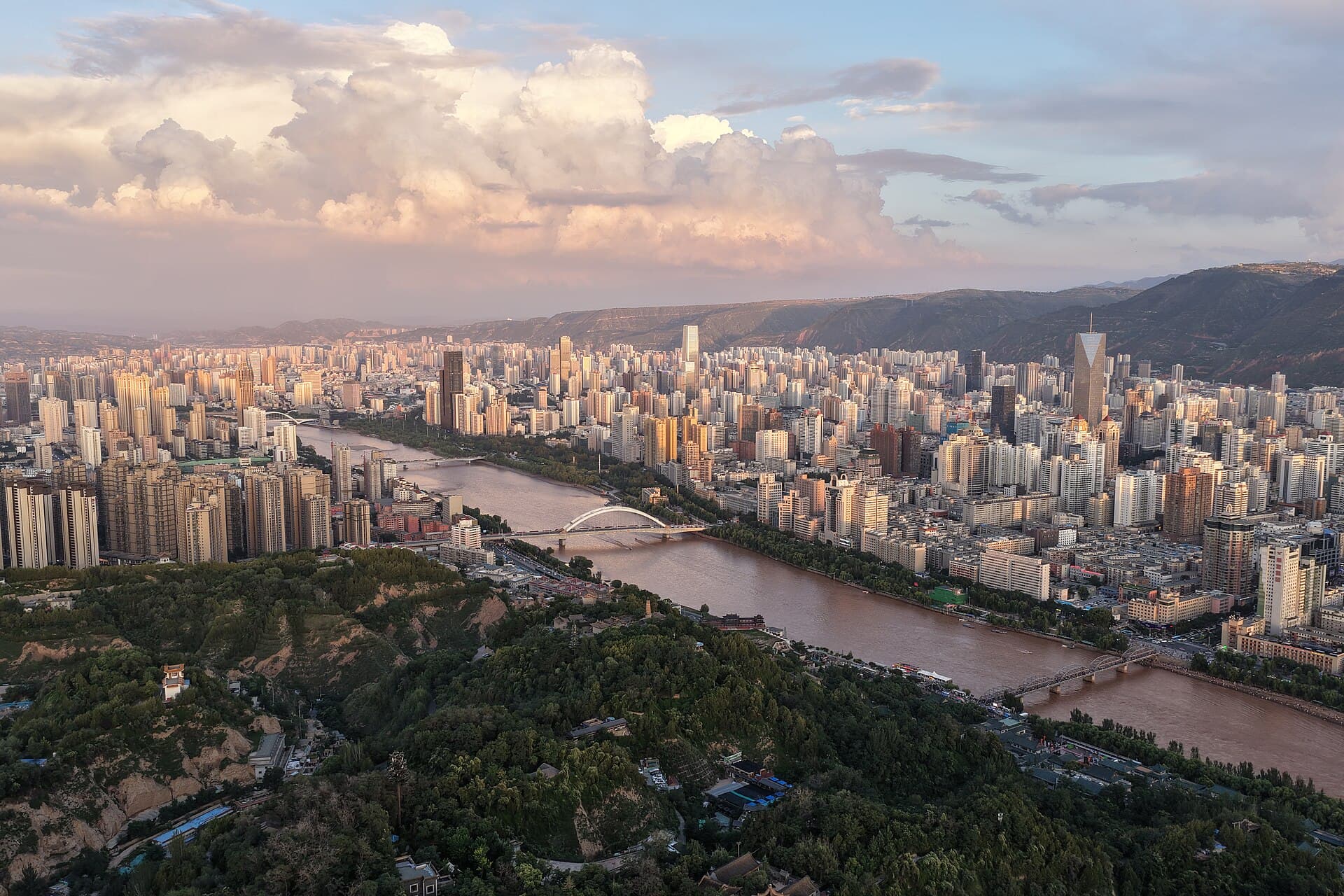 Megalizard29 / CC BY-SA 4.0, via Wikimedia Commons
“Where the Yellow River carves its golden path through history.”
Not the postcards. The stories even locals don't know — whispered in your ear, right where they happened.
The iconic Lanzhou beef noodle soup, a staple across China, has a specific origin story tied to a Hui Muslim cook.
Before 1909, crossing the mighty Yellow River in Lanzhou involved a surprisingly precarious method.
The White Pagoda, a prominent landmark, holds a unique architectural secret that defies typical pagoda construction.
Discover every secret of Lanzhou
Every address, every reveal in full — in your ear, right where it happened.
You pick your stops. You walk. The voice reveals what the others miss.
No tours available yet. Check back soon — we're preparing them.
Lanzhou, the capital of Gansu province in northwestern China, is a city shaped by the Yellow River, which flows directly through it. At an elevation of 1,600 meters (5,200 ft), Lanzhou holds a strategic position as a key regional transportation hub, connecting western China by rail to the eastern half of the country. Once known as the "Golden City," Lanzhou was a vital stop on the ancient Northern Silk Road, a legacy still palpable in its cultural fabric.
While often seen as a transit point for travelers heading further west or south, Lanzhou possesses its own distinct character. The city offers a blend of historical sites, a lively culinary scene, and scenic riverside landscapes. Its semi-arid climate brings warm, partly cloudy summers and freezing, dry, and mostly clear winters, with significant temperature variations throughout the year.
Lanzhou has undergone significant environmental improvements, transforming from a city once obscured by pollution to one recognized for its climate progress. Today, the city invites exploration, from its iconic hand-pulled beef noodles to its ancient waterwheels and expansive mountain views.
## An Ancient Crossroads on the Silk Road Lanzhou's history stretches back over two millennia, with its origins traced to the ancient Western Qiangs. The area became part of the State of Qin in the 6th century BC. Under the Han Dynasty in 81 BC, it was established as Jincheng commandery, meaning "Golden City," a name it sometimes retained due to gold discoveries or its perceived impregnability. Lanzhou's strategic importance was cemented by its location as a major link on the Northern Silk Road and a crucial Yellow River crossing point.
Following the fall of the Han Dynasty, Lanzhou served as the capital for a succession of tribal states and, in the 4th century, briefly as the capital of the independent state of Liang. The Sui Dynasty, in 581, officially bestowed the city with its current name, Lanzhou, inspired by the nearby Gaolan Mountains. From the 5th to the 11th centuries, the present-day Gansu province, with its diverse cultural heritage, became a significant center for Buddhist study.
Throughout its history, Lanzhou experienced periods of control by various empires, including the Tibetan Empire and the Western Xia dynasty, before being reabsorbed by the Song Dynasty. During the Ming Dynasty, the city was fortified with defensive walls. In 1666, under the Qing Dynasty, Lanzhou was designated the capital of Gansu Province, solidifying its administrative role.
## Modern Development and Industrial Growth During the Second Sino-Japanese War (1937–1945), Lanzhou became a critical terminus for the Chinese–Soviet highway, facilitating the transport of Soviet supplies. Post-1949, Lanzhou transformed into a major industrial center, particularly for the petrochemical industry, and a key transportation node with the construction of its first railway in 1953. The city has also developed into an important center for science and education, home to major universities and branches of the Chinese Academy of Sciences. In recent years, Lanzhou has made significant strides in improving its air quality, earning recognition for its climate progress.
Begin your exploration at the Zhongshan Bridge, often called the "First Bridge over the Yellow River." Built between 1907 and 1909, this iron bridge offers impressive views of the river and the surrounding city, especially at night. Nearby, the Yellow River Mother Sculpture is a prominent landmark symbolizing the nurturing spirit of the river. Stroll along the Green Corridor of Binghe Road, a riverside park that stretches along the Yellow River, connecting various attractions.
Climb to White Pagoda Mountain Park for expansive views of Lanzhou. The park is named after its 17-meter-high White Pagoda, a seven-story structure with Buddhist figures carved on its eight sides. The park once held "three treasures": an elephant leather drum, bronze bells, and a redbud tree, though the tree has since withered.
Immerse yourself in local history and culture at the Gansu Provincial Museum. This comprehensive museum houses over 350,000 artifacts, including significant collections of Neolithic painted pottery, Han Dynasty bamboo slips, and Silk Road treasures. A highlight is the "Bronze Galloping Horse" from the Eastern Han Dynasty, a national treasure depicting a horse in dynamic motion.
For a glimpse into ancient irrigation techniques, visit the Lanzhou Waterwheel Garden. This park features reconstructed ancient waterwheels, first invented by Duan Xu in 1556 during the Ming Dynasty, which once irrigated vast farmlands along the Yellow River.
Lanzhou experiences a semi-arid climate with distinct seasons. The warm season, from mid-May to early September, offers average daily high temperatures above 74°F (23°C), with July being the warmest month. The cold season, from late November to late February, sees average daily highs below 45°F (7°C), with January being the coldest. The best time to visit Lanzhou for warm-weather activities is from mid-June to early September. However, the most recommended times for comfortable weather and fewer crowds are April, May, September, and October. These transitional months offer pleasant temperatures, sunny days, and lovely scenery, including colorful autumn leaves in September and October.
Lanzhou is a major transportation hub, with frequent flights from large Chinese cities and as the terminus of the Longhai Railway. Within the city, two metro lines (Line 1 and Line 2) run east-west, connecting key areas. Buses are also a useful way to get around, with fares typically around ¥2-3. Taxis and ride-sharing services are available. While some upscale hotels and foreign brand stores accept credit cards, cash is still widely used, especially in smaller establishments, so carrying some local currency is advisable.
English is not commonly spoken in Lanzhou, particularly outside of 4- and 5-star hotels where staff may have basic English skills or use translation apps. It's helpful to have a translation app on hand or to travel with a guide. Public toilets at attractions may be basic and sometimes incur a small fee.