Jingxing Bird and Flower Market
Among the chirping birds and fragrant blossoms of Kunming's oldest market, a peculiar trade once flourished beyond just pets and plants.
Full story unlocks in the tour
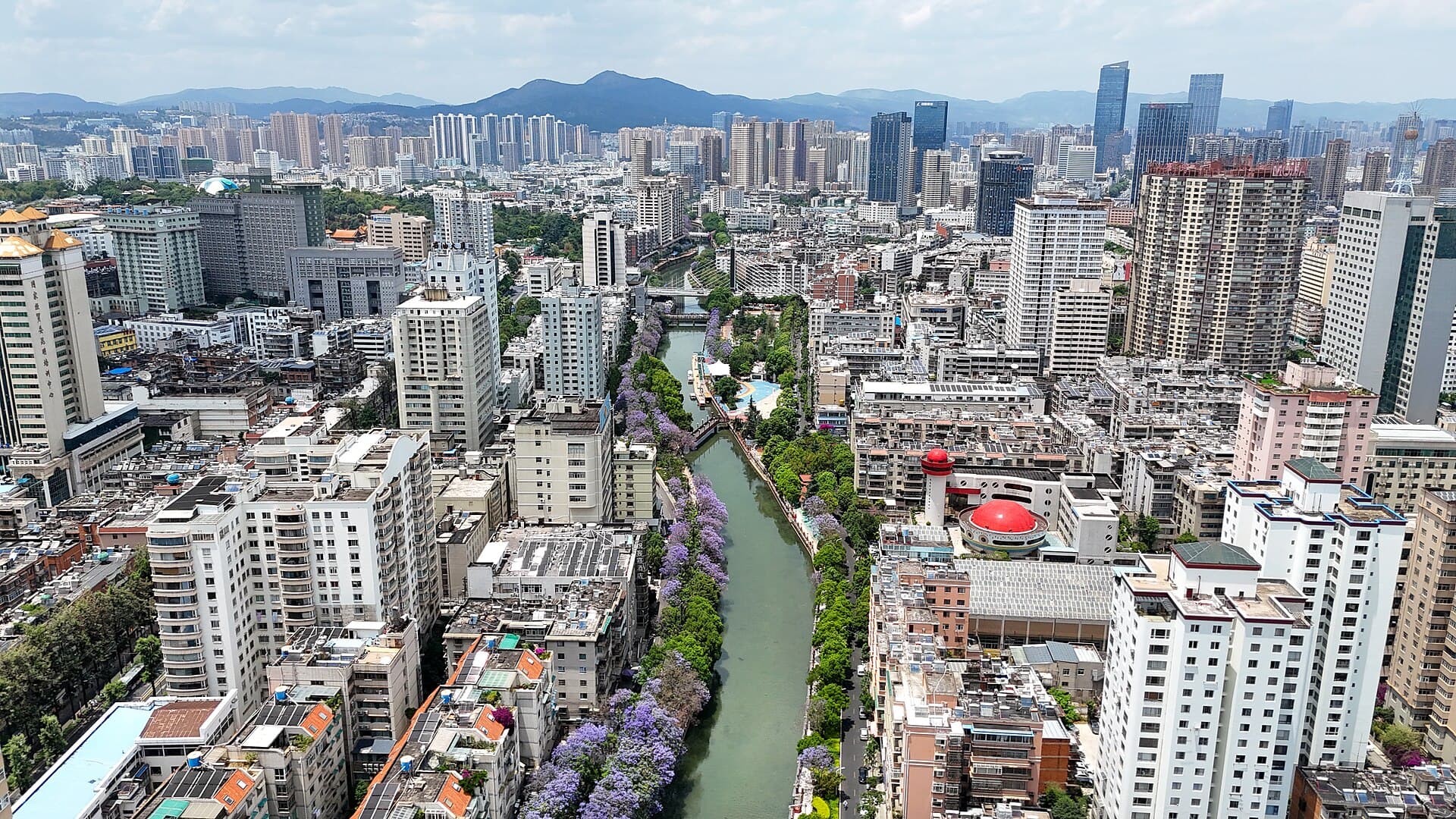 瑞丽江的河水 / CC BY-SA 4.0, via Wikimedia Commons
“Where perpetual spring breathes life into ancient streets and lively markets.”
Not the postcards. The stories even locals don't know — whispered in your ear, right where they happened.
Among the chirping birds and fragrant blossoms of Kunming's oldest market, a peculiar trade once flourished beyond just pets and plants.
Unlike most Buddhist temples that ascend a hill, Kunming's most significant temple defies tradition with its unique architectural layout.
Every winter, Kunming's Green Lake Park hosts thousands of unexpected, long-distance visitors seeking refuge from harsh climates.
Discover every secret of Kunming
Every address, every reveal in full — in your ear, right where it happened.
You pick your stops. You walk. The voice reveals what the others miss.
No tours available yet. Check back soon — we're preparing them.
Kunming, the capital of Yunnan Province, is known across China as the "City of Eternal Spring" due to its consistently mild, temperate climate year-round. Situated on the Yunnan–Guizhou Plateau at an elevation of 1,888 meters (6,194 feet), the city enjoys abundant sunshine and a frost-free period, fostering lush vegetation and blooming flowers throughout the seasons. This unique geographical position, with low latitude and high elevation, creates a climate that avoids extreme heat in summer and severe cold in winter, making it a pleasant destination for travelers at almost any time.
More than just its agreeable weather, Kunming serves as a crucial political, economic, communications, and cultural center for Yunnan. It acts as a gateway to Southeast Asia, South Asia, and even the Middle East, reflecting a wealth of cultures and a history spanning over 2,400 years. The city's rapid expansion has seen the development of modern infrastructure alongside its ancient sites, offering a blend of contemporary urban life and historical appeal.
Kunming's origins stretch back over 2,400 years, with archaeological evidence suggesting a developed civilization, the Kingdom of Dian, around Dian Lake as early as the 3rd century BCE. This ancient kingdom was known for its advanced bronze casting and served as an important cultural and economic center. During the Han Dynasty (205 BC–AD 220), the region, then named Dian, became a key point for trade with Burma and India.
Throughout subsequent dynasties, Kunming's strategic location ensured its continued importance. It was known as Kunzhou during the Sui Dynasty (581–618) and Tuodong city in the independent states of Nanzhao and Dali from the 8th century onward. The city received its current name, Kunming, in 1276 during the Mongol Yuan Dynasty, when it was established as the administrative center of the region and described by Marco Polo as a prosperous city with bustling trade. During the Ming and Qing dynasties, it functioned as the seat of the superior prefecture of Yunnan.
The late Qing Dynasty saw Kunming designated as a commercial port, and the completion of the Dianyue Railway in 1910 significantly boosted its role as a major market and transport hub. Its transformation into a modern city accelerated with the outbreak of the Sino-Japanese War in 1937, and during World War II, Kunming was a vital Chinese military center, hosting the headquarters for the US Army Forces China-Burma-British Raj and serving as a transport terminus for the Burma Road. After 1949, Kunming rapidly developed into an industrial metropolis, with major iron, steel, and chemical complexes.
Begin your exploration at Green Lake Park (Cuihu Gongyuan), a tranquil urban oasis established in the 17th century. The park features four small lakes connected by traditional Chinese bridges, and in winter, it becomes a temporary home for Siberian seagulls. Nearby, the Yuantong Temple offers a unique architectural experience, as it's built on a downhill slope, with visitors descending to its main hall. This ancient Buddhist temple, over 1,200 years old, houses Yuan Dynasty statues and a Thai-style Copper Buddha Hall, symbolizing friendship.
For a sensory immersion, visit the Jingxing Bird and Flower Market on Yongdao Street. Established in 1983, it's a lively market where you can find an array of flowers, birds, fish, and local handicrafts, offering a glimpse into daily Kunming life. Beyond the city center, the Stone Forest (Shilin), a UNESCO World Heritage site, presents a dramatic karst landscape of towering limestone formations, a testament to geological forces over millions of years. For broad views of Dian Lake and the city, head to the Western Hills Forest Park (Xishan), where you can explore Buddhist and Taoist temples carved into the cliff face, including the impressive Dragon Gate grottoes.
Kunming's "City of Eternal Spring" moniker means it's suitable for visiting year-round due to its mild climate. However, the most favorable weather conditions, with comfortable temperatures and minimal rainfall, occur from late March through May and from October to November. Spring (March to May) is ideal for witnessing blooming flowers, including cherry blossoms and jacarandas. Autumn (September to November) offers clear skies and crisp air, perfect for outdoor activities. While summers (June to August) are warm and humid with more rainfall, they are still pleasant compared to other cities. Winters (December to February) are cool and dry, with abundant sunshine.
Kunming Changshui International Airport (KMG) serves as the primary gateway, with metro Line 6 offering a convenient and affordable connection to the city center. The city also offers an extensive high-speed rail network, connecting it to major Chinese cities. Within Kunming, the metro system (Lines 1, 2, 3, and 6) is an efficient way to get around, with fares starting from ¥2. Buses are also widely available, and for door-to-door convenience, taxis and ride-hailing services like Didi are readily accessible. It's advisable to have your destination written in Chinese for taxi drivers. Consider purchasing a rechargeable Kunming Tong card for seamless travel on both metro and most city buses. UV rays can be strong due to the altitude, so sun protection is recommended.