Hušnjakovo Hill
The discovery here in 1899 reshaped our understanding of human history, but it wasn't just about bones.
Full story unlocks in the tour
 Zeitblick / CC BY-SA 3.0, via Wikimedia Commons
“Where ancient echoes meet the rolling hills of Zagorje.”
Not the postcards. The stories even locals don't know — whispered in your ear, right where they happened.
The discovery here in 1899 reshaped our understanding of human history, but it wasn't just about bones.
The town's very name hints at a creature that once thrived in its waters, a local delicacy now largely absent.
A medieval fortress once guarded this strategic point, but its enduring legacy isn't just about defense.
Discover every secret of Krapina
Every address, every reveal in full — in your ear, right where it happened.
You pick your stops. You walk. The voice reveals what the others miss.
No tours available yet. Check back soon — we're preparing them.
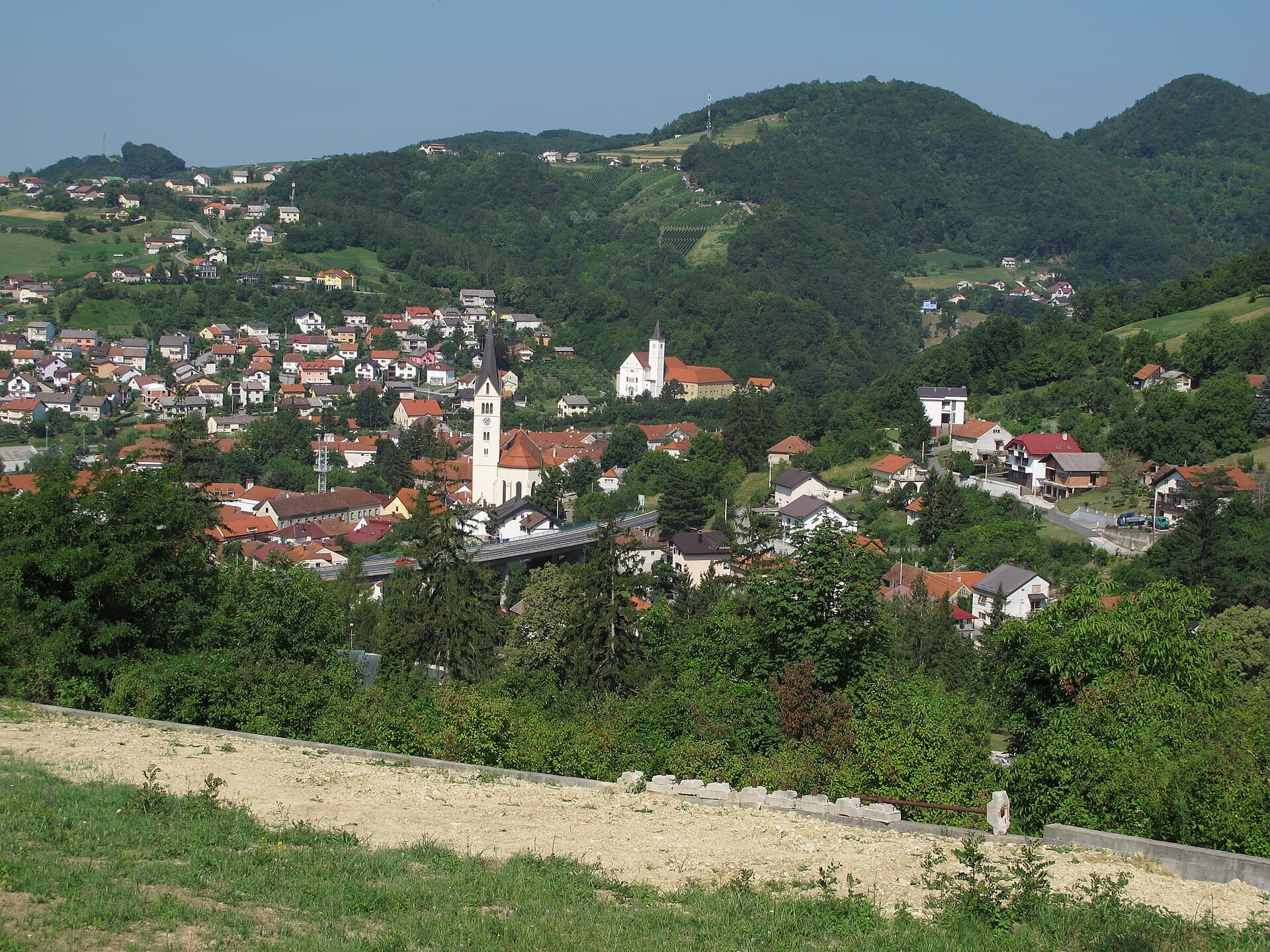
Krapina, a town in northern Croatia, rests in the heart of the Hrvatsko Zagorje region, approximately 55 kilometers north of Zagreb. This area is characterized by its verdant hills, deep forests, and agricultural fields. The town itself, though small with a population under 13,000, holds a profound significance in the narrative of human evolution and Croatian history.
Known primarily for its world-renowned Neanderthal site, Krapina offers a journey back in time, allowing visitors to connect with ancient human ancestors. Beyond its prehistoric allure, the town presents a blend of cultural heritage, from its medieval fortress to its role in the Croatian National Revival. Krapina serves as the administrative and cultural center of the Krapina-Zagorje County, embodying the spirit of the Zagorje region.
The town's location along the Krapinčica River, from which it derives its name, adds to its regional identity. Krapina is not merely a historical site but a living town with cultural events, local gastronomy, and opportunities for outdoor activities in the surrounding natural landscape.
The history of Krapina stretches back an astonishing 125,000 years, primarily due to the groundbreaking discovery on Hušnjakovo Hill. In 1899, geologist and paleontologist Dragutin Gorjanović-Kramberger unearthed over 800 fossilized remains of Neanderthals, making it the largest and most extensive collection of Neanderthal remains found in a single location worldwide. This paleoanthropological site, now a protected natural monument, provided unprecedented insights into the life, culture, and anatomy of early Neanderthals. The findings included not only bones from approximately 80 individuals of varying ages but also around 1,200 stone tools, indicating a developed material culture, and 2,400 animal bones. The site's significance is further underscored by the discovery of what is believed to be the world's oldest jewelry – etched white-tailed eagle claws – suggesting an early aesthetic sense among Neanderthals.
Krapina's documented history begins in 1193, when it was first mentioned as a royal fortress. The medieval fortress, constructed on a hill overlooking the modern town, served as a crucial defensive point along the border towards the Sutla River. Over centuries, it was owned by various noble families and even King Louis I, who granted Krapina the status of a free royal city in 1347. During the late 16th and early 17th centuries, the Krapina fortress played a significant role in Croatian political life, hosting five sessions of the Croatian Sabor during periods of Ottoman incursions. Today, a two-story building, part of the original fortress complex, remains, dominating the town's skyline.
The 19th century marked another important chapter in Krapina's history with the birth of Ljudevit Gaj in 1809. Gaj was a pivotal figure in the Croatian National Revival, a movement focused on establishing the Croatian language and national identity. His birthplace in Krapina is now a museum, commemorating his life and work. The town continued to modernize in the latter half of the 19th century, with the construction of the "Zagorje railroad" in 1886, which significantly boosted the region's development. Krapina's historical trajectory, from its deep prehistoric roots to its medieval strategic importance and its role in national awakening, showcases a continuous thread of human activity and cultural significance.
The Krapina Neanderthal Museum and Archaeological Site on Hušnjakovo Hill is the town's foremost attraction. This modern museum, opened in 2010, offers an interactive journey through the evolution of life on Earth, with a particular focus on the Krapina Neanderthals. Visitors can explore 18 thematic units, featuring reconstructions, original fossils, and multimedia installations, including the world's largest Neanderthal diorama with 17 hyperrealistic figures. The museum's architecture, designed to blend into the surrounding landscape with a cave-like entrance, enhances the immersive experience.
Beyond the Neanderthal site, the historic urban core of Krapina invites exploration. A remnant of the medieval Krapina fortress stands on a hill, offering a glimpse into the town's strategic past. The Church of Our Lady of Jerusalem is noted as one of Croatia's most beautiful Baroque churches. Visitors can also explore the birthplace of Ljudevit Gaj, a key figure in the Croatian National Revival, which now functions as a museum. For those interested in vintage vehicles, there's a museum dedicated to old cars. The surrounding Hrvatsko Zagorje region also offers opportunities for hiking, cycling, and exploring wine roads.
The best time to visit Krapina is during the late spring (May-June) and early autumn (September-October). During these months, the weather is mild and pleasant, with average daytime temperatures ranging from 22°C to 28°C, making it ideal for exploring the outdoor archaeological site and other attractions. Rainfall is moderate, and the landscapes of Hrvatsko Zagorje are particularly scenic, with autumn bringing brilliant colors to the hills. Summer (July-August) is also popular, with warmer temperatures, though it can be busier. Winter (December-February) is cold, with temperatures averaging 0-5°C, but offers a quieter experience and opportunities for thermal spa visits in nearby Krapinske Toplice.
Krapina is easily accessible by car, located about an hour's drive from Zagreb via the A2 highway (with a toll) or a slightly longer, toll-free route on Zagorska magistrala. Bus services also connect Krapina to Zagreb, with a journey time of approximately one hour. Once in Krapina, the town is small enough to navigate on foot, allowing easy access to its main sights. If arriving by car, be aware that parking in the city center typically requires payment.
While Krapina itself has limited hotel accommodations, nearby Krapinske Toplice, about 15 km away, offers thermal spas and various lodging options. For a more authentic experience, guesthouses and private apartments can be found in Krapina. The local cafes and restaurants provide hearty meals at reasonable prices, offering a taste of traditional Zagorje cuisine.