Pantai Dasar Sabak
This quiet beach, about 10 kilometers from the city, holds a secret that reshaped global history.
Full story unlocks in the tour
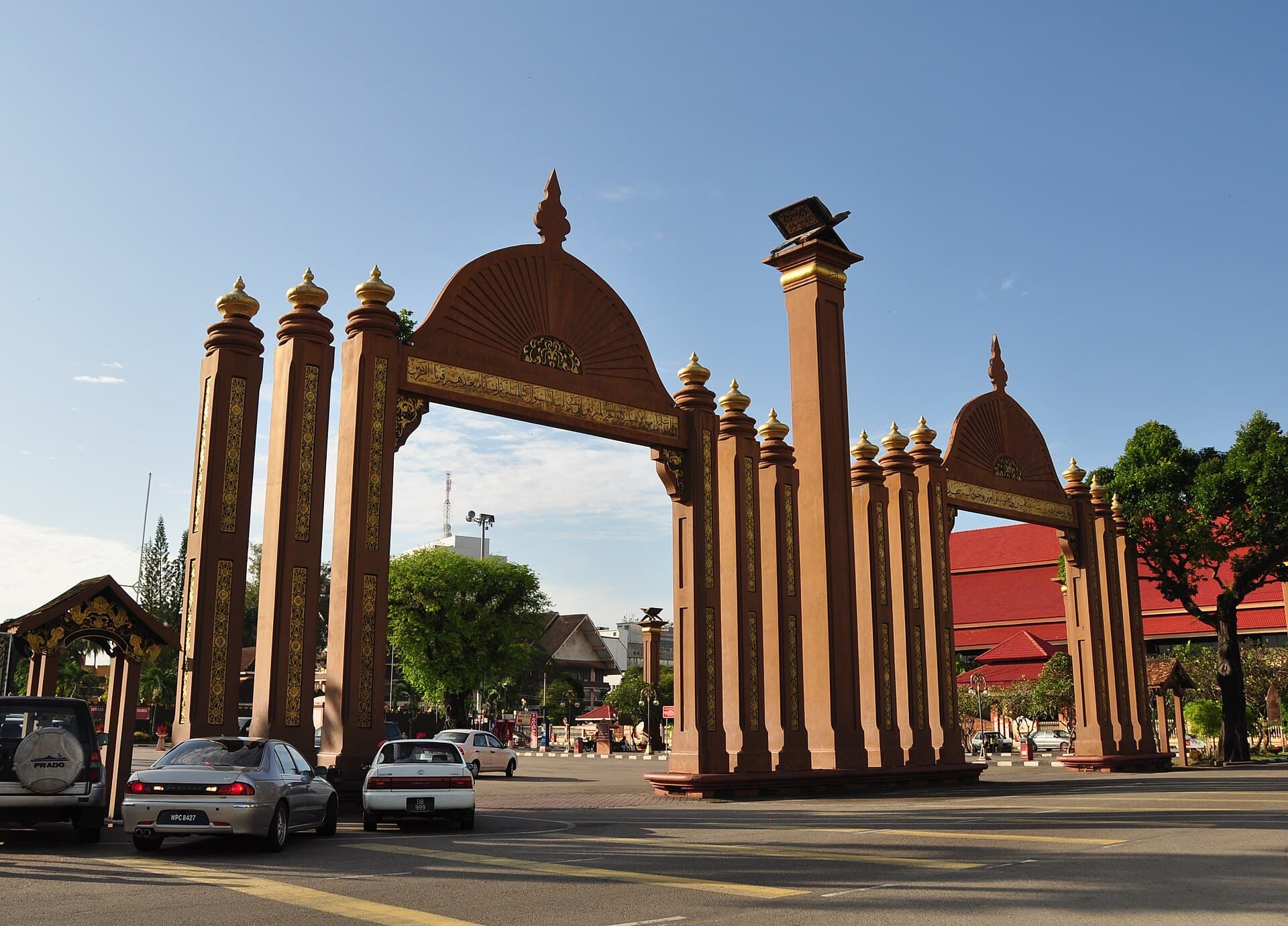 CK Tan / CC BY 3.0, via Wikimedia Commons
“Where tradition breathes, and culture unfolds with every sunrise.”
Not the postcards. The stories even locals don't know — whispered in your ear, right where they happened.
This quiet beach, about 10 kilometers from the city, holds a secret that reshaped global history.
Wander through this lively market, and you'll quickly notice a distinctive feature that sets it apart from many others across Malaysia.
Despite Kelantan being a predominantly Muslim state, a surprising number of places of worship dedicated to another major religion can be found, particularly near the Thai border.
Discover every secret of Kota Bharu
Every address, every reveal in full — in your ear, right where it happened.
You pick your stops. You walk. The voice reveals what the others miss.
No tours available yet. Check back soon — we're preparing them.
Kota Bharu, the capital of Malaysia's Kelantan state, offers a distinct cultural experience. Situated in the northeastern part of Peninsular Malaysia, near the mouth of the Kelantan River and close to the Thai border, the city blends urban energy with deep-rooted traditions. Known colloquially as 'KB,' it serves as a fascinating gateway to the traditional heartland of the east coast, preserving age-old customs from kite flying to shadow puppetry.
Often seen by travelers as a transit point to the Perhentian Islands, Kota Bharu is a destination in its own right, inviting those who linger to discover a different side of Malaysia. The city's atmosphere is notably conservative, reflecting its status as an Islamic city, yet it welcomes visitors with warm hospitality and a lively cultural presence. Here, traditional Malay heritage is proudly displayed, influenced by its proximity to Thailand, creating a unique blend of cultures and flavors.
Before its official founding, the area now known as Kota Bharu was called Kuala Kelantan and served as home to Kelantan's royal palace. The city's history is deeply intertwined with the rise of the Kelantan Sultanate. In 1844, Sultan Muhammad II officially founded Kota Bharu, meaning 'new city' or 'new fort' in Malay, and designated it as the new state capital. This move followed a period of unifying smaller principalities that began around 1760 and aimed to fortify the area against external threats, particularly from neighboring Siam (present-day Thailand). The establishment of Kota Bharu, with the construction of the Istana Balai Besar palace in 1844, cemented its status as the administrative and political hub of the region.
Kota Bharu's strategic location placed it at the forefront of a pivotal moment in global history. On December 8, 1941, Japanese troops landed at Pantai Dasar Sabak, approximately 10 kilometers from the city, marking the first act of invasion in Malaya and one of the initial battles of the Pacific War—occurring even before the attack on Pearl Harbor. The city and state fell to Japanese forces on February 15, 1942, who then used it as an airbase in their campaign through Malaysia and Singapore. After the war, British administration resumed until 1957, when Kota Bharu became part of the independent Federation of Malaya, later transforming into the Federation of Malaysia in 1963.
In recognition of its role in preserving Malay traditions, crafts, and arts, Kota Bharu was officially granted the status of 'Cultural Capital' on July 25, 1991, by the late Sultan Ismail Petra. Further emphasizing its identity, the Kelantan State Government rebranded Kota Bharu as the 'Islamic City' (Bandar Raya Islam) on October 1, 2005, through its 'Developing With Islam' policy. This designation reflects the city's strong Islamic identity, which influences daily life and public services.
Start your exploration at the Siti Khadijah Market (Pasar Besar Siti Khadijah), a lively, multi-story octagonal building. It's a sensory experience where local women predominantly sell fresh produce, traditional snacks, and colorful batik textiles. For a glimpse into royal heritage, visit Istana Jahar, built in 1887. This former palace now serves as the Museum of Royal Traditions and Customs, showcasing intricate wood carvings, royal ceremonies, and historical artifacts. While the current royal palace, Istana Balai Besar, is not open to the public, its unique architecture can be admired from the outside.
Delve into local craftsmanship at the Handicraft Village and Craft Museum (Kampung Kraftangan), where you can learn about batik painting, silverware, and woodcarvings, and purchase unique souvenirs. The War Museum (Bank Kerapu Second World War Memorial), housed in the old Bank Kerapu building, details Japan's occupation of Malaya and the local resistance, featuring wartime relics, photographs, and documents. For a tranquil escape, Pantai Cahaya Bulan (Moonlight Beach), located outside the city, offers serene views of the South China Sea. The Muhammadi Mosque, the state mosque, is another significant religious and architectural landmark.
Kota Bharu experiences tropical weather with consistent heat and humidity throughout the year. The average daytime temperature hovers around 30°C (86°F), with nights rarely dropping below 23.5°C. The driest and sunniest period, and generally considered the best time to visit, is from February to April. February often stands out as the least hot among these months. While rainfall is a constant feature, November and December see the highest frequency of precipitation, with rain occurring on up to 29 days a month. For beach activities and warm weather, early January to mid-March is also recommended.
Kota Bharu is a conservative Islamic city, so dressing modestly is highly recommended; cover your shoulders and knees. Women may find a lightweight scarf useful for visiting religious sites. Public displays of affection are discouraged, and alcohol is generally not sold in public restaurants or convenience stores, though some Chinese establishments may offer it discreetly.
The city is generally safe for night walks in well-lit areas, but public transport options dwindle significantly after dark. For late-evening travel, rely on ride-hailing apps like Grab or arrange transport through your hotel. The primary gateway is Sultan Ismail Petra Airport (KBR), about 7.6 km from the city center. The nearest railway station is Wakaf Bharu, across the Kelantan River, approximately 6 km from the city center, served by the scenic Jungle Railway. Many attractions are within walking distance, but taxis and Grab are readily available for longer distances. Note that most museums and some attractions are closed on Fridays, as the weekend in Kelantan falls on Friday and Saturday.