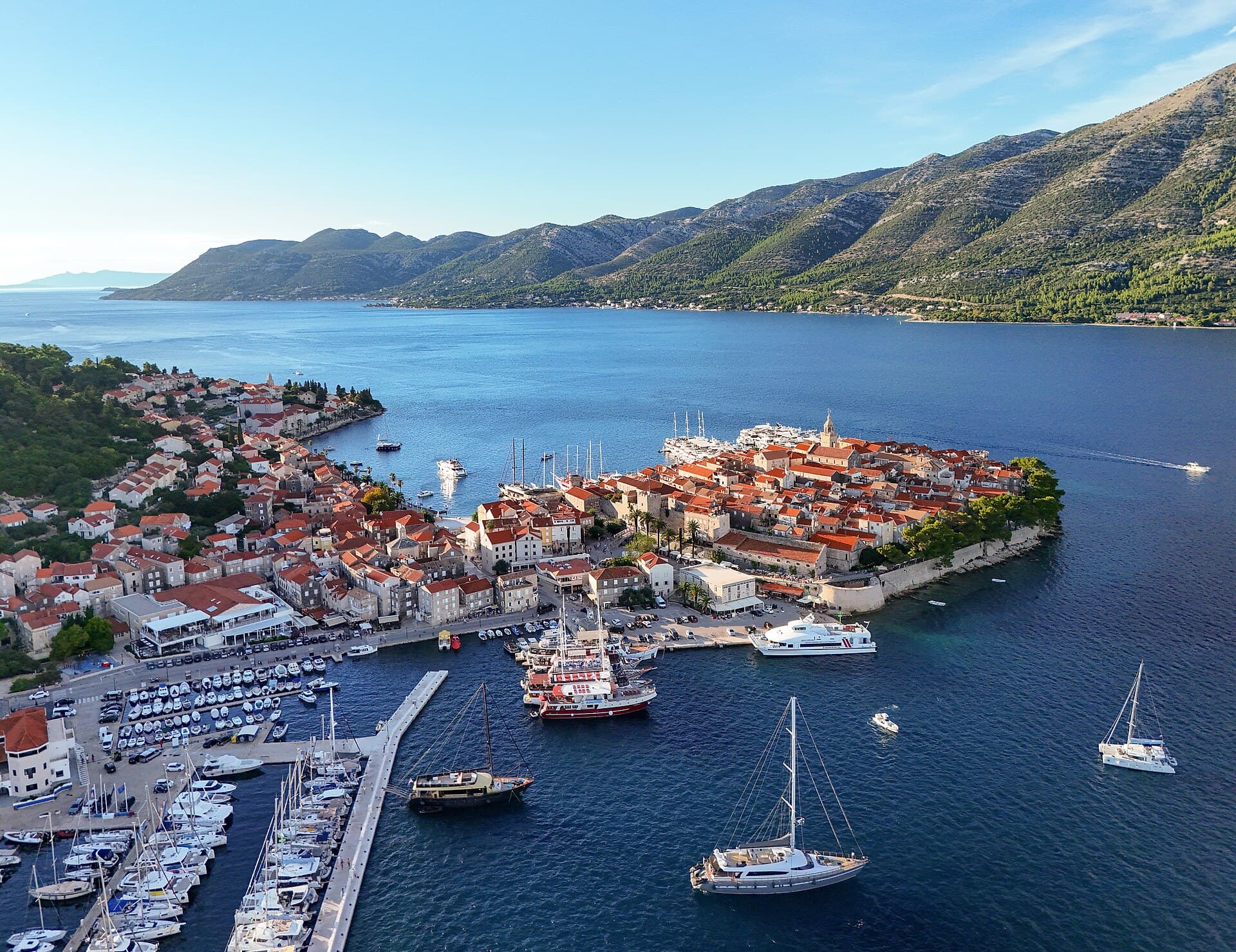
The Old Town's Fishbone Street Plan
The medieval architects of Korčula weren't just thinking about aesthetics when they designed the town's unique layout.
Full story unlocks in the tour
 Quintin Soloviev / CC BY 4.0, via Wikimedia Commons
“Where ancient walls meet emerald seas and legends linger in the air.”
Not the postcards. The stories even locals don't know — whispered in your ear, right where they happened.
The medieval architects of Korčula weren't just thinking about aesthetics when they designed the town's unique layout.
Korčula proudly claims to be the birthplace of the legendary explorer Marco Polo, a claim that has sparked centuries of friendly debate.
This dramatic sword dance, performed for centuries in Korčula, tells a captivating story of conflict and rescue.
Discover every secret of Korčula
Every address, every reveal in full — in your ear, right where it happened.
You pick your stops. You walk. The voice reveals what the others miss.
No tours available yet. Check back soon — we're preparing them.
Korčula, an island off Croatia's Dalmatian coast, is often referred to as "Little Dubrovnik" due to its remarkably preserved medieval walled town. This captivating island, the sixth-largest in the Adriatic, offers lush pine forests, ancient olive groves, and sprawling vineyards that inspired its ancient Greek name, Korkyra Melaina, or "Black Corfu." Beyond its striking natural beauty, Korčula offers a relaxed and authentic ambiance, making it a compelling destination for those seeking a blend of history, culture, and Adriatic scenery.
The island's main settlement, also named Korčula, is a fortified town situated on a peninsula, its stone architecture and historic character reflecting nearly four centuries of Venetian rule. Visitors can wander through its narrow, winding streets, which are laid out in a distinctive fishbone pattern, designed to provide both shade and protection from the wind. Korčula is also renowned for its unique wine culture, producing indigenous white grape varieties like Grk and Pošip, which are celebrated by wine enthusiasts.
The history of Korčula stretches back to prehistoric times, with archaeological findings in places like Vela Spila cave near Vela Luka indicating human habitation as far back as the Mesolithic and Neolithic periods. The island was first settled by Mesolithic and Neolithic peoples, with evidence of human dwelling dating back almost 20,000 years BCE. Around 1000 BCE, Illyrians, semi-nomadic tribal people focused on agriculture, also settled the island, leaving behind numerous old stone buildings and fortresses.
In the 4th century BCE, ancient Greeks from Knidos colonized the island, naming it Korkyra Melaina, or "Black Corfu," a nod to their homeland and the island's dense pine forests. The "Lumbarda Psephisma," one of the oldest written monuments in Croatia, is a stone plaque from this era, inscribed in Ancient Greek, documenting an agreement between Greek colonizers and indigenous Illyrians. The Romans later conquered the island in the 1st century BCE, incorporating it into the Roman province of Illyricum, and subsequently Dalmatia.
Korčula's strategic maritime location made it a key interest for Venice, which took control in the 13th century. This marked the beginning of a significant Venetian influence that shaped the town's architecture and culture for nearly four centuries, from 1420 to 1792. During this period, the medieval walls and many of the luxuriously decorated palaces that define Korčula's Old Town were constructed. The town also faced various conflicts, including a notable battle against the Ottomans in 1571. After the fall of the Venetian Republic, Korčula experienced a period of shifting rule, held by the Austrians, French, Russians, English, and Italians, before finally becoming part of the Kingdom of Serbs, Croats, and Slovenes in 1921, which later became Yugoslavia. Following World War II, Korčula became part of the Republic of Croatia, and since then, tourism has become a primary focus.
Begin your exploration in Korčula Old Town, a remarkably preserved medieval settlement encircled by 13th-century stone walls and towers. Wander through its narrow, winding streets, designed in a unique fishbone pattern to maximize ventilation and provide shade. At the heart of the Old Town stands the Gothic-Renaissance Cathedral of St. Mark, a 15th-century masterpiece with intricate stonework and a bell tower offering expansive views. Nearby, the Marco Polo House, though debated as his actual birthplace, offers a small museum and impressive views from its tower.
Beyond the Old Town, consider a visit to the islet of Badija, home to a Franciscan monastery and walking paths, with secluded beaches on its northern side. Another nearby islet, Vrnik, features historic quarries and clear shallow waters ideal for swimming. For a deeper dive into local culture, seek out a performance of the Moreška sword dance, a centuries-old tradition depicting a battle between two kings. Korčula is also celebrated for its wine culture; explore the vineyards of Lumbarda, known for the indigenous Grk white wine, and indulge in wine tastings.
The best time to visit Korčula is during the shoulder seasons, from April to May and September to early October. During these months, the weather is pleasant with comfortable temperatures, fewer crowds, and more reasonable accommodation prices. The sea is also warm enough for swimming by May and remains so through September. While July and August offer the hottest weather and liveliest atmosphere with numerous festivals, they also bring peak crowds and higher prices. Many activities and ferries operate more frequently during the summer months. The low season, from November to March, sees many establishments closed.
Korčula is an island destination, primarily reachable by ferry from various points on the Croatian mainland, including Dubrovnik and Split, as well as other islands like Hvar and Mljet. There are both car and foot passenger ferries available. Within Korčula Town, walking is the easiest way to get around, given its compact size. For exploring the wider island, options include cycling, local buses, taxis, or renting a scooter or car. The official currency in Croatia is the Euro, adopted in early 2023. While credit cards are widely accepted, it's always useful to have some cash on hand. Due to the popularity of Korčula, especially during peak and shoulder seasons, it is advisable to book accommodations and popular tours in advance. Many of Korčula's beaches are pebble or rocky, so packing water shoes is recommended for comfort.