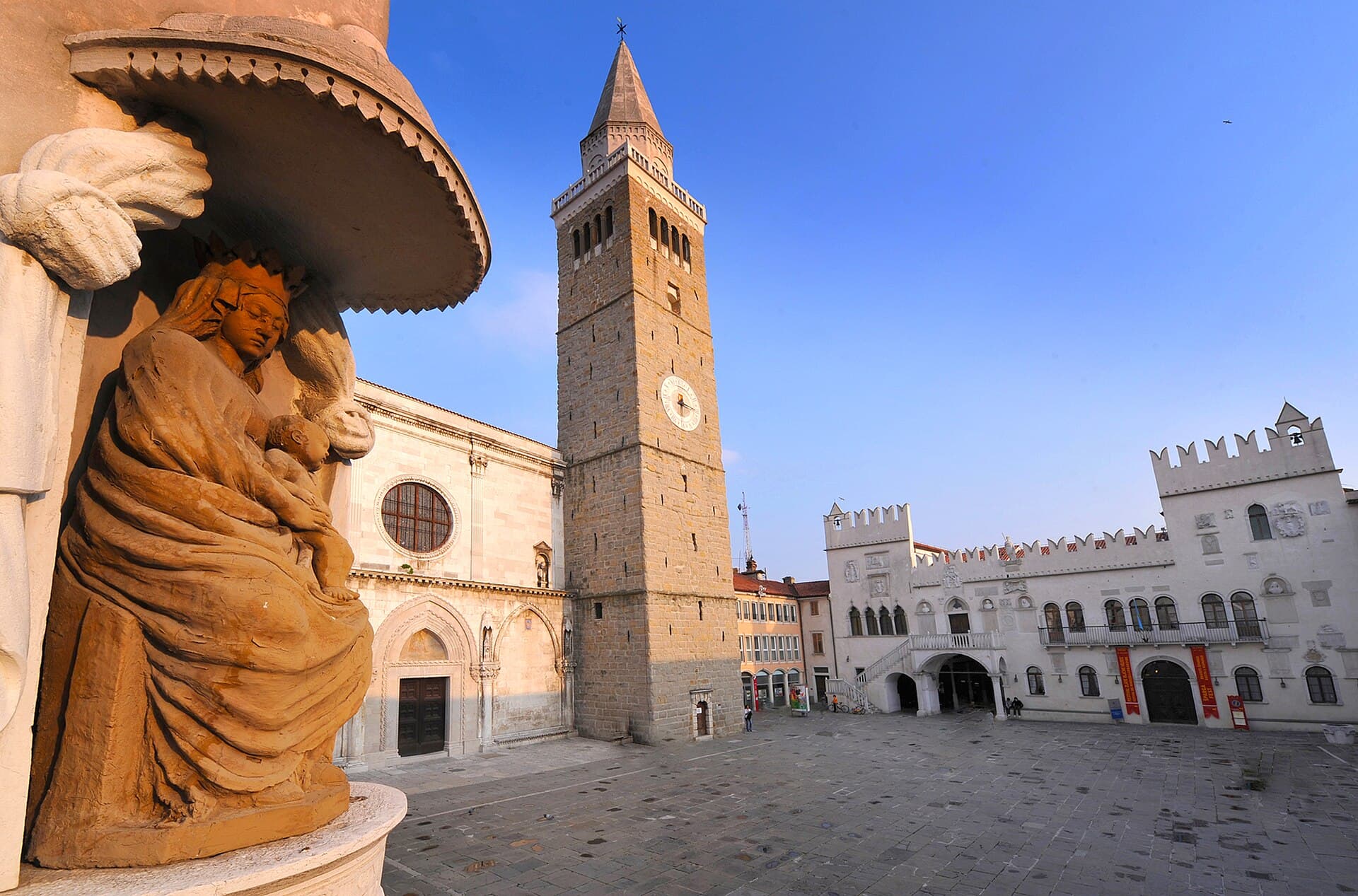
Tito Square
The grand Praetorian Palace on Tito Square holds more than just the city hall.
Full story unlocks in the tour
 TICKoper / CC BY-SA 4.0, via Wikimedia Commons
“Where Venetian echoes meet Adriatic rhythms.”
Not the postcards. The stories even locals don't know — whispered in your ear, right where they happened.
The grand Praetorian Palace on Tito Square holds more than just the city hall.
Koper was once an island, and the Muda Gate was one of its crucial entry points.
Ascending Koper's Bell Tower offers a sweeping panorama, but listen closely.
Discover every secret of Koper
Every address, every reveal in full — in your ear, right where it happened.
You pick your stops. You walk. The voice reveals what the others miss.
No tours available yet. Check back soon — we're preparing them.
Koper, Slovenia's largest coastal city, presents a captivating blend of Venetian elegance and a bustling port atmosphere. Once an island, it was connected to the mainland by a causeway in 1825, and its old town still retains the intricate, winding passages and architectural styles of its past. This city serves as Slovenia's primary maritime gateway, with a busy international port that provides a dynamic backdrop to its historic core.
Beyond its historical appeal, Koper is a functional, lived-in city that provides a genuine glimpse into Slovenian coastal life. It is a bilingual area, with both Slovene and Italian spoken, reflecting its close proximity to the Italian border and its long history under Italian influence. Koper is also an excellent starting point for exploring the wider Istrian peninsula and Slovenia's diverse natural landscapes, from the Karst region to the Julian Alps, all within a short drive.
Koper's story stretches back to the Middle Bronze Age, around 1500 B.C. The settlement began on an island in the Gulf of Koper, known to the Romans in the 3rd century BCE as Capris, and later as Aegida. During the Byzantine era, between the mid-6th and 8th centuries, it was called Justinopolis.
The city's strategic location on the Adriatic made it a coveted territory. After periods under Lombard and Frankish rule, Koper was granted town rights by Emperor Conrad II in 1035. A pivotal shift occurred in 1278 when Koper joined the Republic of Venice, initiating a long period of Venetian dominance that lasted until 1797. During this time, Koper, then known as Caput Histriae (meaning 'head of Istria'), became the capital of Venetian Istria, and its architecture and culture were profoundly shaped by Venetian influence.
Following the fall of the Venetian Republic, Koper experienced Napoleonic French and Austrian Empire rule before becoming part of Italy. After World War II, it was part of the Free Territory of Trieste until it was incorporated into Yugoslavia in 1954. In 1991, with Slovenia's independence, Koper became a significant economic and cultural center, home to Slovenia's only commercial port and a university. The city's layered past is still evident in its preserved medieval character, despite modern developments.
Begin your exploration in Tito Square (Titov Trg), the core of Koper's old town. This grand Venetian-style piazza is framed by significant historical buildings. The Praetorian Palace, a 15th-century Venetian Gothic masterpiece, stands prominently, serving as the city hall. Adjacent to it is the Cathedral of the Assumption, with its 12th-century origins and a 14th-century bell tower that offers sweeping views after a 204-step climb.
Wander through the narrow, winding streets of the old town, where Venetian lions and sun motifs are still visible on building facades, reminders of Koper's past. Visit Carpaccio Square, home to the reddish Venetian-Gothic Carpaccio House and the Column of St. Justinen, commemorating the Battle of Lepanto. The Taverna, once a Venetian salt depot, now hosts various events. Do not overlook the Muda Gate, the only surviving city gate from the 16th century. For a moment of tranquility, find the Da Ponte fountain in Presernov Trg, the largest fountain in Koper.
Beyond the historic center, consider a visit to the Škocjanski zatok Nature Reserve, a semi-saline wetland popular with birdwatchers, or explore the Karst edge, a magnet for rock climbers. The city also serves as a convenient base for day trips to nearby Piran, Lake Bled, Ljubljana, or the Postojna and Škocjan Caves.
Koper's Mediterranean climate makes it an appealing destination year-round. For warm, sunny days ideal for swimming, hiking, and enjoying outdoor festivals, the period from April through September, often extending into October, is recommended. Spring and early autumn offer pleasant temperatures and fewer crowds, making them excellent for exploring the city and countryside. While summers are warm, occasional thunderstorms can provide a break from the sun. Winters are mild compared to inland Slovenia, with infrequent frost or snow.
Koper is easily navigable on foot, particularly its compact old town, which is just a short walk from the cruise port. Slovenia is an EU country, and the Euro (€) is the official currency. English is commonly spoken, though learning a few Slovene phrases like "Hvala vam" (thank you) is always appreciated. For those planning to drive, a Vinjeta (highway toll sticker) is required for Slovenian highways. Public transportation connects Koper to nearby coastal towns like Izola and Piran, and bus and train services are available to Ljubljana. Public toilets are available at several locations, including the Koper Market and Bonifika Stadium. Koper is considered a very safe destination with low crime rates.