Mevlana Museum
The Mevlana Museum is a place of profound spiritual significance, but one detail within its walls hints at a deeper, more personal connection to its founder.
Full story unlocks in the tour
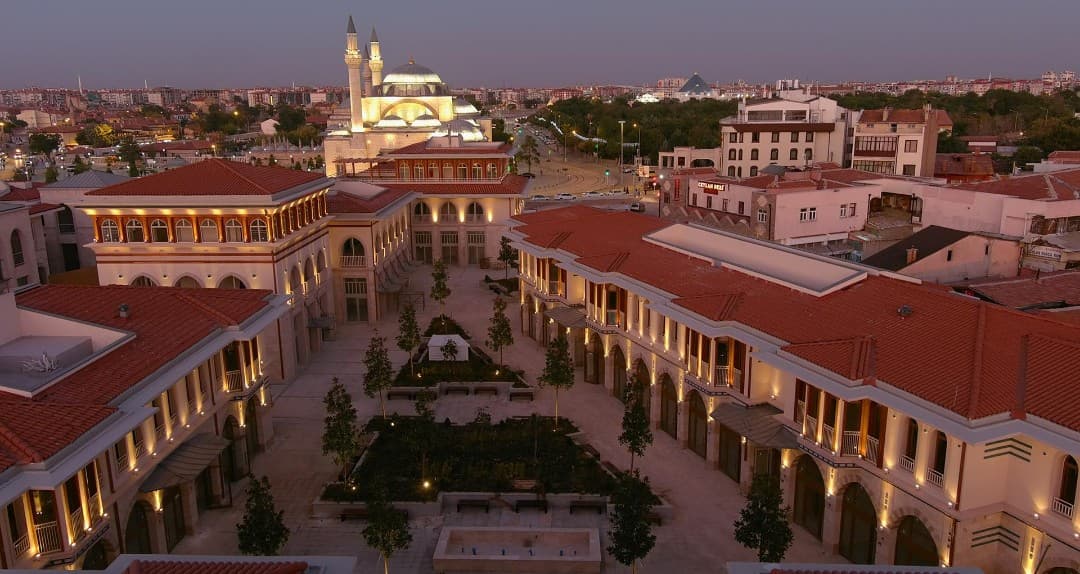 Konya Karatay Belediyesi / CC BY 4.0, via Wikimedia Commons
“Where ancient echoes meet the whirling heart of Sufism.”
Not the postcards. The stories even locals don't know — whispered in your ear, right where they happened.
The Mevlana Museum is a place of profound spiritual significance, but one detail within its walls hints at a deeper, more personal connection to its founder.
Just a short distance from Konya, the ancient village of Sille holds a surprising connection to an early Christian empress.
The mesmerizing Sema ceremony of the Whirling Dervishes is a spiritual journey, but the seemingly simple act of their whirling holds a specific, symbolic direction.
Discover every secret of Konya
Every address, every reveal in full — in your ear, right where it happened.
You pick your stops. You walk. The voice reveals what the others miss.
No tours available yet. Check back soon — we're preparing them.
Konya, a city in Turkey's Central Anatolia region, offers a captivating blend of ancient history, spiritual depth, and modern life. It is widely recognized as the spiritual heartland of the Mevlevi Order, famed for its Whirling Dervishes, and the final resting place of the revered 13th-century poet and mystic, Rumi.
Beyond its profound spiritual significance, Konya is a city where the past is palpable. Traces of civilizations dating back to 7000 BC, including the Hittites, Romans, Seljuks, and Ottomans, are evident throughout the city. From the iconic Mevlana Museum to bustling traditional bazaars and serene parks, Konya invites a slower pace of exploration, revealing its unique character to those who delve deeper.
As Turkey's sixth-largest city by surface area, Konya presents a conservative yet welcoming atmosphere. It's a destination that appeals to both devout pilgrims and curious travelers seeking an authentic cultural experience, distinct from Turkey's more frequented coastal areas.
Konya's history stretches back to the Neolithic Age, with the earliest settlements dating between 8000-5500 BC. Archaeological research at sites like Çatalhöyük, located within the province, reveals a history of continuous human habitation, with evidence of early house architecture and sacred buildings. The city was known as 'Iconium' in ancient times, a name rumored to be derived from 'Icon,' meaning 'Sacred Image,' or from a monument built to commemorate a dragon-slayer.
Throughout antiquity, Konya was under the rule of various empires, including the Hittites, Phrygians, Persians, Greeks, and Romans. By the 10th century, it was part of the Byzantine Empire until the arrival of the Seljuk Turks. Following the Seljuk victory over the Byzantines and their entry into Anatolia, Konya became a pivotal city, marking the beginning of Turkish-Islamic dominance in the region.
In 1074, the Anatolian Seljuk Sultanate was established, and Konya eventually became its capital, a position it held until the empire's collapse in 1308. During this period, Konya experienced a golden age, flourishing with architectural works of art and attracting poets, philosophers, and scholars, including Rumi and Shams Tabrizi. After the Seljuks, Konya was governed by the Karamanid Principality before being incorporated into the Ottoman Empire by Mehmed the Conqueror in 1465. Under Ottoman rule, Konya continued to be an important administrative and cultural center. Today, Konya is a rapidly developing city, preserving its historical and cultural heritage while embracing modernity.
The Mevlana Museum is Konya's most renowned attraction, housing the mausoleum of Rumi and serving as the spiritual home of the Whirling Dervishes. Visitors can explore the dervish cells, the Semahane (ritual hall), and a collection of artifacts related to Mevlevi life, including manuscripts and musical instruments.
Alaeddin Hill offers expansive views of the city and is home to the Alaeddin Mosque, a beautiful example of Seljuk architecture. Nearby, Karatay Medresesi (Tile Museum) showcases intricate Seljuk tilework.
For a glimpse into ancient history, the Çatalhöyük archaeological site, a UNESCO World Heritage site, is a significant Neolithic settlement. A short trip to Sille Village reveals a tranquil, historic Greek Orthodox community with rock-carved chapels and the ancient Aya Eleni Church.
Other notable sites include the Aziziye Mosque, known for its Ottoman architecture, and the bustling Bedesten Bazaar for a taste of local commerce. The Konya Archaeological Museum houses artifacts spanning various historical periods.
Konya experiences a continental climate with hot, dry summers and cold winters. The most pleasant times to visit are spring (April to June) and autumn (September to October), when the weather is mild and ideal for exploring. These seasons also see fewer tourists. Summers (July and August) can be hot, though still popular, while winters (December to February) are cold, with temperatures sometimes dropping below freezing. December is particularly significant for the Mevlana Festival (Şeb-i Arûs), commemorating Rumi's death, which draws a large number of visitors.
The official currency in Konya, and Turkey, is the Turkish Lira (TRY); it's advisable to carry some cash for smaller transactions. Turkish is the official language, and English is not as widely spoken as in major tourist centers. Konya is a religiously conservative city, so modest dress is recommended, especially when visiting mosques and religious sites. Women should carry a headscarf for mosque entry.
Konya Airport (KYA) is approximately 18 km from the city center, with Havas shuttles, taxis, and rental cars available for transport. The city is also well-connected by high-speed train (YHT) from Ankara and Istanbul, and an extensive bus network. Within the city, the central area is walkable, and public transportation, including trams and buses, is efficient. Taxis are also readily available.