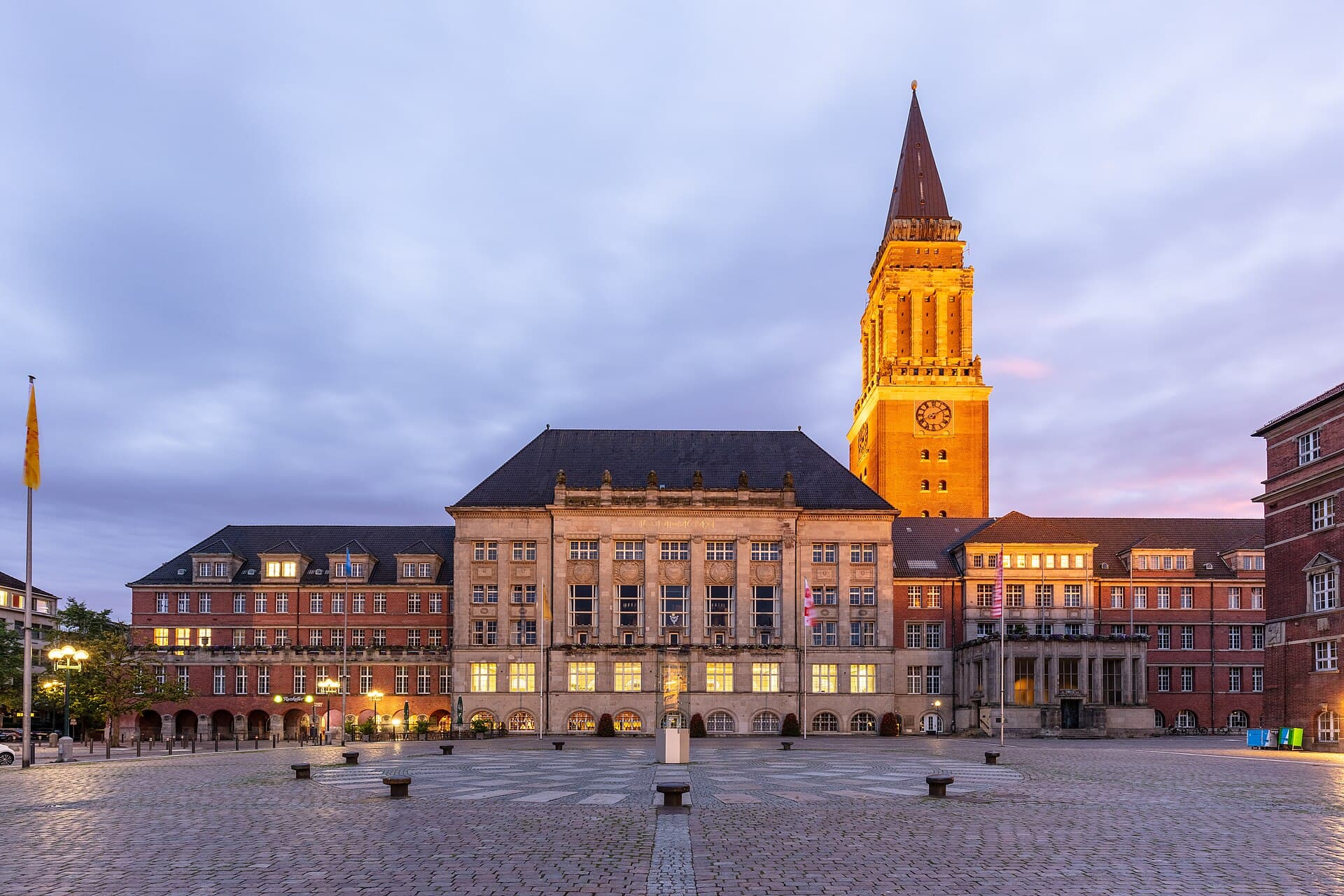
Kiel Town Hall Paternoster
In Kiel's Town Hall, a peculiar elevator offers a journey through time, but it's not for the timid.
Full story unlocks in the tour
 Diego Delso / CC BY-SA 4.0, via Wikimedia Commons
“Kiel: Where the Baltic Sea breathes life into northern Germany.”
Not the postcards. The stories even locals don't know — whispered in your ear, right where they happened.
In Kiel's Town Hall, a peculiar elevator offers a journey through time, but it's not for the timid.
A short ferry ride from Kiel reveals a World War II submarine that is more than just a museum piece.
The world's busiest artificial waterway has a surprisingly captivating viewing spot.
Discover every secret of Kiel
Every address, every reveal in full — in your ear, right where it happened.
You pick your stops. You walk. The voice reveals what the others miss.
No tours available yet. Check back soon — we're preparing them.
Kiel, the capital of Schleswig-Holstein, is a city where maritime heritage deeply influences the urban landscape. Situated at the eastern end of the Kiel Canal, where the Baltic Sea flows inland to form the Kiel Fjord, it serves as a significant link between the Baltic and North Seas. Unlike many German cities with medieval architecture, Kiel possesses a more contemporary feel due to extensive post-World War II reconstruction, which created wide boulevards and functional buildings. This modern character allows the city to focus on its strengths: maritime culture, outdoor recreation, and scientific innovation.
Often described as the "Gateway to the Baltic," Kiel is a working port where you can witness enormous cruise ships and ferries to Scandinavia docked near city center shopping areas. The city's identity is intrinsically tied to its 17-kilometer-long fjord, a major shipping lane and a hub for recreational activities. Beyond its industrial pulse, Kiel is a university town with a lively, youthful atmosphere, particularly prominent in marine sciences and climate research.
Kiel's history began modestly as a Viking settlement in the 8th century, though its official founding as "Holstenstadt tom Kyle" by Count Adolf IV of Holstein occurred in 1233. It gained city rights in 1242 and quickly became a significant trading hub, joining the Hanseatic League in 1284. However, Kiel was expelled from the league in 1518 for allegedly harboring pirates.
The city's strategic location led to centuries of shifting allegiances. From 1773 to 1864, it was ruled in personal union by the King of Denmark. A decisive change came in 1865 when Kiel became a Prussian naval base, triggering rapid industrialization and urban growth as shipyards expanded. This period also saw the Kiel Canal's completion in 1895, further cementing its maritime importance.
The 20th century brought significant challenges. Kiel played a crucial role in both World War I and World War II, with its naval facilities heavily targeted during the conflicts. The city was the site of the Kiel Mutiny in 1918, when sailors refused orders for a final battle with the British Navy, sparking the German Revolution and leading to the formation of the Weimar Republic. World War II left much of Kiel in ruins, leading to extensive reconstruction that shaped its modern appearance. In 1946, Kiel was named the seat of government for Schleswig-Holstein, officially becoming the state's capital in 1952. Today, Kiel remains an important maritime center, with high-tech shipbuilding and ocean research, and has twice hosted the Olympic sailing competitions, in 1936 and 1972.
Begin your exploration at the Kiellinie, Kiel's waterfront promenade. This 3.5-kilometer stretch along the Kiel Fjord offers views of marinas, navy ships, and cruise liners. You'll find food stalls with local specialties like Fischbrötchen (fish sandwiches) and the GEOMAR Aquarium, which features an outdoor seal pool where you can observe seals for free.
In the city center, the Kiel Town Hall (Rathaus) is a landmark building with a distinctive tower offering expansive views of the city and fjord. Nearby, the St. Nikolai Church, dating back to around 1240, is one of Kiel's oldest buildings, featuring Gothic architecture and historical artifacts. The Old Market Square (Alter Markt) surrounds the church, offering cafes and bars.
For maritime history, the Kiel Maritime Museum, housed in a former fish auction hall, provides an in-depth look at the city's shipbuilding legacy and its role as a major port. The Old Botanical Garden, established in 1669, is Germany's oldest botanical garden, offering a verdant escape in the heart of the city. Do not miss the Kiel Canal locks at Holtenau for a fascinating display of engineering as ships traverse the waterway.
The best time to visit Kiel is during the summer months, from June to August, when the weather is warm and sunny. This period also coincides with the annual Kieler Woche (Kiel Week), the world's largest sailing event, which transforms the city into a lively festival with races, concerts, and food. Spring (April-May) and autumn (September-October) offer pleasant temperatures and fewer crowds. While winters can be cold and rainy, Kiel's Christmas markets in December offer a unique charm.
Kiel is well-connected by public transportation, primarily buses and ferries operated by KVG. Single one-way bus tickets cost around EUR 2.50, and multi-day passes are available. Ferries are a convenient way to cross the Kiel Fjord. The city is bike-friendly with a developed network of cycle paths, and e-scooters are also available for rent. Kiel Hauptbahnhof (main train station) connects the city to the German and Danish rail systems. For international air travel, Hamburg Airport (HAM) is the closest major hub, with shuttle bus and train connections to Kiel. Driving in the city center can be challenging due to pedestrian zones, so a rental car is more suitable for regional trips.