The grand Tash Hauli Palace, constructed with the labor of over 1,000 enslaved people, once housed a Khan with four wives and more than 30 concubines. Yet, it reveals a surprising detail about how its royal residents truly preferred to sleep.
Fulvio Spada from Torino, Italy / CC BY-SA 2.0, via Wikimedia CommonsKhiva
“Where ancient Silk Road echoes meet domes of turquoise.”
Khiva, as no one tells it.
Not the postcards. The stories even locals don't know — whispered in your ear, right where they happened.
Khiva's Juma Mosque presents a dense grove of over 200 carved wooden pillars, some reaching back to the 10th century. A closer look, however, uncovers a subtle detail in their construction, hinting at an ancient engineering secret.
The distinctive Kalta Minor Minaret, with its striking turquoise tiles, remains famously incomplete. The initial vision for this towering structure was far grander, and its halted construction is linked to a dramatic turn of events.
Discover every secret of Khiva
Every address, every reveal in full — in your ear, right where it happened.
You pick your stops. You walk. The voice reveals what the others miss.
How long do you have in Khiva?
No tours available yet. Check back soon — we're preparing them.
The story of Khiva
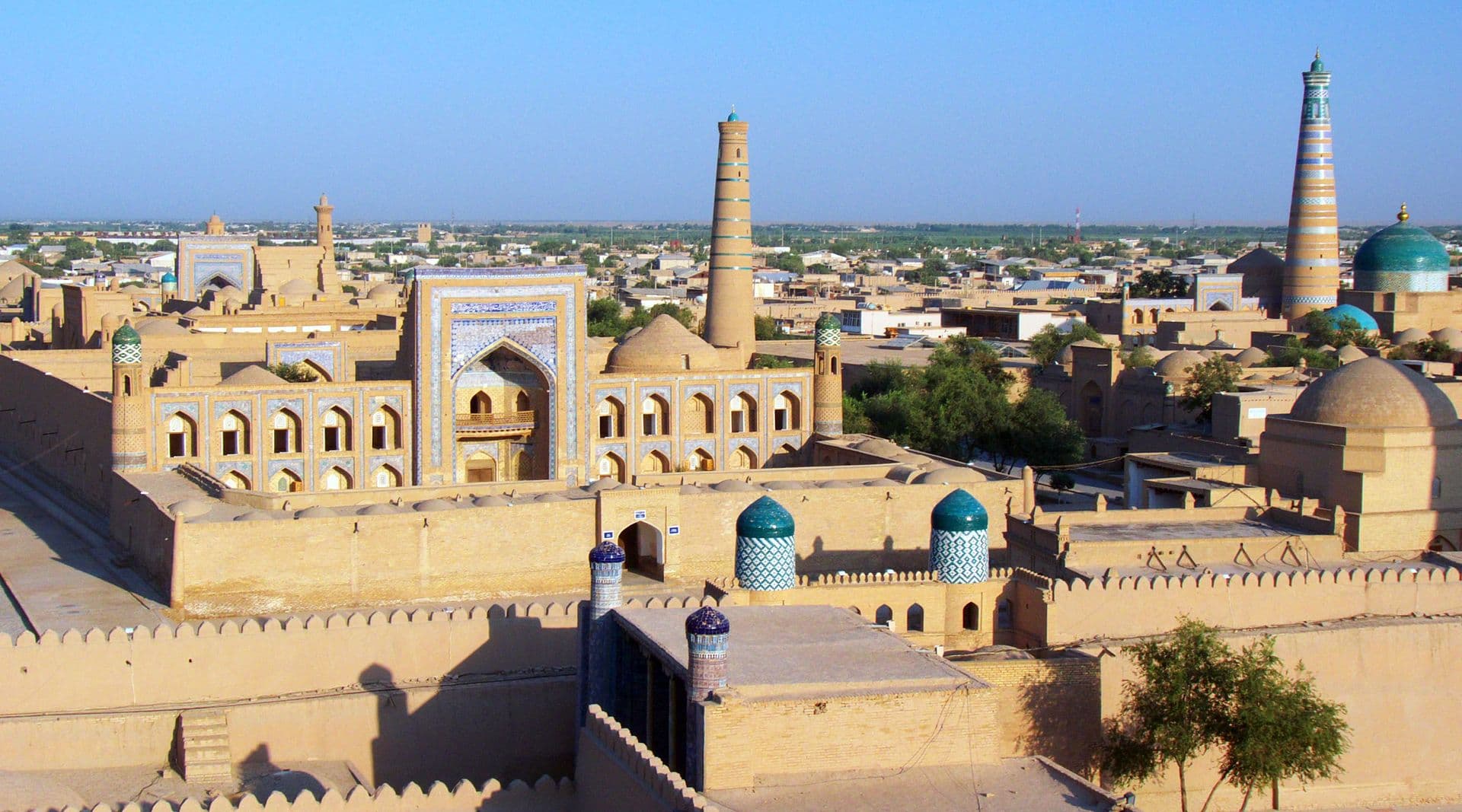
Khiva, in Uzbekistan's western Khorezm region, is a city where time appears to pause. Its inner city, Itchan Kala, is a UNESCO World Heritage site and a remarkably preserved example of an ancient Silk Road trading post. Stepping through its gates feels like entering a living museum, with mud-brick walls, soaring minarets, and intricate tilework creating an atmosphere that carries visitors centuries into the past.
While Khiva may be more distant than its celebrated Silk Road counterparts, Samarkand and Bukhara, those who undertake the journey often find it to be the most captivating stop of all. The compact nature of Itchan Kala, spanning just 26 hectares, means its dozens of architectural monuments and hundreds of old houses can be explored on foot, revealing a unique blend of history, craftsmanship, and a quiet allure that distinguishes it.
Legend asserts Khiva was founded by Shem, the son of the biblical Noah, and that its walled city is even shaped like an ark. Regardless of its mythical origins, archaeological evidence confirms continuous habitation for over 2,500 years, making it a truly ancient settlement with a profound legacy.
Khiva's recorded history extends back to the 10th century, though archaeological findings suggest habitation as early as the 6th century BCE. It served as a crucial stop on the northern branch of the Silk Road, a bustling nexus where traders prepared for the arduous desert crossing to Persia, exchanging goods, water, and fodder, and tending to their caravans. This strategic location brought both prosperity and danger, as Khorezm, the region where Khiva lies, was conquered by the Achaemenid State and later devastated by Genghis Khan in 1220.
By the early 17th century, Khiva ascended to prominence as the capital of the Khanate of Khiva, governed by the Uzbek Kongirad dynasty. This period saw substantial architectural development, with many of the surviving structures in Itchan Kala dating from the late 18th and early 19th centuries. However, this era also marked Khiva's grim reputation as a major center for the slave trade between the 17th and 19th centuries. Tens of thousands of Persians and an unknown number of Russians were enslaved and brought to Khiva's markets, often compelled to work on large construction projects like the Tash Hauli Palace. The slave trade was abolished in 1873 when the Russian Empire conquered Khiva and established it as a protectorate.
In the early 20th century, Khiva contained nearly 170 mosques and madrassas, reflecting its status as a significant Islamic learning center. After the Russian Revolution, the Khanate of Khiva was dissolved in 1919, and Khiva became the capital of the Khorezm People's Soviet Republic. In 1924, the Khorezm oasis was divided, and Khiva became part of modern Uzbekistan. The Soviets meticulously restored many of the ancient buildings in Itchan Kala, transforming it into a museum city. Today, Itchan Kala is recognized as Central Asia's first UNESCO World Heritage Site, a testament to its enduring historical and architectural importance.
The primary attractions of Khiva are concentrated within Itchan Kala, the walled inner city. A good starting point is the Kalta Minor Minaret, an iconic, unfinished tower adorned with vivid turquoise tiles, initially conceived to be the tallest in the Islamic world. Nearby, the Muhammad Amin Khan Madrasah, now housing the Orient Star Hotel, provides a glimpse into historical educational institutions.
Explore the Kuhna Ark, the former residence of the Khans, and ascend its watchtower for expansive views of Itchan Kala's domes and minarets. The Juma Mosque is a singular architectural wonder, featuring a hypostyle hall supported by 213 individually carved wooden pillars, some dating back to the 10th century. Do not overlook the Islam Khodja Minaret, the tallest in Khiva, offering exceptional vistas for those who climb its 175 steps.
The Pahlavan Mahmud Mausoleum honors Khiva's patron saint, a 13th-century wrestler and poet, and dazzles with its intricate blue and green tilework. The Tash Hauli Palace, or "Stone House," is a 19th-century royal residence noted for its opulent courtyards, bright tilework, and carved wooden details. For a different perspective, walk along the ancient city walls, accessible from the North Gate, providing sweeping views of the desert oasis.
Beyond the major monuments, wander the narrow alleyways of Itchan Kala to discover local artisans, traditional bazaars, and inviting tea houses.
The most favorable times to visit Khiva are during the spring (April to June) and autumn (September to October) when the weather is mild and agreeable for exploration. Temperatures during these months typically range from 17°C to 28°C (63°F to 82°F), and visitor numbers are generally lower than in peak summer. Spring also brings apricot blossoms, enhancing the city's appeal. The traditional Persian New Year, Nowruz, is celebrated around March 20-21 with festivities.
Summers (July to August) can be intensely hot, with temperatures surpassing 40°C (104°F). Winters (December to February) are cold, with temperatures between -5°C and 5°C, and some hotels may close.
Khiva is a compact city, and its main attractions within Itchan Kala are easily explored on foot. While you can freely enter Itchan Kala, a museum pass is required to access most of the monuments, mosques, and museums inside the walled city. This pass is typically valid for two days and can be purchased at the West Gate. Some sites, like the Islam Khodja Minaret, Kuhna Ark Watchtower, and Pahlavan Mahmud Mausoleum, may require a separate, additional fee.
Khiva is accessible by train, with new high-speed services connecting it to Bukhara and Samarkand, and reducing travel time from Tashkent. Urgench International Airport, currently undergoing renovation, serves as the main air hub, with Khiva just a short distance away. Many guesthouses are located within Itchan Kala, offering a distinctive experience, but booking ahead is recommended, especially during shoulder and peak seasons.
- Do I need a ticket to enter Itchan Kala?
- You can enter and walk around the walled city of Itchan Kala without a ticket. However, a museum pass is required to enter most of the individual monuments, mosques, and museums within the walls.
- How long should I spend in Khiva?
- While the main points of interest can be seen in one day, two full days are ideal to explore Itchan Kala thoroughly, enjoy sunsets from various viewpoints, and experience the city's atmosphere after day-trippers have left.
- What are the best ways to get to Khiva?
- Khiva is accessible by train from major Uzbek cities like Tashkent, Samarkand, and Bukhara. There are also flights to Urgench International Airport, which is a short drive from Khiva.
- Can I climb the minarets in Khiva?
- You can climb the Islam Khodja Minaret for expansive views of Itchan Kala. An additional fee is typically required for this. The Kalta Minor Minaret is not open for climbing.
- Is Khiva very touristy?
- While Khiva is a popular destination for travelers, especially Itchan Kala, it often feels less crowded than Samarkand or Bukhara, particularly in the mornings and evenings after tour groups depart.
- What kind of food can I expect in Khiva?
- You can expect traditional Uzbek cuisine, including dishes like *shivit osh* (green noodles), *tukhum barak* (egg dumplings), and various kebabs. Many restaurants offer rooftop dining with views of Itchan Kala.