Cromwell's Bridge
A particular bridge in Kenmare bears a name that seems to be a historical misstep, sparking local theories about its true origin.
Full story unlocks in the tour
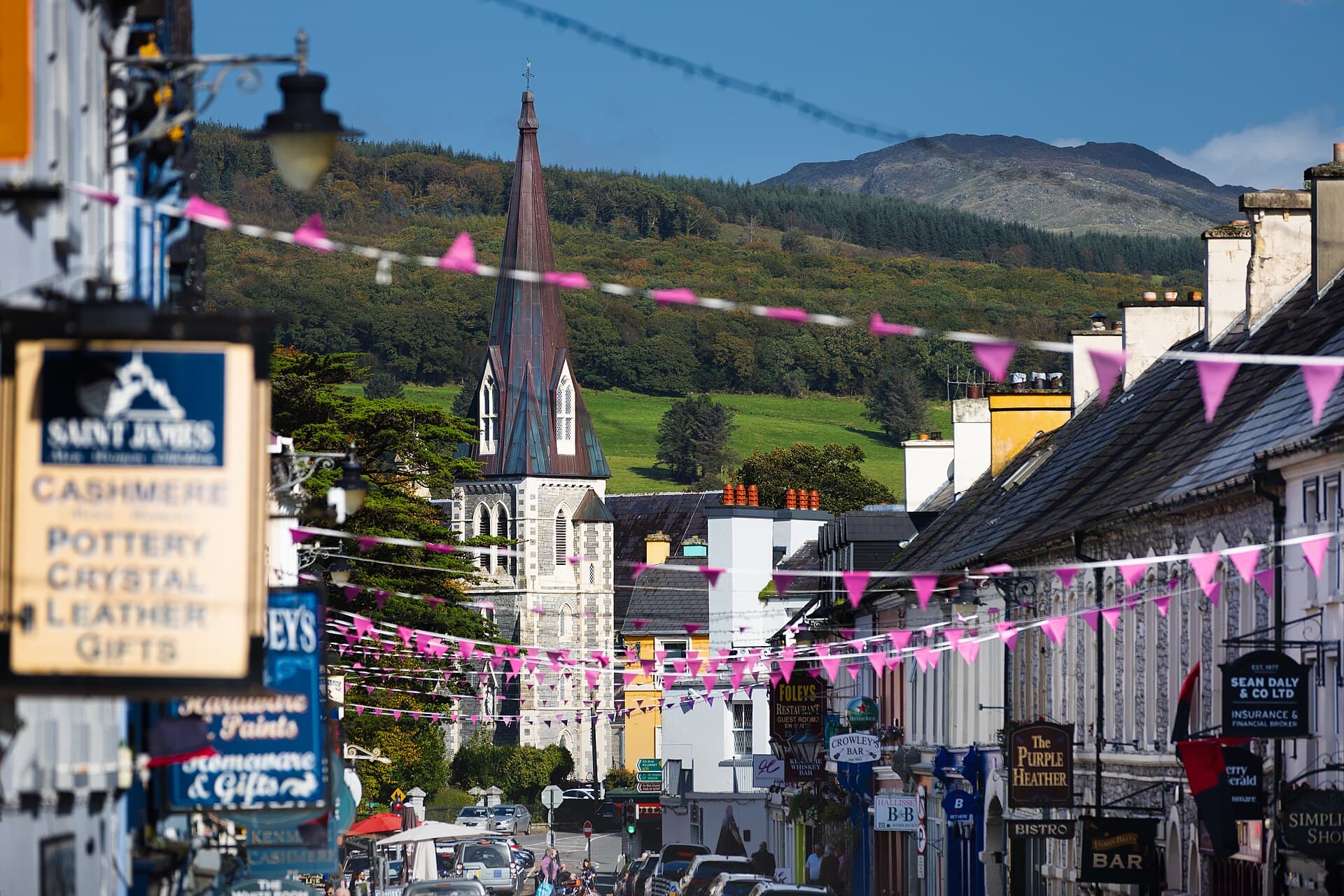 Podstawko / CC BY-SA 4.0, via Wikimedia Commons
“Where two peninsulas converge, a town awakens.”
Not the postcards. The stories even locals don't know — whispered in your ear, right where they happened.
A particular bridge in Kenmare bears a name that seems to be a historical misstep, sparking local theories about its true origin.
A Bronze Age stone circle, unusually situated within the town, holds a secret about the panorama its creators once beheld.
The exquisite Kenmare Lace, celebrated across the globe, owes its very existence to an unexpected, profound catalyst.
Discover every secret of Kenmare
Every address, every reveal in full — in your ear, right where it happened.
You pick your stops. You walk. The voice reveals what the others miss.
No tours available yet. Check back soon — we're preparing them.
Kenmare, or 'An Neidín' meaning 'the little nest' in Irish, is a delightful town in County Kerry, Ireland, resting at the head of Kenmare Bay. It occupies a strategic point where the Roughty River flows into the sea, and where the Iveragh and Beara Peninsulas meet. Known for its brightly painted streets, traditional pubs, and a reputation as a culinary capital, Kenmare offers a harmonious blend of natural splendor, enduring heritage, and a lively local spirit. It serves as an excellent starting point for exploring the renowned Ring of Kerry and the quieter Ring of Beara, opening a path to some of Ireland's most dramatic landscapes.
The town's compact design encourages exploration on foot, inviting visitors to wander through its boutiques, artisan workshops, and art galleries. Beyond the town center, Kenmare is encircled by mountains such as MacGillycuddy's Reeks and Mangerton Mountain, making it a favored location for hillwalking. Whether seeking outdoor adventures, gastronomic pleasures, or a deep immersion in Irish heritage, Kenmare extends a genuine and inviting experience.
The land surrounding Kenmare carries the marks of ancient habitation, with evidence of human presence reaching back 5,000 years in the Sheen Valley. The most striking ancient monument is the Kenmare Stone Circle, among the largest in Ireland's southwest, believed to date from the Bronze Age (2,200-500 B.C.). This egg-shaped arrangement of 15 substantial boulders, featuring a central boulder dolmen, is thought to have served ritual or ceremonial purposes, possibly even functioning as an agricultural calendar aligned with celestial events.
During the early medieval period, the area, then identified as Ceann Mhara ('head of the sea'), experienced Viking incursions. The contemporary town of Kenmare, however, stands as a testament to careful planning. Following Oliver Cromwell's campaign, the land was granted to the English scientist Sir William Petty in 1656 as payment for mapping Ireland. Petty envisioned a settlement in the 1670s, but it was his descendant, William Petty-Fitzmaurice, the 1st Marquess of Lansdowne, who brought the town to fruition around 1775. He directed surveyor John Powell to design an X-plan layout, with Main Street, Henry Street, and Shelbourne Street converging in a triangular marketplace. This made Kenmare one of Ireland's earliest 'planned towns.'
Kenmare's story also includes periods of profound difficulty. The Great Famine (1845-1849) left the community grappling with widespread poverty. In response, the Poor Clare nuns arrived in 1861, establishing a school and an industrial lace-working enterprise in 1864. Kenmare Lace, a needlepoint creation, earned international recognition for its original designs, with Queen Victoria herself placing orders. This initiative provided essential employment for women and girls in the post-famine years.
Further infrastructure developments marked the town's expansion. Ireland's first suspension bridge over the Kenmare River opened in 1841, serving the community until 1932 when it was replaced by a new concrete structure. In the early 20th century, Kenmare was briefly occupied by the Anti-Treaty IRA during the Irish Civil War before being retaken by the Irish Army in December 1922. Today, the town's Carnegie Arts Centre, housed in a former Carnegie Library, continues to host local drama and touring productions.
Begin your exploration in the vividly colored town center, where Henry Street, Main Street, and Shelbourne Street meet. A brief walk from the center leads to the Kenmare Stone Circle, an impressive Bronze Age monument composed of 15 boulders with a central dolmen, sometimes referred to as 'The Druid's Circle.' For a quiet retreat, visit Reenagross Woodland Park, a peninsula offering walking trails and views of Kenmare Bay, originally part of the Lansdowne Estate.
Delve into local history at the Kenmare Heritage Centre, situated in the renovated Courthouse, which presents exhibitions on Kenmare Lace and local lore. You can also visit the Kenmare Lace and Design Centre to learn more about this distinctive craft. The Holy Cross Church is notable for its stained glass windows. For those interested in art, Kenmare offers numerous private galleries and art shops.
Beyond the town, consider a drive along the scenic Ring of Kerry or the more tranquil Ring of Beara, both easily accessed from Kenmare. Nearby sites include Bonane Heritage Park, with its archaeological findings spanning 5,000 years, and Gleninchaquin Park, known for its cascading waterfall and hiking paths. For a unique experience, visit Molly Gallivan's Cottage and Traditional Farm to observe rural Irish life from two centuries past.
The ideal period to visit Kenmare for comfortable outdoor activities is from late June to early September, when temperatures are generally cool to mild, ranging from 12-17°C (54-63°F). July typically offers the clearest skies, while January experiences the most rainfall. May and September provide a good balance of agreeable weather, ample daylight, and fewer visitors. While June through August are busy, all tourist services are fully operational. Autumn brings a display of rich foliage, and spring offers a quieter charm. For those interested in local events, Kenmare hosts a cultural weekend in mid-April, a horse show in early June, and a food festival in late October.
Kenmare is situated in County Kerry, Ireland, accessible by car via the N71 from Killarney or the R569 from Cork. While bus services are available from Killarney, renting a car provides the most freedom for exploring the surrounding countryside. The nearest airport is Kerry Airport (KIR), though Dublin, Shannon, or Cork airports may offer a wider selection of flights.
Once in Kenmare, the town is very walkable, with a main car park on Railway Road near Holy Cross Church. Public restrooms are also located there. For those wishing to explore beyond the town without a car, local taxi services and bicycle rentals are available. Kenmare provides a variety of accommodations, from guesthouses and B&Bs to five-star hotels. Dining options are abundant, with many restaurants and pubs serving locally sourced produce. It is advisable to reserve tables at popular establishments in advance, particularly during the peak season of July and August.