Kecskemét Town Hall
The Town Hall, a masterpiece of Hungarian Art Nouveau, holds a distinct narrative within its walls, beyond its vivid Zsolnay majolica tiles.
Full story unlocks in the tour
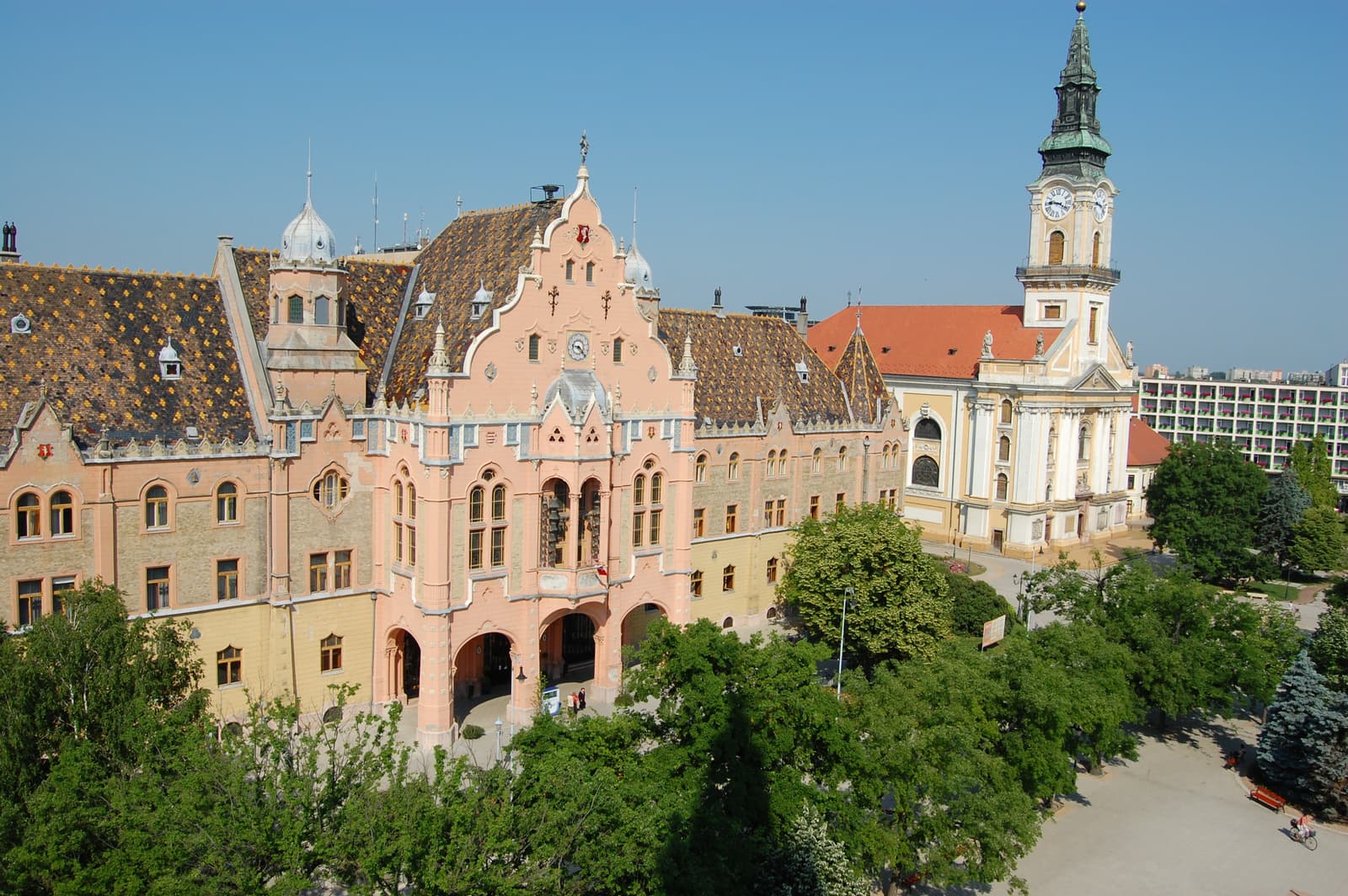 bree88 / CC BY-SA 2.5 hu, via Wikimedia Commons
“Where Art Nouveau designs meet the warmth of apricot brandy.”
Not the postcards. The stories even locals don't know — whispered in your ear, right where they happened.
The Town Hall, a masterpiece of Hungarian Art Nouveau, holds a distinct narrative within its walls, beyond its vivid Zsolnay majolica tiles.
This national museum, housed in a former synagogue, presents more than simply a collection of Hungarian photography.
The largest late Baroque cathedral in the Great Plain possesses a bell with a particularly resonant, and somewhat fiery, past.
Discover every secret of Kecskemét
Every address, every reveal in full — in your ear, right where it happened.
You pick your stops. You walk. The voice reveals what the others miss.
No tours available yet. Check back soon — we're preparing them.
Kecskemét, a city in central Hungary, offers a compelling fusion of history, culture, and singular architecture. Positioned roughly equidistant from Budapest and Szeged, it serves as the capital of Bács-Kiskun County. Often called the 'capital' of Hungarian Art Nouveau architecture, the city's downtown area is defined by its colorful, elaborate buildings.
The city's name is thought to derive from the Hungarian word 'kecske,' meaning goat, a nod to the animal depicted in its coat of arms. Beyond its architectural allure, Kecskemét is celebrated for its agricultural legacy, particularly its apricots, which are transformed into the renowned barackpálinka (apricot brandy). This regional specialty speaks to the sandy farmland surrounding the city, frequently referred to as 'the orchard of Hungary,' which yields a substantial portion of the country's fruit.
Kecskemét provides a more deliberate, immersive encounter with traditional Hungarian culture and countryside life compared to larger urban centers. It is a place where you can wander through expansive, open squares, explore lively markets, and savor local cuisine, all while experiencing a cordial, less crowded environment.
The history of Kecskemét extends back over five millennia, with evidence of settlement dating to five thousand years ago. By the 14th century, it had evolved into a privileged 'field-town' (oppidum) and a significant trade hub, officially recognized by King Louis I of Hungary in 1368. Its strategic position at the confluence of ancient trade routes contributed to its expansion, drawing merchants and artisans.
During the 16th-century Ottoman invasion, Kecskemét remained largely untouched, a rare fortune attributed to a special agreement to pay taxes directly to the Turkish pasha in Buda, granting the town protection. This allowed Kecskemét to continue its development, becoming an important agricultural center, particularly known for animal breeding. However, overgrazing in the late 18th century led to the depletion of pastures and sand movement, prompting extensive reforestation and the planting of fruit and vines.
The 19th century witnessed a significant shift towards viticulture and fruit growing, especially apricots, which became the economic foundation of the city. This era of prosperity fueled investment in the city's appearance, leading to the construction of numerous Art Nouveau buildings that define its architectural character today. While the 20th century brought challenges like the Great Depression and World War II, Kecskemét has re-emerged as a thriving city, serving as the capital of Bács-Kiskun County since 1950 and a dynamically developing industrial, commercial, and cultural center. It is also the birthplace of acclaimed composer Zoltán Kodály, for whom an internationally recognized institute of music pedagogy is named.
The origin of Kecskemét's name has been a topic of discussion for over a century, though many believe it comes from 'kecske' (goat) and 'mét' (district), referring to a place where goat breeding occurred. This theory is supported by the presence of a goat in the city's coat of arms and historical documents that refer to the city as Aegopolis, or 'Goatcity'. Another local legend connects Saint Miklós, the patron saint of merchants, with the gifting of goats to newly evangelized people.
The city's motto, 'Neither height, nor depth can frighten us,' dates back to 1809. It is linked to Erzsébet Bánffy, the 14-year-old daughter of Baron László Bánffy, who promised an embroidered silk flag to the noble bander of Kecskemét. Although the flag arrived late due to wars, her letter and the flag, bearing the motto, were preserved in the city's archive, forever linking her to Kecskemét's enduring spirit.
Kecskemét's city center is a trove of architectural splendor, primarily displaying the Art Nouveau style. The most emblematic structure is the Town Hall, a late 19th-century building designed by Ödön Lechner and Gyula Pártos, adorned with colorful Zsolnay majolica tiles. Nearby, the Katona József Theatre, an eclectic-style building from the late 19th century, stands before a 1742 Holy Trinity Column, a common Central European monument commemorating plague victims.
Another notable Art Nouveau building is the Cifrapalota (Ornamented Palace), constructed in 1902 and now home to the Kecskemét Gallery. Its glazed façade ornaments and roof tiles were also crafted by the Zsolnay factory. The former synagogue, an elegant white Moorish-style structure from 1864, now functions as the House of Science and Technics. For a deeper exploration of Hungarian culture, visit the Hungarian Photography Museum, housed in a former Orthodox Synagogue, displaying works by Hungarian artists and photographic equipment. The Leskowsky Musical Instrument Collection is the country's sole public collection of musical instruments, featuring over 2,000 pieces from various continents and eras, offering interactive experiences. Do not overlook the Great Catholic Church, the largest late Baroque cathedral in the Great Plain, with a 73-meter-high tower. For a family-friendly excursion, the Kecskemét Wildlife Garden offers a collection of 500 animals across 120 species within a shaded woodland setting.
The most agreeable times to visit Kecskemét are late spring and early autumn (April–June and September–October). During these months, temperatures remain mild, ideal for exploring the city on foot and enjoying outdoor pursuits. Summers can be warm, particularly at midday, while winters are cooler and better suited for indoor attractions. Kecskemét also hosts various cultural and folk events throughout the year, celebrating Hungarian traditions, music, and equestrian heritage. The city generally experiences moderate rainfall, with May and June being the wettest months. For warm-weather activities like those involving a beach or pool, early July to mid-August is optimal.
Kecskemét is situated approximately 86 kilometers (53 miles) southeast of Budapest. The simplest way to reach Kecskemét from Budapest is by train from Budapest Nyugati station, with hourly departures and a travel time of about 80 minutes. Second-class tickets, including a seat reservation, cost around €6. Alternatively, driving takes approximately one hour via the M5 motorway.
Once in Kecskemét, most major attractions are concentrated in the city center and are readily accessible on foot, typically within a ten-minute walk from the train station. City buses are available for destinations further afield. While knowing some basic Hungarian phrases is helpful, many people in the tourism industry speak English. The local currency is the Hungarian Forint (HUF), and credit cards are widely accepted in most establishments, though carrying some cash for smaller vendors is advisable. Accommodation options include hotels, guesthouses, and Airbnb rentals, with a hotel room typically costing from 30 EUR per day.