Gergeti Trinity Church
This iconic 14th-century church, a symbol of Georgia, once served a surprising dual purpose beyond worship.
Full story unlocks in the tour
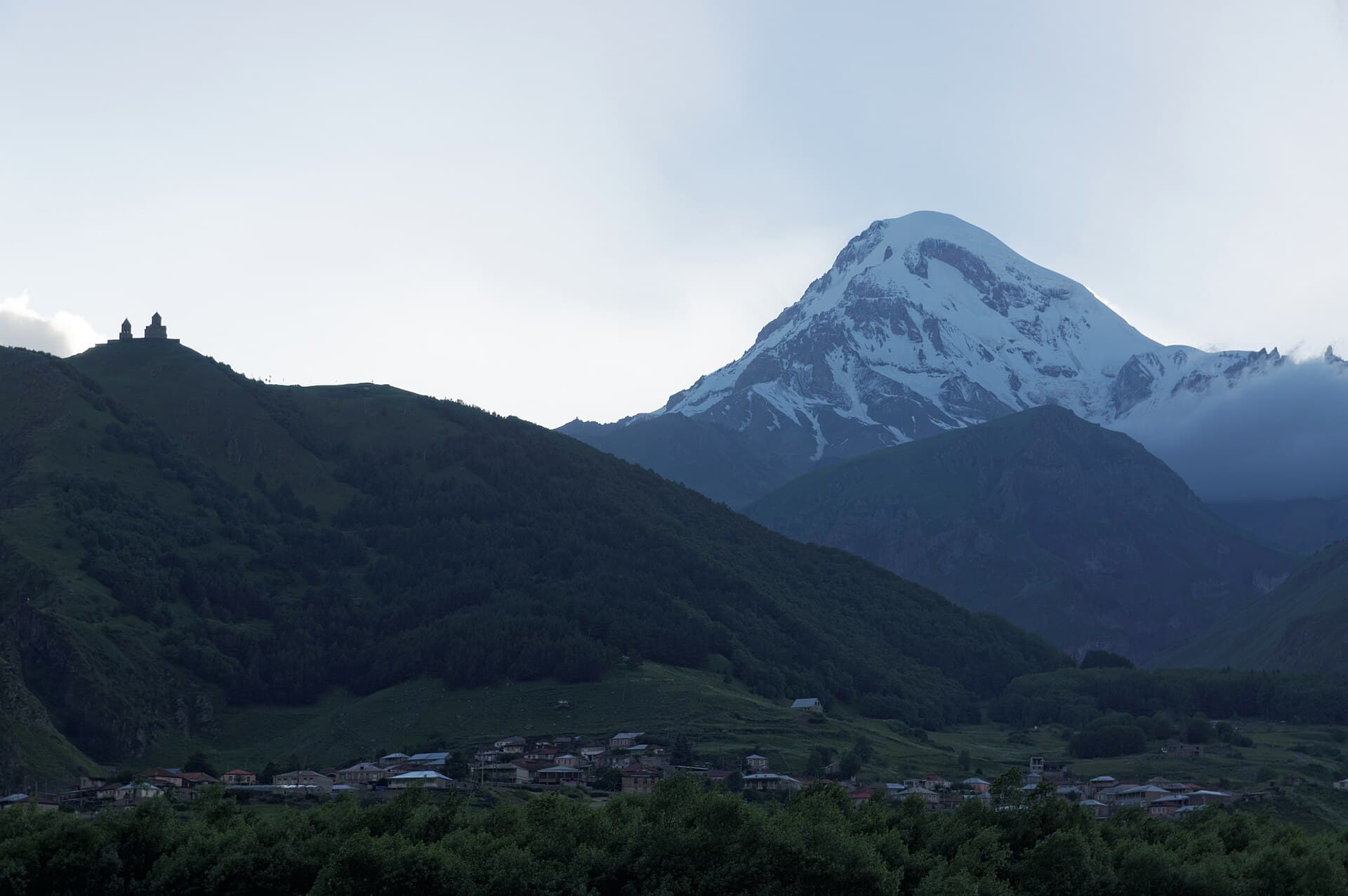 Vyacheslav Argenberg / CC BY 4.0, via Wikimedia Commons
“Where ancient legends cling to glacial peaks and quiet valleys echo with history.”
Not the postcards. The stories even locals don't know — whispered in your ear, right where they happened.
This iconic 14th-century church, a symbol of Georgia, once served a surprising dual purpose beyond worship.
The majestic Mount Kazbek, a dormant volcano, is tied to a figure from Greek mythology, but with a Georgian twist.
This dramatic mountain pass, a historical gateway between continents, was once believed to be guarded by a mythical barrier built by a famous ancient conqueror.
Discover every secret of Kazbegi
Every address, every reveal in full — in your ear, right where it happened.
You pick your stops. You walk. The voice reveals what the others miss.
No tours available yet. Check back soon — we're preparing them.
Kazbegi, officially known as Stepantsminda, is a townlet cradled in the Mtskheta-Mtianeti region of northeastern Georgia, a country that bridges Europe and Asia. It is a place where the towering peaks of the Caucasus Mountains meet lush valleys and crystal-clear rivers, creating a landscape that draws nature lovers and hikers. The town sits along the Georgian Military Highway, a historic route connecting Georgia with Russia, approximately 155 kilometers (96 miles) north of Tbilisi. While the drive from the capital takes about 3-4 hours, the journey itself offers scenic stops along the way.
Dominated by the imposing Mount Kazbek, a 5,047-meter (16,581 ft) dormant stratovolcano, Kazbegi offers a blend of spectacular mountain scenery and authentic Georgian culture. The area is a hub for outdoor activities, from trekking and mountaineering to paragliding and horseback riding. Despite its modest size, with a population of around 1,300 people, Kazbegi serves as a base for exploring the surrounding Kazbegi Municipality, which includes the Dariali Gorge, Truso Valley, and Juta Valley.
The area now known as Stepantsminda has been settled for millennia, with archaeological discoveries dating back to the 6th-5th centuries BCE. Its strategic location along one of the oldest crossroads between Europe and Asia, specifically within the Dariali Gorge, made it a significant point on ancient trade routes, including a segment of the Silk Road. This natural passage, just 11 kilometers from Stepantsminda, has been fortified since at least 150 BC, with various empires, including the Romans and Persians, recognizing its importance as a gateway.
The town's original name, Stepantsminda, meaning 'Saint Stephen,' is rooted in local legend. It is said to be named after a Georgian Orthodox monk named Stephan who, by ringing a bell, warned villagers of an approaching avalanche, saving their lives and prompting them to relocate to a safer spot. For nearly a century, from 1925 until 2006, the town was officially known as Kazbegi, named after a local feudal magnate, Kazi-Beg Chopikashvili, and later his grandson, the renowned Georgian writer Alexander Kazbegi. Despite the official reversion to Stepantsminda in 2006, the name Kazbegi remains widely used by locals and travelers alike to refer to the town, the surrounding region, and the prominent Mount Kazbek.
Throughout its history, the region has maintained a strong connection to its Orthodox Christian heritage. The Gergeti Trinity Church, a 14th-century cross-cupola church, stands as a testament to this, having served as a sanctuary for precious religious relics during invasions. During the Soviet era, religious services were prohibited, but the church remained a popular tourist destination. Today, it is an active establishment of the Georgian Orthodox and Apostolic Church. The area's enduring traditions are also reflected in local festivals like Atengenoba, Kazbegoba, and Gergetoba, which celebrate the region's culture and spiritual significance.
The main draw of Kazbegi is the dramatic natural landscape and its iconic landmarks. The Gergeti Trinity Church is a 14th-century cross-cupola church situated at an elevation of 2,170 meters (7,120 ft) beneath Mount Kazbek. It offers expansive views of the surrounding mountains and is accessible by a challenging 1.5-hour hike or a 4x4 vehicle from Stepantsminda. The church's isolated location has made it a symbol of Georgia.
Mount Kazbek, a 5,047-meter (16,581 ft) dormant stratovolcano, dominates the skyline. Known in Georgian as Mkinvartsveri, meaning 'ice-capped,' it is the third-highest peak in Georgia and a popular destination for mountaineers. The surrounding Kazbegi National Park offers diverse landscapes for exploration.
Beyond the church and mountain, explore the Dariali Gorge, a narrow defile carved by the Terek River, with sheer granite walls rising up to 1,800 meters. This historically significant pass, once known as the 'Gates of Alexander,' is part of the Georgian Military Highway and features waterfalls, including the Gveleti Waterfall. Other valleys like Truso Valley and Juta Valley offer additional hiking opportunities and scenic beauty. For a glimpse into local life and history, visit the Stepantsminda Historical Museum, housed in the memorial home of writer Aleksandre Kazbegi.
Kazbegi can be visited year-round, but the experience varies significantly by season. The best time for hiking and outdoor activities is from late spring to early autumn (May to October), when the weather is milder, and mountain trails are open. July and August are peak season, offering the warmest temperatures (average highs of 22°C/72°F) and lush green landscapes, ideal for trekking and clear views of Mount Kazbek. For fewer crowds and beautiful autumn colors, consider September and October. Winter (December to February) transforms Kazbegi into a snowy landscape, suitable for snow sports in nearby Gudauri, though some trails and roads may be closed.
Kazbegi is approximately 155-165 kilometers (96-102 miles) north of Tbilisi. The journey along the Georgian Military Highway typically takes 3-4 hours by road. Options for getting there include renting a car for flexibility, taking a marshrutka (shared minibus) from Tbilisi's Didube Bus Station, hiring a private taxi, or joining a guided tour. A private transfer with services like GoTrip can cost around 200 GEL. While a day trip from Tbilisi is possible, staying at least two nights is recommended to fully experience the area and allow for hiking. Accommodation ranges from guesthouses to boutique hotels like Rooms Hotel Kazbegi. Taxis are available for local transport, including to Gergeti Trinity Church, with a round trip costing around 60 GEL (or 15-20 GEL per person in a shared van). Pack clothing suitable for varying weather conditions, as mountain weather can change quickly.