The Well Tower
Karlštejn Castle’s water supply was a closely guarded secret, essential for its defense.
Full story unlocks in the tour
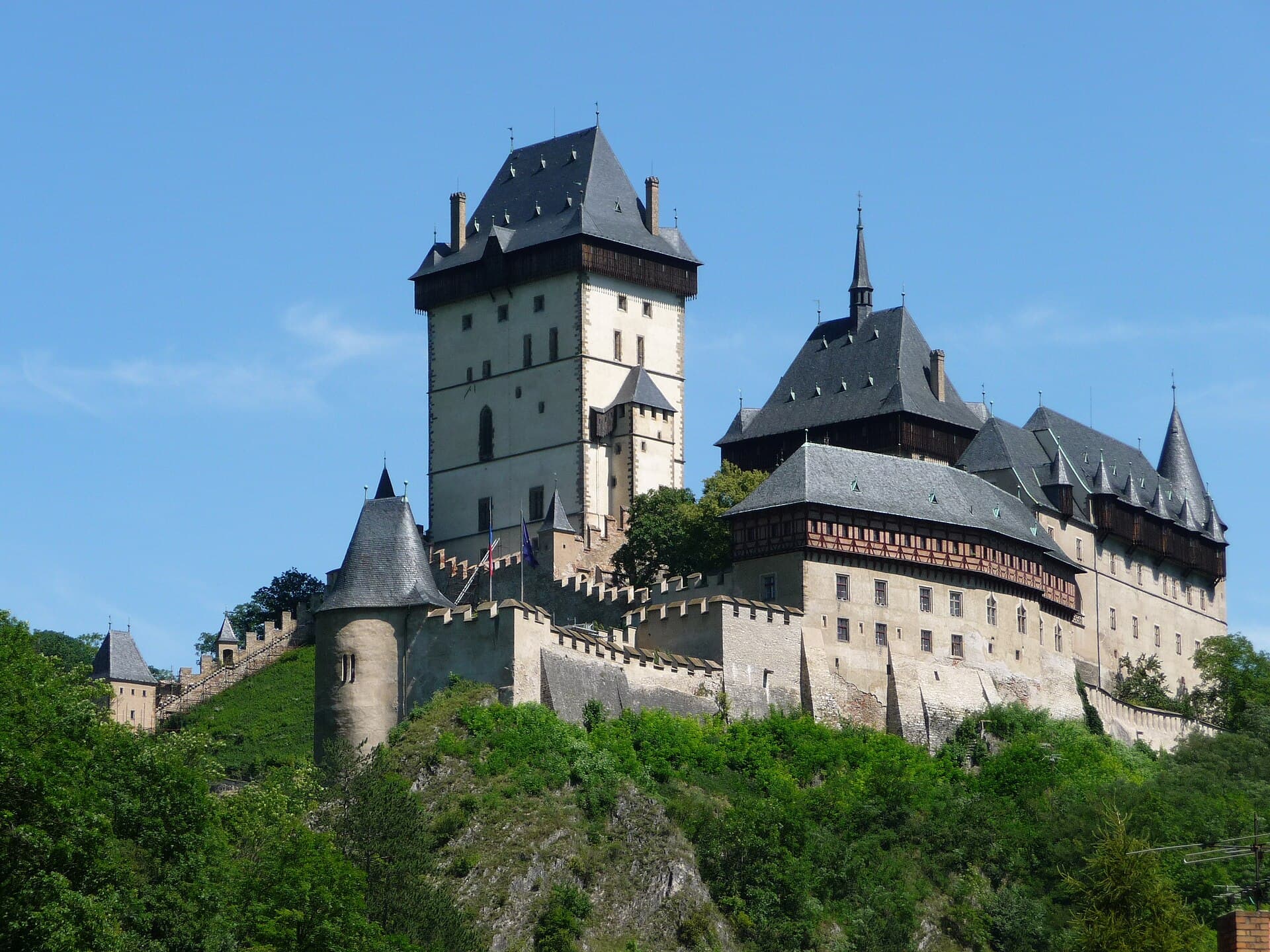 Jürgen Regel, Marian… / CC BY 3.0, via Wikimedia Commons
“A fortress built not for living, but for safeguarding the sacred.”
Not the postcards. The stories even locals don't know — whispered in your ear, right where they happened.
Karlštejn Castle’s water supply was a closely guarded secret, essential for its defense.
The most sacred space within Karlštejn Castle held unimaginable riches, protected by more than just thick walls.
Beyond its regal purpose, Karlštejn holds tales of darker human dramas.
Discover every secret of Karlštejn
Every address, every reveal in full — in your ear, right where it happened.
You pick your stops. You walk. The voice reveals what the others miss.
No tours available yet. Check back soon — we're preparing them.
Karlštejn Castle, a Gothic masterpiece, ascends from a hilltop in the Bohemian Karst, approximately 30 kilometers southwest of Prague. Founded in 1348 by Charles IV, King of Bohemia and Holy Roman Emperor, the castle was conceived not as a primary residence, but as an impenetrable vault for his most sacred possessions: the Imperial Regalia, Bohemian Crown Jewels, and a vast collection of holy relics.
The castle's distinctive tiered architecture, with its various buildings ascending in importance, reflects its singular purpose. From the Burgrave's Palace at the lowest level to the commanding Great Tower at its apex, each section served a specific function in protecting these invaluable treasures. Karlštejn remains one of the most famous and frequently visited castles in the Czech Republic, drawing hundreds of thousands of visitors annually.
Today, Karlštejn offers a tangible connection to the power and piety of Charles IV, a ruler renowned for establishing Charles University in Prague and shaping the cultural landscape of Bohemia. Its formidable presence, with thick walls and towering turrets, stands as a testament to medieval engineering and a symbol of Czech statehood.
## Founding and Purpose Karlštejn Castle was founded in 1348 by Charles IV, King of Bohemia and Holy Roman Emperor. Its primary purpose was to safeguard the Imperial Regalia, the Bohemian crown jewels, and Charles IV's extensive collection of holy relics. Charles IV personally oversaw much of the construction and interior decoration, particularly the chapels.
## Construction and Early Years The initial phase of construction focused on fortifications, economic buildings, and administrative structures, including the Well Tower and the Burgrave's House. Charles IV first resided at the castle in 1355, with the main structures largely complete or nearing completion. The monumental Great Tower, standing 60 meters (197 feet) high, was constructed between 1356 and 1365. The castle's construction culminated in 1365 with the consecration of the Chapel of the Holy Cross within the Great Tower, which became the repository for the imperial coronation treasure.
## Medieval Significance and Sieges Karlštejn continued to function as a secure treasury after Charles IV's death in 1378. During the Hussite Wars in the early 15th century, the Bohemian crown jewels were moved to Karlštejn for safekeeping. The castle withstood a seven-month siege by Hussite forces in 1422, with attackers even resorting to catapulting dead bodies and filth over the walls, but they never managed to breach its defenses. The Imperial Crown of the Holy Roman Empire was kept at Karlštejn until 1421. The Bohemian crown jewels remained there until 1619.
## Later Renovations and Modern Appearance After 1480, the castle underwent late Gothic reconstruction, followed by Renaissance-style modifications in the late 16th century. During the Thirty Years' War, the crown jewels and archives were moved to Prague in 1619, and the castle's strategic role diminished. By the 18th century, Karlštejn had fallen into disrepair. Its present appearance is largely the result of a major Gothic Revival restoration led by architect Josef Mocker between 1887 and 1899, which aimed to restore its original Gothic look.
Karlštejn Castle is a tiered complex, with its buildings arranged according to their historical significance. The journey through the castle typically begins with the lower sections, including the Burgrave's Palace and the unique Well Tower. The Well Tower, while appearing to be a traditional well, is actually a water reservoir fed by a subterranean channel from a nearby stream.
Ascending through the castle, visitors encounter the majestic five-story Imperial Palace, which once housed Charles IV's private and representative rooms. Further up is the Marian Tower, home to the Church of the Assumption of the Virgin Mary and St. Catherine's Chapel. The pinnacle of the castle is the Great Tower, a formidable defensive structure that once housed the Chapel of the Holy Cross.
The Chapel of the Holy Cross is considered the spiritual heart of the castle and is its most treasured room. It features a gilded vault with glass lenses, simulating a starry sky, and walls adorned with 129 panel paintings of saints by Master Theodoric, alongside semi-precious stones. A replica of the royal Crown of Bohemia is also on display. Views from the Great Tower extend over the surrounding Bohemian Karst landscape.
Karlštejn Castle is open from March to the end of November, typically every day except Monday. During the winter months, from November to the end of February, the castle operates on a reduced schedule, usually open Friday to Sunday for Tour 1. Special Advent tours and Christmas masses are sometimes held in December. Visiting in the shoulder seasons (spring or autumn) or on a weekday can help avoid larger crowds, especially during peak summer months. The surrounding Bohemian Karst landscape is particularly scenic in autumn or winter.
Karlštejn Castle is approximately 30 kilometers southwest of Prague. The most common way to reach it is by train from Prague's main stations (Praha hlavní nádraží or Praha-Smíchov) to Karlštejn village, a journey of about 40 minutes. From the train station, it's a 20- to 30-minute uphill walk to the castle entrance. Paid parking is available on the outskirts of Karlštejn village, about 1.4 kilometers from the castle, as driving is not permitted closer to the entrance.
All interior visits to Karlštejn Castle are by guided tour with fixed routes and scheduled entry times. There are typically two main tour routes: Tour 1, covering the Imperial Residence of Charles IV, and Tour 2, which includes the more exclusive Castle Chapels, such as the Chapel of the Holy Cross. Tour 2, being highly sought after, often sells out in advance, especially during summer, so booking online is recommended. The castle has many steps and narrow doorways, which can be challenging for visitors with reduced mobility.