St. Angelo Fort
The formidable St. Angelo Fort, a sentinel over the Arabian Sea, holds a surprising connection to a renowned European art institution.
Full story unlocks in the tour
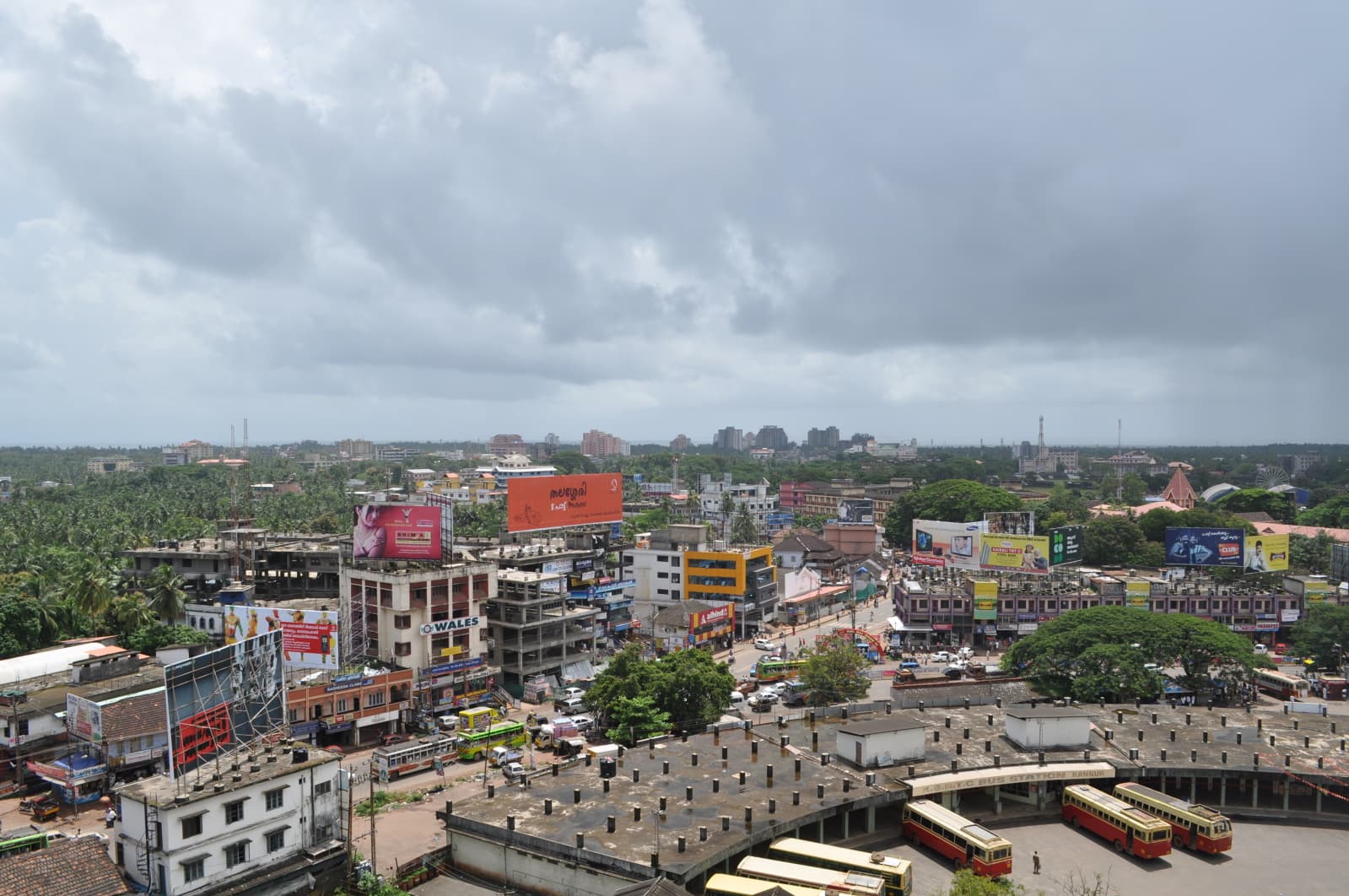 Kidu (talk) / Public domain, via Wikimedia Commons
“Where ancient rituals meet sun-kissed sands.”
Not the postcards. The stories even locals don't know — whispered in your ear, right where they happened.
The formidable St. Angelo Fort, a sentinel over the Arabian Sea, holds a surprising connection to a renowned European art institution.
At this distinctive temple, the revered deity receives an unconventional offering.
Asia's longest drive-in beach offers more than just a scenic cruise.
Discover every secret of Kannur
Every address, every reveal in full — in your ear, right where it happened.
You pick your stops. You walk. The voice reveals what the others miss.
No tours available yet. Check back soon — we're preparing them.
Kannur, historically known as Cannanore, is a coastal city in Kerala, India, often referred to as the "Land of Looms and Lores" due to its significant handloom industry and ritualistic Theyyam dance forms. Situated on the Malabar Coast, it was once a crucial port in the spice trade, drawing Arab, Dutch, Portuguese, and British settlers, whose influences are still evident in its architecture and culture.
This less-explored northern Kerala destination offers a blend of unspoiled beaches, ancient forts, and deep-rooted cultural traditions. It provides an authentic and immersive travel experience, away from more crowded tourist paths. Kannur’s particular allure lies in its ability to preserve its historical essence while gradually embracing modern developments, including its own international airport.
Kannur's story extends back to prehistoric settlements, with evidence of rock-cut caves and megalithic burial sites found in areas like Taliparamba. During the early historic period (1st–5th century CE), it formed a part of the Chera kingdom, which controlled significant trade routes along the coast, facilitating the movement of spices like pepper and fostering contact with Roman and Arab traders. Marco Polo himself referred to Kannur as a "great emporium of spice trade."
Later, Kannur became the capital of the Kolathiri Rajas, a powerful dynasty that maintained extensive trade relations with Persia and Arabia in the 12th and 13th centuries. The 17th century saw Kannur become the capital of the Arakkal, Kerala's only Muslim royal dynasty, which followed a matrilineal system where the eldest female member, known as the Arakkal Beevi, was crowned ruler. The Arakkal Museum, housed in a former palace, offers insights into this distinctive royal heritage.
The arrival of European colonial powers profoundly shaped Kannur. The Portuguese constructed St. Angelo Fort in 1505, which was later seized and modernized by the Dutch in 1663, who then sold it to the Arakkal Ali Rajas in 1772. The British eventually conquered Kannur in 1790, utilizing it as a major military station on the Malabar Coast. The region experienced significant resistance to British rule, particularly a revolt led by Pazhassi Raja between 1792 and 1806. Kannur also played a vital role in the Indian freedom movement, with Payyannur serving as a key venue for the Salt Satyagraha in Malabar in 1930. The district of Kannur was formally established on January 1, 1957, following the formation of the state of Kerala.
Kannur presents a diverse array of attractions, intertwining history, culture, and natural splendor. The commanding St. Angelo Fort, constructed by the Portuguese in the 16th century, offers expansive views of the Arabian Sea and Mappila Bay. Nearby, the Arakkal Museum, housed in a former royal palace, illuminates the heritage of Kerala's only Muslim royal family.
For those who appreciate the shore, Kannur provides several options. Payyambalam Beach is easily accessible within the city, featuring an unbroken coastline ideal for leisurely walks. A short drive south leads to Muzhappilangad Drive-in Beach, Asia's longest drive-in beach, where visitors can drive their vehicles along a four-kilometer stretch of firm sand. Other peaceful beaches like Kizhunna Ezhara Beach offer more secluded experiences.
Cultural immersion can be found at the Parassinikkadavu Sri Muthappan Temple, a distinctive religious site where dogs are revered and the deity receives unusual offerings. Kannur is also synonymous with Theyyam, a ritualistic dance form blending mythology, folklore, and spirituality, often performed in local temples between October and May. For those who appreciate nature, the Parassinikkadavu Snake Park offers an opportunity to observe various snake species.
The most favorable time to visit Kannur spans the winter months, from October to February. During this period, the climate is cool and agreeable, with temperatures typically ranging between 13°C and 25°C, and humidity remains low. This season is ideal for exploring the city, enjoying the beaches, and witnessing the Theyyam festivals, which are primarily held between November and February. While summers (March to May) can be hot and humid, and monsoons (June to September) bring substantial rainfall, winter offers the most comfortable and culturally rich experience.
Kannur International Airport (CNN) serves the city, providing domestic and international flights. The airport is approximately 25-28 km east of Kannur city. Kannur Railway Station (CAN) is a major rail hub, well-connected to other parts of Kerala and significant Indian cities like Mumbai, Chennai, and Bangalore. The station offers amenities such as waiting rooms, food stalls, and free Wi-Fi.
For road travel, Kannur is situated on National Highway 66, linking it to cities like Kozhikode and Mangalore. The Central Bus Terminal at Thavakkara is a significant hub for both long-distance and local buses, including KSRTC services, and is located near the railway station. Within the city, auto-rickshaws are a budget-friendly mode of transport, and private taxis are also available, though it's advisable to book through your hotel. Walking is generally not recommended due to traffic. When visiting temples, modest attire is required; men may need to wear a mundu and remove their shirts, while women should cover their knees and shoulders.