The Prosna River
Kalisz is often called 'Poloniae urbs vetustissima' – Poland's oldest city. But the evidence for this claim comes from an unexpected ancient source.
Full story unlocks in the tour
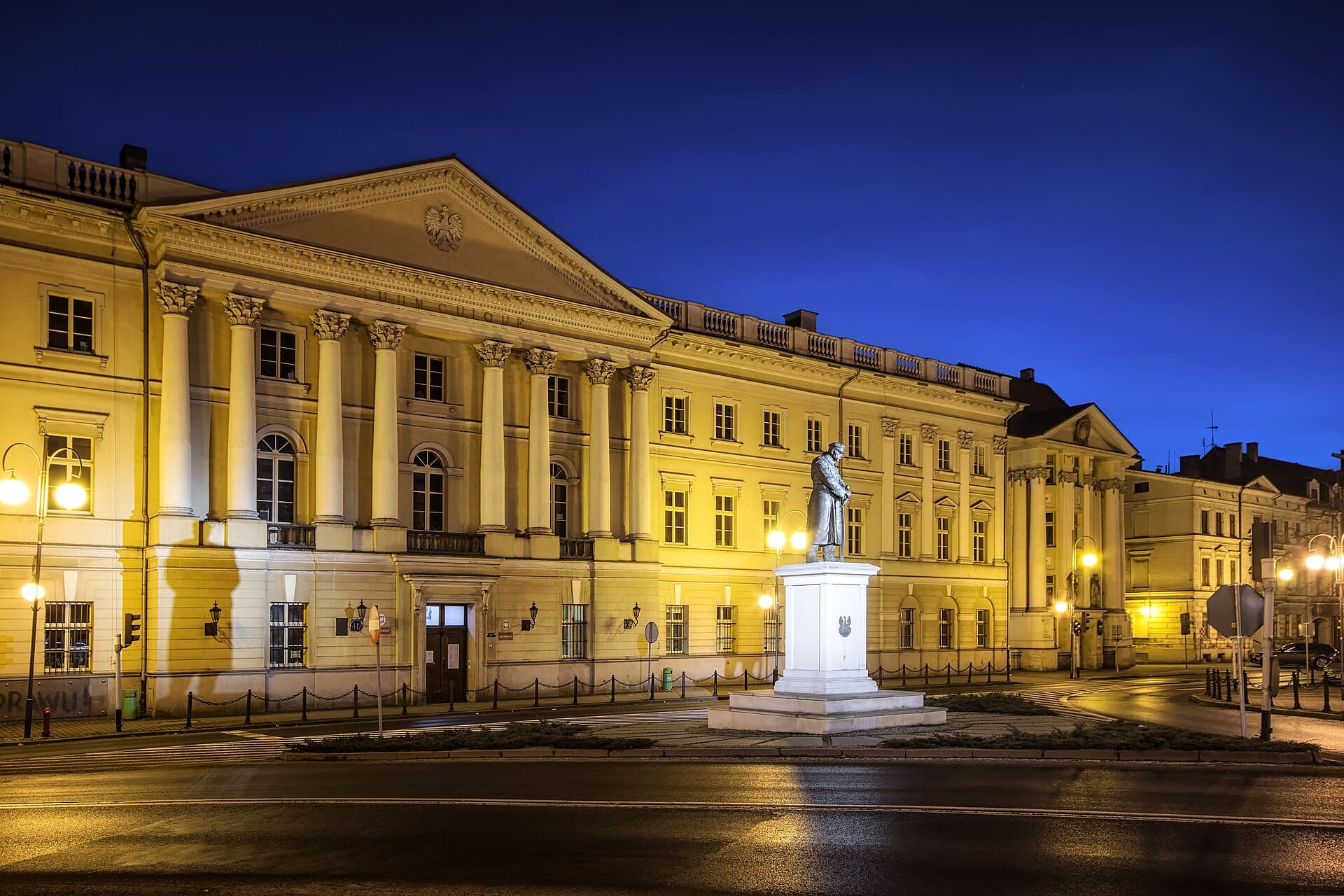 Sławomir Milejski / CC BY-SA 4.0, via Wikimedia Commons
“Where ancient echoes meet the pulse of Polish life.”
Not the postcards. The stories even locals don't know — whispered in your ear, right where they happened.
Kalisz is often called 'Poloniae urbs vetustissima' – Poland's oldest city. But the evidence for this claim comes from an unexpected ancient source.
The current layout of Kalisz's Old Town, with its distinct street grid, is surprisingly ancient.
Before Kalisz became a medieval city, it was a crucial stronghold for Poland's first ruling dynasty, the Piasts, and played a role in the spread of Christianity.
Discover every secret of Kalisz
Every address, every reveal in full — in your ear, right where it happened.
You pick your stops. You walk. The voice reveals what the others miss.
No tours available yet. Check back soon — we're preparing them.
Kalisz, the second-largest city in the Greater Poland Voivodeship, is a place where history is not merely preserved, but actively woven into the fabric of daily life. Situated on the Prosna River, it is often referred to as 'Poloniae urbs vetustissima'—the oldest city in Poland—a title it carries due to its mention by Ptolemy in the 2nd century AD. This central Polish city, with a population of around 97,905 residents as of December 2021, offers a compelling blend of historical depth and modern Polish character.
While not as frequented by international tourists as Kraków or Warsaw, Kalisz presents an authentic Polish experience, complete with a compact Old Town, a regional museum, and pleasant riverside parks. It is a city that has balanced the preservation of its historical heritage with contemporary development, offering an excellent quality of life at an accessible cost. From its medieval origins as a trading hub on the Amber Route to its later role as a significant industrial and cultural center, Kalisz invites you to uncover centuries of stories etched into its streets and structures.
The history of Kalisz extends back to the Mesolithic Era, with archaeological traces of settlement found in the Prosna river valley. Its strategic location on the ancient Amber Route, connecting the Adriatic and Baltic Seas, significantly influenced its early development. The mention of 'Kalisia' by Claudius Ptolemy around 150 AD is often cited as the earliest written record of the city, solidifying its claim as Poland's oldest documented city.
In the early Middle Ages, Kalisz was home to a significant fortified settlement at Zawodzie, crucial to the early Piast state. By 1139, it became the capital of its own duchy, with Duke Mieszko III the Old as its first ruler. The city received municipal autonomy around 1257 under the Środa Śląska Law, a local variation of the Magdeburg Law, leading to rapid growth. Kings like Casimir III the Great and Władysław II Jagiełło further contributed to its medieval prosperity.
Kalisz also holds a unique place in Jewish history; in 1264, Duke Bolesław the Pious issued the Statute of Kalisz, an unprecedented charter protecting the rights of Jews in his realm. This act of tolerance made Kalisz a sanctuary and home to one of Poland's oldest Jewish communities. Over centuries, the city's favorable location fostered a multicultural environment, attracting Germans, Greeks, Macedonians, Russians, and Ukrainians.
However, the city faced periods of decline due to epidemics, fires, and wars from the mid-17th to the late 18th century. In 1793, after the Second Partition of Poland, Kalisz came under Prussian control, then became the capital of a department in the Duchy of Warsaw in 1807, and later fell under Russian rule until 1914. Despite these shifts, Kalisz became a leading center for piano manufacturing in the 19th and early 20th centuries.
The 20th century brought immense challenges. In August 1914, during World War I, the city suffered near-total destruction by the Prussian army, with 95% of its historic center burned and its population drastically reduced. The city was painstakingly rebuilt after Poland regained independence in 1918. World War II brought further suffering, including the extermination of its significant Jewish community, which constituted about one-third of the total population. In the post-war period, Kalisz developed as an industrial, commercial, cultural, and educational hub, and since 1999, it has been a city with district rights within the Wielkopolska Province.
Begin your exploration in Kalisz's Old Town, a historical area on the right bank of the Prosna River, characterized by its trapezoidal shape and historic tenement houses. The Market Square (Rynek) is the city's heart, lined with colorful buildings and cafes, and home to the neo-classicist Town Hall, rebuilt in the 1920s. Nearby, the Cathedral Church of St. Nicholas, founded between 1253 and 1257 by Duke Bolesław the Pious, stands as the oldest church in Kalisz.
Take a stroll along the Prosna River promenade, where numerous bridges connect the city's islands, offering pleasant views and a sense of the river's historical influence. Do not miss the Wojciech Bogusławski Theatre, one of Poland's oldest continuously operating drama theaters, established in 1801. For a glimpse into the city's past, visit the Kalisz Regional Museum, which houses archaeological finds and exhibits on the area's history.
To delve deeper into Kalisz's ancient roots, head to the Zawodzie Archaeological Park, where a reconstruction of the Piast-era hillfort offers insight into the early medieval settlement. The City Park (Park Miejski), established in 1798, provides a green oasis with mature trees, paths, and ponds, ideal for relaxation.
The most pleasant time to visit Kalisz for warm-weather activities is from mid-June to early September, when average daily high temperatures are above 68°F (20°C). July is the warmest month, with an average high of 75°F (24°C). Spring (March through May) and fall offer mild weather and fewer crowds, making them ideal for sightseeing. Winters are cold and snowy, with January being the coldest month, averaging a high of 35°F (2°C) and a low of 26°F (-3°C).
Kalisz is a generally safe city with low crime rates, well-lit streets, and an efficient emergency response system. The official currency is the Polish Zloty (PLN). ATMs are widely available, and most hotels and businesses accept major credit cards. When using ATMs or making card payments, it is advisable to choose to be charged in Polish Zloty for better exchange rates.
Kalisz is well-connected by train and bus. Direct trains run from Kalisz to Warsaw, Poznań, Wrocław, and Łódź. Numerous bus routes connect Kalisz to other Polish cities and even international destinations. The closest international airport is Poznań-Ławica Airport (POZ), approximately 254 kilometers (158 miles) away, with bus and taxi services available to Kalisz. Within the city, public transportation primarily consists of buses, and walking is a pleasant way to explore the compact Old Town.