Mponeng Gold Mine
Imagine descending into the Earth for over an hour, not to reach a destination, but merely to arrive at a working environment.
Full story unlocks in the tour
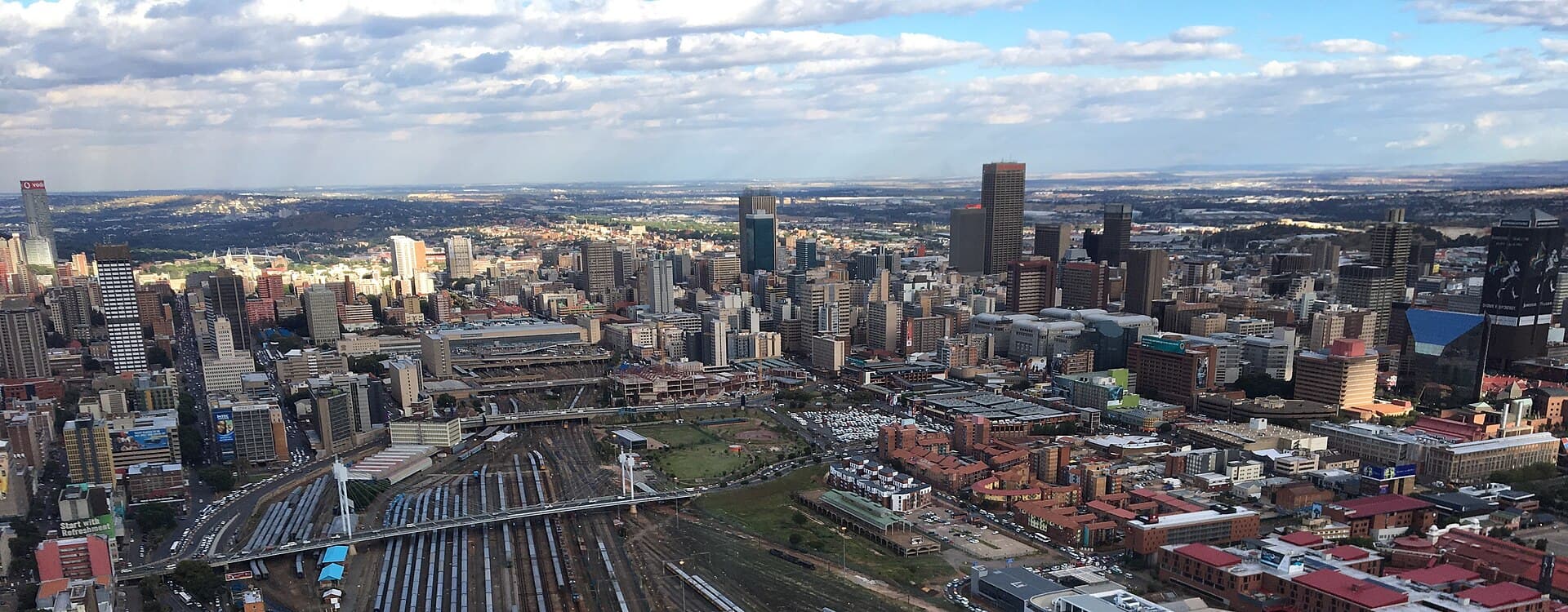 Mark Hillary / CC BY 2.0, via Wikimedia Commons
“Johannesburg: A city forged by gold, shaped by revolutionaries, and draped in a forest of its own making.”
Not the postcards. The stories even locals don't know — whispered in your ear, right where they happened.
Imagine descending into the Earth for over an hour, not to reach a destination, but merely to arrive at a working environment.
Ever wondered why your morning coffee might taste slightly different, or why boiling an egg takes a minute longer?
From the ground, they're a striking pair of cooling towers; up close, they offer a unique kind of thrill.
Discover every secret of Johannesburg
Every address, every reveal in full — in your ear, right where it happened.
You pick your stops. You walk. The voice reveals what the others miss.
No tours available yet. Check back soon — we're preparing them.
Johannesburg, affectionately known as 'Jozi,' 'Joburg,' or 'eGoli' (City of Gold), stands as South Africa's most populous city and the provincial capital of Gauteng, the nation's wealthiest province. This energetic metropolis, built upon the mineral-laden Witwatersrand, has long served as a nexus for the global mineral and gold trade. It reigns as Africa's wealthiest city by GDP and private wealth, home to the continent's largest stock exchange. Johannesburg is a city of intriguing contrasts, where the echoes of its gold rush origins intertwine with a lively contemporary culture, making it a compelling destination for those seeking to understand modern South Africa.
Unlike many major urban centers, Johannesburg does not sit beside a grand river, expansive lake, or ocean coastline; its very existence stems purely from the gold unearthed beneath the Witwatersrand in 1886. Despite its sprawling urban footprint, it is widely considered the largest human-made forest in the world, with over 10 million trees crafting a surprisingly verdant landscape. This singular fusion of natural and urban elements, coupled with a flourishing arts scene, diverse culinary offerings, and significant historical landmarks, ensures Johannesburg continually surprises and engages its visitors.
The story of Johannesburg begins in 1886 with the discovery of the world's most abundant gold reef on the Witwatersrand by Australian prospector George Harrison. This ignited an unparalleled gold rush, transforming the desolate veld into a bustling tented mining camp almost overnight. Within a decade, the population swelled to over 100,000, and by 1896, it had already become the largest city in South Africa. The city's swift expansion led to its official establishment as a village overseen by a Health Committee in 1886, evolving into a municipality by 1898.
Early in the 20th century, Johannesburg played a crucial role in the Second Boer War (1899–1902), after which the Transvaal region, where the city is located, came under British administration. Following the conflict, a new wave of migrants, including 60,000 Chinese laborers, arrived to revitalize the mines. The 1930s saw significant building developments after South Africa abandoned the gold standard, and by 1928, Johannesburg officially achieved city status.
The mid-20th century brought the profound impact of apartheid. During the 1950s and early 1960s, the apartheid government enforced policies of racial segregation, resulting in the forced relocation of Black populations to designated areas known as townships, with Soweto emerging as the most prominent. Johannesburg became a microcosm of the nation's struggle against racial discrimination, a period that deeply shaped its social and political landscape. Revered figures like Nelson Mandela and Archbishop Desmond Tutu, both Nobel Peace Prize winners, once resided on Vilakazi Street in Soweto, a testament to the area's historical weight in the pursuit of justice.
Today, Johannesburg stands as a diverse, forward-thinking, and energetic city, a testament to South Africa's journey towards democracy and a showcase for activism and optimism. It functions as the economic heart of South Africa and is home to the Constitutional Court, the nation's highest judicial body, situated on Constitution Hill, a former prison complex that now symbolizes the country's dedication to justice. The city's ongoing urban regeneration, particularly evident in areas like Maboneng, reflects its dynamic evolution and lively cultural scene.
To truly comprehend Johannesburg, a visit to the Apartheid Museum is vital. Its interactive exhibits powerfully recount South Africa's history of racial segregation and the arduous journey to freedom. Nearby, Constitution Hill offers a poignant window into the country's past as a former prison complex that now houses the Constitutional Court. Guided tours provide profound insights into its significance.
No journey to Johannesburg is complete without exploring Soweto (South Western Townships). Consider a guided tour, ideally with a local, to visit landmarks such as Vilakazi Street, the only street in the world where two Nobel Peace Prize winners, Nelson Mandela and Archbishop Desmond Tutu, once lived. The Hector Pieterson Memorial commemorates the 1976 Soweto Uprising and serves as a crucial stop.
For a glimpse into the city's origins, wander through the Mining District, an open-air museum centered around Main Street, which has housed the city's mining headquarters since its inception. The Maboneng Precinct offers a contemporary contrast with its lively street art, galleries, and culinary offerings. For recreation, consider the Johannesburg Botanical Gardens and Emmarentia Dam, or an exciting visit to Gold Reef City Theme Park, which also delves into the gold rush era.
Johannesburg experiences a subtropical highland climate, characterized by mild, sunny winters and warm, often thundery, summers. The shoulder seasons of autumn (March to May) and spring (September to November) are generally considered the most favorable times for a visit. During these months, temperatures are pleasant, ranging from 15°C to 25°C (59°F to 77°F), with less rainfall. Spring is particularly lovely as the jacaranda trees blossom, painting the city in shades of purple. While summer (December to February) brings warmth and lively festivals, it is also the rainy season with frequent afternoon thunderstorms. Winter (June to August) is dry and sunny during the day but can become quite cold at night, with temperatures sometimes dipping to freezing.
Johannesburg is an expansive city, and while public transport is improving, driving often proves the most practical way to navigate. The Gautrain offers a swift and efficient rail link from O.R. Tambo International Airport to key areas such as Sandton and Rosebank. Ride-hailing applications like Uber are also widely available.
Safety is a common consideration, but by exercising sensible precautions, you can enjoy a wonderful visit. Avoid displaying valuables, remain aware of your surroundings, and plan your routes in advance. It is advisable to use reputable tour operators for township visits and to avoid walking alone at night. The local currency is the South African Rand (ZAR), divided into 100 cents. Credit and debit cards are broadly accepted, but carrying some cash for smaller businesses or gratuities is a good practice.