Janaki Mandir
The grand Janaki Mandir, a marvel of architecture, is said to have cost a fortune to build. But the name 'Nau Lakha Mandir' hints at a specific, almost unbelievable sum.
Full story unlocks in the tour
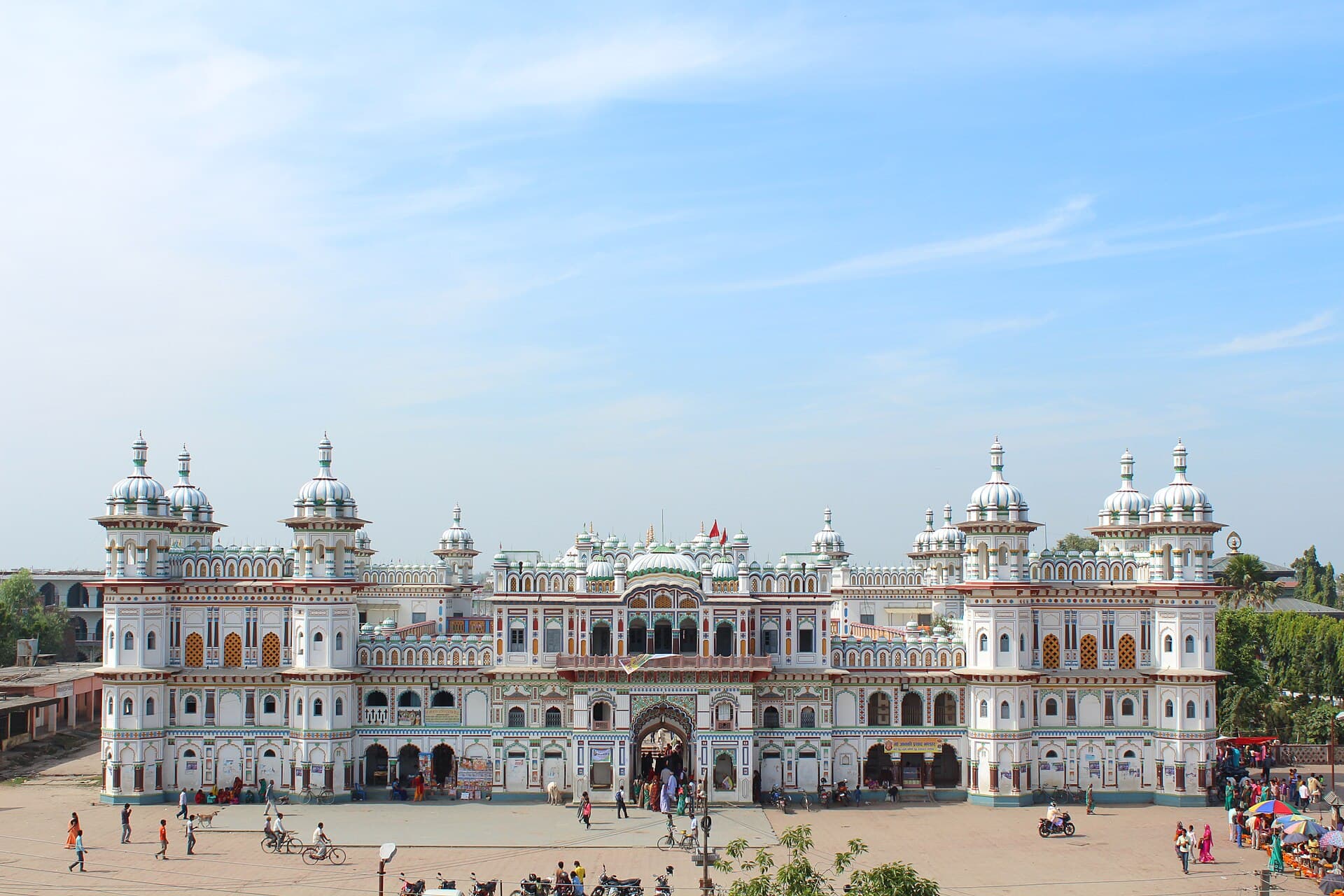 Abhishek Dutta (https://abhishekdutta.org) / CC BY-SA 3.0, via Wikimedia Commons
“Where ancient epics breathe in lively hues.”
Not the postcards. The stories even locals don't know — whispered in your ear, right where they happened.
The grand Janaki Mandir, a marvel of architecture, is said to have cost a fortune to build. But the name 'Nau Lakha Mandir' hints at a specific, almost unbelievable sum.
Among Janakpur's many sacred ponds, Dhanush Sagar holds a unique origin story, tied directly to a pivotal moment in the Ramayana.
The royal household of Thailand maintains a surprising, centuries-old connection to Janakpur, rooted in a specific, sweet tradition.
Discover every secret of Janakpur
Every address, every reveal in full — in your ear, right where it happened.
You pick your stops. You walk. The voice reveals what the others miss.
No tours available yet. Check back soon — we're preparing them.
Janakpur, often called Janakpurdham, is a city in Nepal's Terai plains that feels like stepping into a living epic. It is a significant pilgrimage destination for Hindus, revered as the birthplace of Goddess Sita and the location of her marriage to Lord Rama, central figures in the ancient Hindu epic, the Ramayana.
The city is the heartland of Mithila culture, a tradition expressed through unique art, language, music, and cuisine. Unlike the bustling mountain cities of Nepal, Janakpur offers a distinct 'Indian' feel, with its flat plains, numerous sacred ponds, and a slower pace of life. It's a place where ancient rituals blend seamlessly with daily routines, offering an authentic cultural experience away from more frequented tourist hubs.
Janakpur's history stretches back to the ancient Kingdom of Videha, also known as Mithila, which flourished in the first millennium BCE. According to Vedic texts and legends, the city was named after the philosopher-king Janaka, who ruled this region. The most profound historical references to Janakpur appear in the Hindu epic Ramayana, which describes it as the birthplace of Goddess Sita, King Janak's daughter, and the site of her marriage to Lord Rama.
Ancient Janakpur was not only a political capital but also a recognized center of intellectual life. King Janaka's court was renowned for its patronage of sages and philosophers, where theological discussions laid the groundwork for Vedic philosophy. The unique cultural tradition of Mithila art, characterized by colorful geometric patterns and scenes from epics, also originated in this region, with women traditionally decorating their homes.
While its ancient roots are full of mythology, modern Janakpur's documented history traces back to the early 18th century. It is believed that in 1657, the ascetic Hindu saint Sannyasi Shurkishordas rediscovered golden statues of Sita and Rama at this site, leading to a revival of pilgrimage and the eventual restoration of the city. The city expanded into a commercial center and became the capital of Dhanusha District in the 1960s.
The most iconic structure in Janakpur, the Janaki Mandir, was built much later, in 1910, by Queen Vrisha Bhanu Kunwari of Tikamgarh, India. This magnificent temple, dedicated to Goddess Sita, stands as a testament to the city's enduring spiritual importance. Today, Janakpur is the capital of Madhesh Province and continues to be a central hub for the Maithili language and for religious and cultural tourism in Nepal. Its candidacy for a UNESCO World Heritage nomination underscores its global cultural value.
The primary attraction in Janakpur is the Janaki Mandir, a grand, three-storied white marble temple dedicated to Goddess Sita. Its architecture blends Mughal and Koiri styles, with intricate carvings and decorations. Admission to the temple is free, though there is a small fee for the adjacent museum, which displays Ramayana artwork.
A short walk from Janaki Mandir is the Ram Sita Bibaha Mandap, a modern pagoda-style structure commemorating the marriage of Rama and Sita. Nearby, the Ram Mandir, built in 1792, is Janakpur's oldest temple, featuring a distinct pagoda design.
Janakpur is known as 'The City of Ponds,' with numerous sacred water bodies. Dhanush Sagar and Ganga Sagar are two significant ponds where pilgrims perform ritual ablutions and participate in ceremonies. These ponds offer peaceful settings, especially at sunset.
Beyond the temples and ponds, explore the Old Janakpur Bazaar for a glimpse into the city's commercial and social life. Janakpur is also a center for Mithila art, a traditional form of painting. You can see this artwork on walls and find handmade items in local markets, reflecting stories from mythology and daily life.
For a unique experience, consider visiting the Janakpurdham Railway, Nepal's only operational railway, which connects to India. While tickets for non-Nepalis may not always be available, it offers a glimpse into local transportation and history.
The best time to visit Janakpur is during the cooler, drier months from October to March. Temperatures are moderate, ranging from 10°C to 25°C, making it comfortable for sightseeing and outdoor activities. This period also offers clear skies, enhancing the overall travel experience.
Consider visiting during major festivals like Sita Bibaha Panchami (November–December) or Rama Navami (April–May) for a truly immersive cultural experience. However, be prepared for larger crowds and book accommodation in advance during these times.
Janakpur is accessible by air and road. Daily flights from Kathmandu to Janakpur Airport take approximately 30-40 minutes. Buses and private vehicles are also available from Kathmandu, though the journey is considerably longer (around 10-12 hours). There is also a railway connection from Jaynagar, India, to Janakpur.
Within Janakpur, cycle-rickshaws, auto-rickshaws, and bicycles are common modes of transport, and many sites are walkable. Modest dress is essential, especially when visiting temples; ensure shoulders and knees are covered, and remove shoes before entering religious sites. While Maithili is the local language, Nepali and Hindi are widely understood, and English is spoken in hotels and tourist areas. The local currency is the Nepali Rupee (NPR), and Indian Rupees are also widely accepted. ATMs are available but can be unreliable, so carrying sufficient cash is advisable.