Hagia Sophia
This architectural wonder has undergone more transformations than many cities themselves.
Full story unlocks in the tour
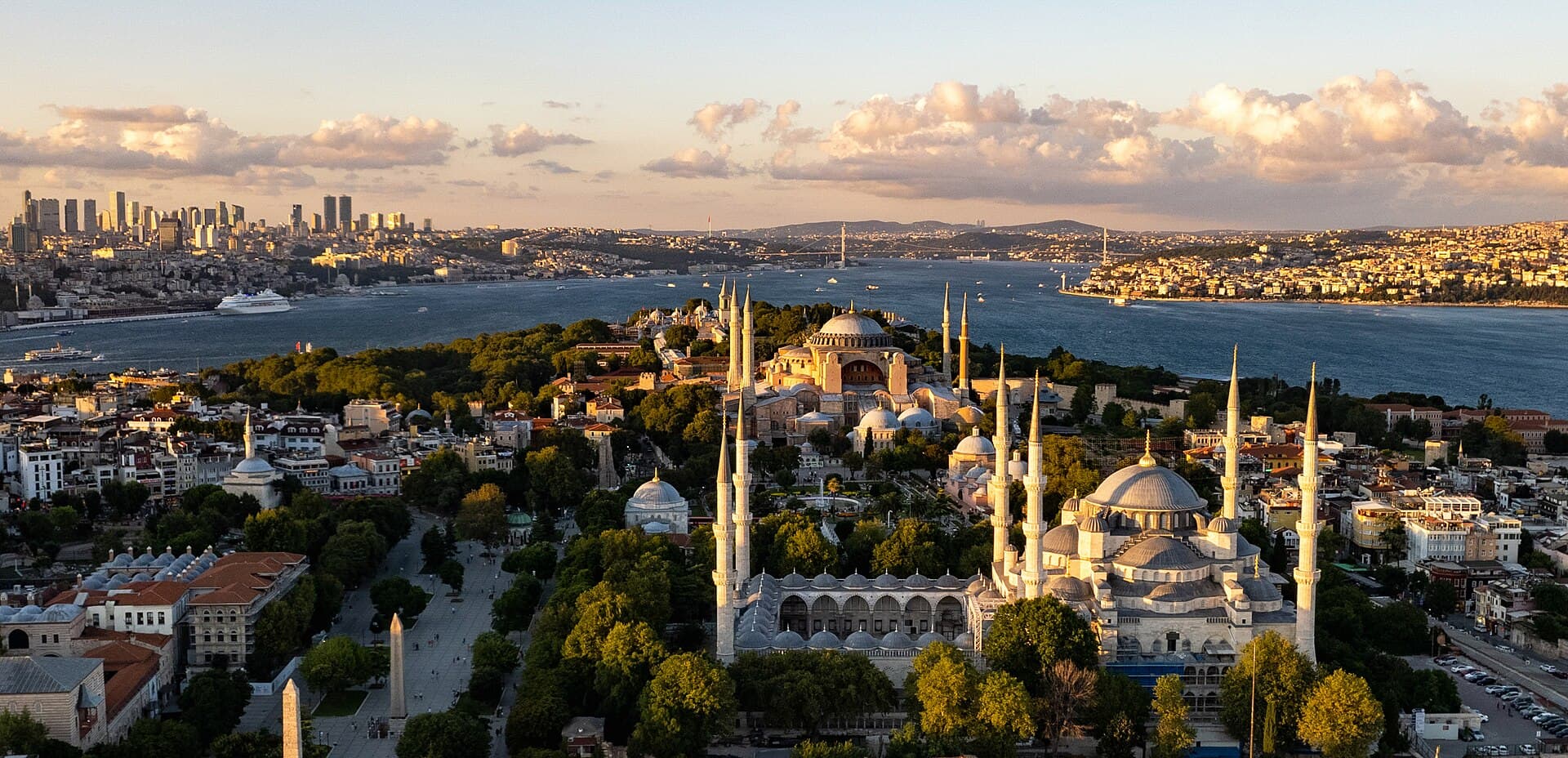 Hunanuk / CC0, via Wikimedia Commons
“Where continents converge and ancient legacies endure.”
Not the postcards. The stories even locals don't know — whispered in your ear, right where they happened.
This architectural wonder has undergone more transformations than many cities themselves.
Beneath these vaulted ceilings, an unexpected origin story connects this ancient marketplace to a globally cherished flower.
This prominent tower has fulfilled many roles, but one of its earliest functions involved a very particular kind of resident.
Discover every secret of Istanbul
Every address, every reveal in full — in your ear, right where it happened.
You pick your stops. You walk. The voice reveals what the others miss.
No tours available yet. Check back soon — we're preparing them.
Istanbul, a city unlike any other, stretches across two continents—Europe and Asia—separated by the Bosphorus Strait. This singular geographical position has shaped a metropolis that is a lively mosaic of cultures, histories, and customs. From the moment you arrive, Istanbul awakens all your senses: the echoing call to prayer, the scent of spices in lively bazaars, the intricate designs of ancient mosaics, and the constant hum of a city that has been a crossroads for millennia.
Once the capital of the Roman, Byzantine, and Ottoman Empires, Istanbul's layered past is evident in its monumental architecture, from grand mosques to imperial palaces. It's a place where ancient wonders stand alongside contemporary life, where a tranquil ferry ride can transport you from one continent to another in minutes, revealing sweeping views of a skyline punctuated by domes and minarets. Whether you are drawn to its profound history, its dynamic markets, or its culinary delights, Istanbul promises an absorbing experience that lingers long after your departure.
The story of Istanbul begins around 660 BCE when Greek settlers from Megara established Byzantium on the Sarayburnu promontory. This early settlement, strategically positioned along the Bosphorus, swiftly developed into a prosperous port. The city briefly fell under Persian dominion before being reclaimed by the Greeks during the Greco-Persian Wars.
Byzantium later came under Roman influence around 146 BCE. Its fortunes varied under Roman rule; Emperor Septimius Severus even leveled the city to its foundations in 196 CE before rebuilding it, adding structures like the Hippodrome. The city's crucial transformation occurred in 330 CE when Roman Emperor Constantine the Great re-established it as Constantinople, making it the capital of the Roman Empire. It was conceived to mirror Rome, even being constructed on seven hills.
For nearly 16 centuries, Constantinople served as the capital for four empires: the Roman Empire (330–395), the Eastern Roman (Byzantine) Empire (395–1204 and 1261–1453), the Latin Empire (1204–1261), and the Ottoman Empire (1453–1922). This era saw the city become instrumental in the advancement of Christianity, with Hagia Sophia serving as the principal church of the Eastern Orthodox Church for almost a millennium.
In 1453, the Ottoman Empire conquered the city, transforming it into an Islamic stronghold and its capital in 1457. Under Ottoman rule, particularly during the reign of Süleyman the Magnificent, Istanbul experienced a golden age of military success, economic prosperity, and cultural brilliance. The city became an international center, welcoming diverse communities of Christians, Greeks, Armenians, and Jews. Although Ankara became the capital of the Republic of Turkey in 1923, Istanbul remains the country's economic, cultural, and historical core.
Begin your journey in Sultanahmet, the historic heart of Istanbul. Here, the Hagia Sophia Grand Mosque, a monumental architectural wonder that has served as a church, mosque, and museum, enthralls with its immense dome and layered past. Directly across stands the Blue Mosque (Sultan Ahmed Mosque), recognized for its six minarets and the exquisite blue tiles that adorn its interior. Nearby, descend into the expansive, atmospheric Basilica Cistern, an ancient underground water reservoir.
Cross the Galata Bridge to the Beyoğlu district, where the medieval Galata Tower offers sweeping city views. Walk along İstiklal Avenue, a lively pedestrian street lined with historic buildings, shops, and cafes. For a sensory experience, explore the Grand Bazaar, one of the world's oldest and largest covered markets, and the fragrant Spice Bazaar. Consider a Bosphorus cruise to observe Istanbul's skyline from the water, bridging two continents.
The most pleasant times to visit Istanbul are during the spring (April to May) and autumn (September to October/November). During these shoulder seasons, the weather is comfortably mild, with average temperatures ranging from 15-25°C (59-77°F), and the city sees fewer visitors than in summer. Spring brings blooming tulips and lively festivals, while autumn offers crisp air and a rich cultural calendar. Summer (June to August) is hot and humid, with temperatures reaching 28-30°C (82-86°F), making it suitable for Bosphorus cruises and outdoor dining, though crowds are at their peak. Winter (December to March) is colder, with occasional snow and rain, but provides a quieter, more economical experience.
Navigating Istanbul is straightforward with its extensive public transportation network, including metro, tram, ferry, and bus lines. The Istanbulkart, a magnetic card, is essential for all public transport and can be acquired at airports, metro stations, and ferry terminals. The T1 tram line is particularly useful for reaching significant historical sites like Hagia Sophia and the Grand Bazaar. Taxis are available, but ensure the meter is operating to prevent overcharging, or utilize ride-hailing applications.
When visiting religious sites like mosques, modest attire is required; women should cover their heads and shoulders, and both men and women should cover their knees. Footwear must be removed before entering mosques. Minor theft can occur in crowded tourist areas, so keep personal items secure. Always carry a form of photographic ID, as it is legally mandated in Turkey.