Isernia La Pineta Archaeological Site
Imagine a place in Europe where humans lived 700,000 years ago, not just leaving tools, but evidence of their daily lives.
Full story unlocks in the tour
 TheFab4 / CC BY-SA 3.0, via Wikimedia Commons
“Where ancient echoes meet mountain air.”
Not the postcards. The stories even locals don't know — whispered in your ear, right where they happened.
Imagine a place in Europe where humans lived 700,000 years ago, not just leaving tools, but evidence of their daily lives.
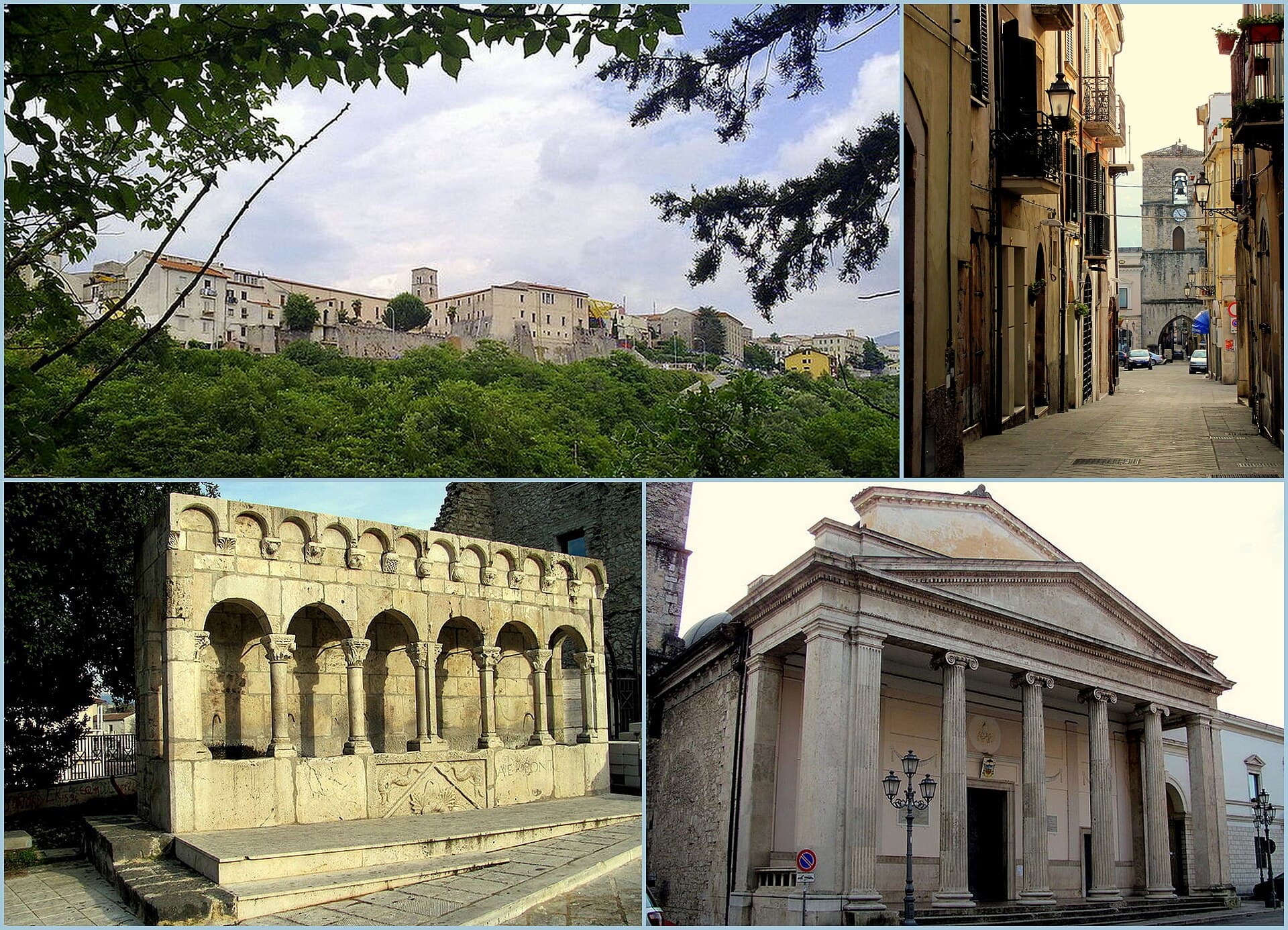
This 13th-century fountain in Isernia's historic center tells a story not just of medieval craftsmanship, but of ancient Roman reuse.
Beneath the neoclassical facade of Isernia's main cathedral lies a much older, pagan secret.
Discover every secret of Isernia
Every address, every reveal in full — in your ear, right where it happened.
You pick your stops. You walk. The voice reveals what the others miss.
No tours available yet. Check back soon — we're preparing them.
Isernia, the capital of its namesake province in Italy's Molise region, invites a journey through millennia of human history. Resting on a rocky ridge between the Carpino and Sordo rivers, the city's layout still echoes its ancient Roman origins, with Corso Marcelli as its central thoroughfare and side streets branching off at right angles. This provincial capital, though modest in scale, offers a quiet escape from more frequented tourist destinations, encouraging visitors to peel back its layers of time.
The Molise countryside, with its gentle hills, open meadows, and oak woods, deepens Isernia's allure for those seeking both cultural immersion and the quiet of nature. From archaeological marvels reaching back to the Paleolithic era to medieval architecture and enduring artisanal traditions, Isernia delivers an authentic Italian experience.
Isernia's narrative begins in the Paleolithic era, with evidence of human presence dating back approximately 700,000 years at the Isernia La Pineta site, making it one of Europe's most significant prehistoric discoveries. The region was home to the Samnites, an ancient Italic people, before falling under Roman control in 263 BC. Known as Aesernia, it became a Roman colony in 264 BC, serving as a vital connection between southern Italy and the mountains.
Through its long history, Isernia has endured numerous periods of destruction. The Roman general Sulla severely damaged it in 88 BC after the Social War, and later the Saracens ravaged it in 800 AD. Earthquakes in 847, 1349, 1456, and 1805 caused extensive damage, necessitating repeated rebuilding efforts for structures like the Cathedral. In 1199, Markward of Anweiler, Count of Molise, sacked the city, and in 1223, Frederick II's soldiers set it ablaze. Despite these formidable challenges, Isernia persevered, becoming a royal city in 1743.
The city also suffered heavy Allied bombing during World War II, particularly on September 10, 1943, which resulted in thousands of deaths and leveled the city center. In 1970, Isernia became the capital of its own province, carved from a portion of Campobasso province. Today, the city retains its historic appeal, with visible Roman and medieval influences woven into its fabric, alongside a more contemporary quarter.
Begin your exploration in Isernia's historic center, where the ancient Roman grid plan remains clear. A prominent landmark is the Fontana Fraterna, a 13th-century monumental fountain crafted from repurposed Roman stone slabs, featuring six water jets and an elegant portico. Nearby, the Cathedral of San Pietro Apostolo stands on the site of a 3rd-century BC Italic pagan temple, its neoclassical facade concealing centuries of reconstruction due to earthquakes.
For a deeper understanding of prehistory, visit the National Museum of Paleolithic in Isernia. This museum displays artifacts from the Isernia La Pineta site, one of Europe's most important Paleolithic discoveries, with casts of original archaeological layers, stone tools, and animal remains dating back over 600,000 years. The Santa Maria delle Monache Archaeological Museum, housed in a former Benedictine convent, also exhibits finds from the La Pineta site and other Roman artifacts.
Beyond the city, consider a trip to the Abbey Complex of San Vincenzo al Volturno, a monumental site revealing the archaeological remains of an ancient monastery. For those who enjoy the outdoors, the Tibetan suspension bridge in Roccamandolfi provides expansive views over the Callora river canyon.
The most agreeable times to visit Isernia are during spring (April to June) and autumn (September to October). In these months, the weather is mild and comfortable for exploring historical sites and engaging in outdoor activities like hiking. Summers (July and August) are warm and suitable for outdoor pursuits, with average high temperatures around 27°C (81°F) in August, though it can also be quite hot. Winters (November to March) are cold, with average high temperatures as low as 8°C (46°F) in February, and the region experiences considerable rainfall, with November being the wettest month.
Isernia is reachable by car, with connections to major Italian cities. While Molise is one of Italy's least populous regions, making it ideal for those seeking a less crowded experience, public transport options might be more limited compared to larger urban centers. Within the city, the historic center is walkable, with many attractions easily accessed on foot. Local cuisine emphasizes simplicity and authenticity, with traditional dishes featuring grain, vegetables, pork, and lamb. Seek out specialties like cavatelli (potato and flour dumplings) with tomato and pork, and laganelle (a type of lasagna) with beans. The region is also known for its white and black truffles and Tintilia del Molise red wine. Accommodations range from guesthouses to hotels, providing a base for exploring the city and its surrounding natural beauty.