Casa de Fierro
An iron house, seemingly plucked from a Parisian street, stands incongruously in the heart of the Amazon jungle.
Full story unlocks in the tour
 LLs / CC BY-SA 4.0, via Wikimedia Commons
“Where the Amazon's pulse meets an urban hum, accessible only by river or sky.”
Not the postcards. The stories even locals don't know — whispered in your ear, right where they happened.
An iron house, seemingly plucked from a Parisian street, stands incongruously in the heart of the Amazon jungle.
In a city where roads are scarce, there's a bustling market where some vendors literally sell their wares from floating platforms.
Imagine a city of nearly half a million people that you can only reach by plane or boat.
Discover every secret of Iquitos
Every address, every reveal in full — in your ear, right where it happened.
You pick your stops. You walk. The voice reveals what the others miss.
No tours available yet. Check back soon — we're preparing them.
Iquitos, the capital of Peru's Loreto Region, is a singular metropolis, an urban expanse carved from the Amazon rainforest's heart. With a population nearing half a million, it stands as the largest city globally unreachable by road, its lifeline inextricably tied to the great Amazon River and its tributaries. This singular isolation has fostered a distinct culture, where the sounds of mototaxis (three-wheeled motorcycles) fill the streets, and the rhythm of riverboats dictates daily life.
Often called the 'Capital of the Peruvian Amazon' or 'The Amazonian Island,' Iquitos is a crucial gateway for adventurers seeking to explore the unparalleled biodiversity of the Amazon basin. From its active markets to its European-influenced architecture, the city offers a captivating blend of history, commerce, and wild nature, serving as a springboard for expeditions into one of the world's most biodiverse ecosystems.
The history of Iquitos is a compelling narrative shaped by its remote Amazonian setting and periods of intense economic transformation. The area was originally inhabited by indigenous peoples, including the Napeano and Iquito tribes, who lived as nomadic hunter-gatherers along the rivers. Spanish historical documents indicate that Iquitos was established around 1757 as San Pablo de Napeanos, a Jesuit mission aimed at gathering and converting local indigenous populations.
Iquitos officially became a river port and the capital of the Loreto region in 1864, a designation that foreshadowed its dramatic growth. The city's most significant transformation occurred during the Amazon rubber boom, spanning roughly from the 1880s to 1912. The global surge in demand for rubber, fueled by the burgeoning automobile and industrial sectors, brought immense wealth to Iquitos. Rubber barons, many of whom were European, invested heavily, importing materials and even entire architectural styles from Europe, earning Iquitos the moniker 'Paris of the Jungle.' This era saw the construction of opulent mansions and notable structures like the Casa de Fierro, a prefabricated iron house.
However, this prosperity came at a steep cost, as indigenous populations were often subjected to brutal exploitation and forced labor in the rubber extraction process. The boom eventually collapsed around 1912 when rubber tree seeds were smuggled out of the Amazon, leading to the establishment of more cost-effective plantations in Asia. Iquitos faced a period of decline, with many steamboats abandoned. Yet, the city adapted, continuing as an important trading port, leveraging its timber, oil, and mineral resources, alongside agriculture. In the 1960s, Iquitos emerged as a trailblazer for Amazonian tourism, a role it maintains today as a primary base for exploring the Peruvian Amazon.
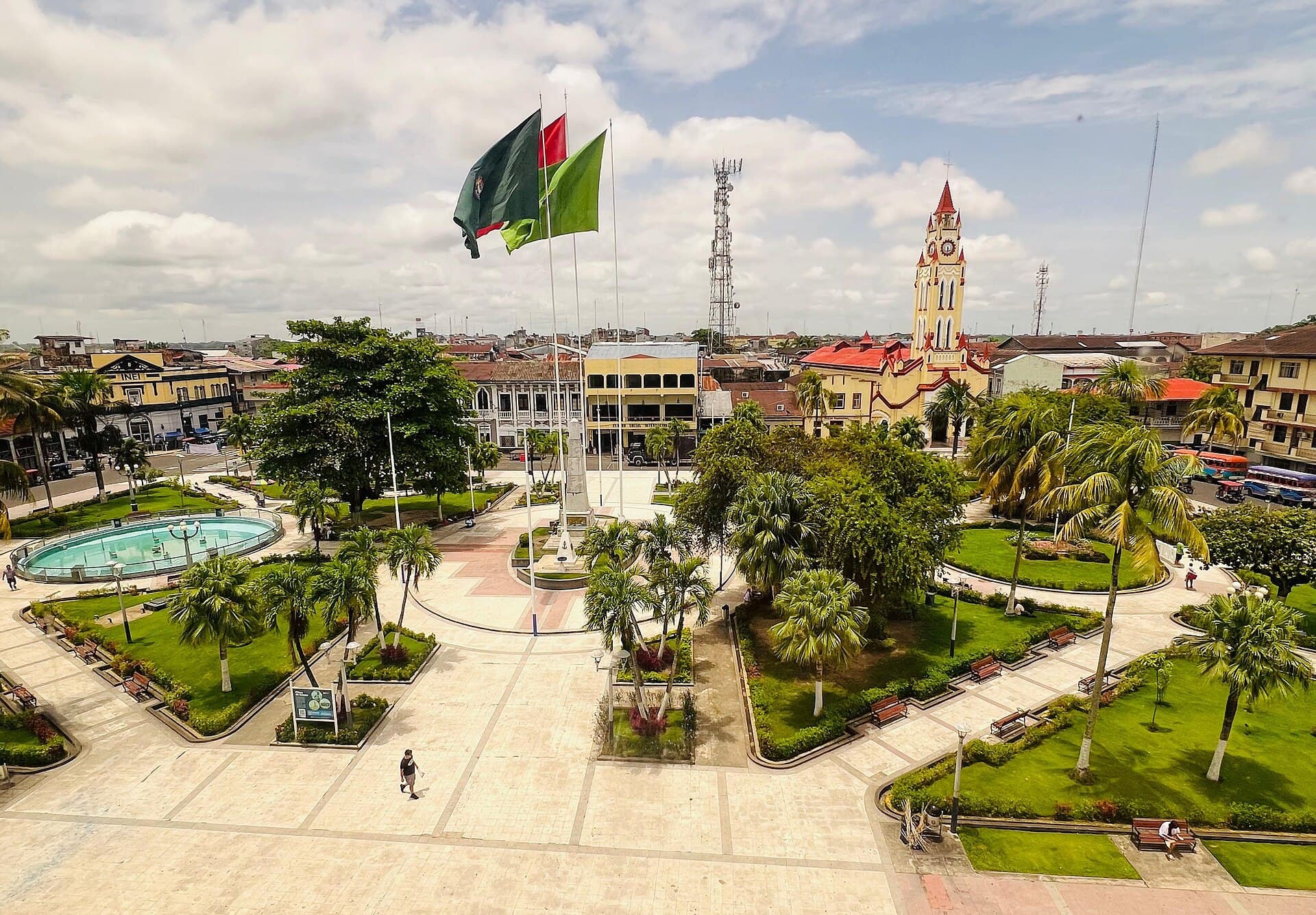
Begin your exploration in the Plaza de Armas, the city's central square, surrounded by buildings that echo the grandeur of the rubber boom era. Here, you'll find the Iquitos Cathedral, a neo-Gothic structure built between 1911 and 1924. A short walk away stands the peculiar Casa de Fierro (Iron House), an entirely metal building with a contested connection to Gustave Eiffel, now housing souvenir shops and a cafe.
Walk along the Malecón Tarapacá, also known as The Boulevard, a scenic waterfront promenade offering views of the Amazon River, especially captivating at sunrise or sunset. This area hums with activity, featuring cafes, restaurants, and street vendors. For a deeper dive into local life, visit the Belén Market, a sprawling, chaotic hub where you can discover exotic fruits, jungle herbs, and a unique floating section accessible by boat during high water.
Beyond the city center, consider a trip to the Manatee Rescue Center, which rehabilitates orphaned or injured Amazonian manatees before their release into the wild. Another option is the Pilpintuwasi Butterfly Farm and Animal Orphanage, an ethical rescue center for various Amazonian species. Many visitors use Iquitos as a starting point for multi-day Amazon River cruises or stays at jungle lodges, offering opportunities for wildlife viewing, piranha fishing, and cultural encounters with indigenous communities.
Iquitos experiences a tropical climate year-round, characterized by heat and humidity, with average daily temperatures around 30-32°C (86-90°F) and cooler nights at 20-22°C (68-72°F). There are two main seasons: the high-water (rainy) season from December to May, and the low-water (drier) season from June to November. During the high-water season, rivers rise significantly, allowing for deeper boat penetration into the flooded forest and increased access to otherwise impassable creeks. The low-water season, particularly August, sees less rainfall and lower river levels, which can expose beaches and concentrate wildlife along the shores, making it ideal for hiking and wildlife spotting. While there's no truly 'dry' season, the period from June to September is generally considered the best for outdoor activities.
Iquitos is only accessible by air or river. Most travelers fly into Coronel FAP Francisco Secada Vignetta International Airport (IQT) from Lima, a 1.5-hour flight. From the airport, mototaxis or taxis can take you to the city center in 15-20 minutes; it's advisable to agree on the fare beforehand (around S/10-S/12 for mototaxis). River travel is also an option, with multi-day boats connecting Iquitos to other Amazonian cities like Pucallpa (Peru), Manaus (Brazil), Coca (Ecuador), or Leticia (Colombia), though these journeys require flexibility.
Within the city, mototaxis are the most common and convenient form of transport. Tap water is not safe to drink, so rely on bottled water. The local currency is the Peruvian Nuevo Sol, though some businesses may accept US dollars. It's recommended to exchange money at banks or use ATMs, and be aware that credit card surcharges may apply. For safety, exercise standard city precautions: explore central areas during the day, keep valuables secure, and take mototaxis back to your hotel after dark. Visiting areas like Belén is best done with a local guide, preferably in the morning.