Museo Regional de Ica "Adolfo Bermúdez Jenkins"
Among the pre-Columbian artifacts, you might notice some skulls that tell a curious story beyond their age.
Full story unlocks in the tour
 Diego Delso / CC BY-SA 4.0, via Wikimedia Commons
“Where desert sands meet ancient whispers and the spirit of pisco flows.”
Not the postcards. The stories even locals don't know — whispered in your ear, right where they happened.
Among the pre-Columbian artifacts, you might notice some skulls that tell a curious story beyond their age.
Just a few minutes from Ica's city center, a small village is known for a peculiar palm tree with a legendary curse.
The fertile Ica Valley, a stark contrast to the surrounding desert, is considered the birthplace of a beloved national spirit.
Discover every secret of Ica
Every address, every reveal in full — in your ear, right where it happened.
You pick your stops. You walk. The voice reveals what the others miss.
No tours available yet. Check back soon — we're preparing them.
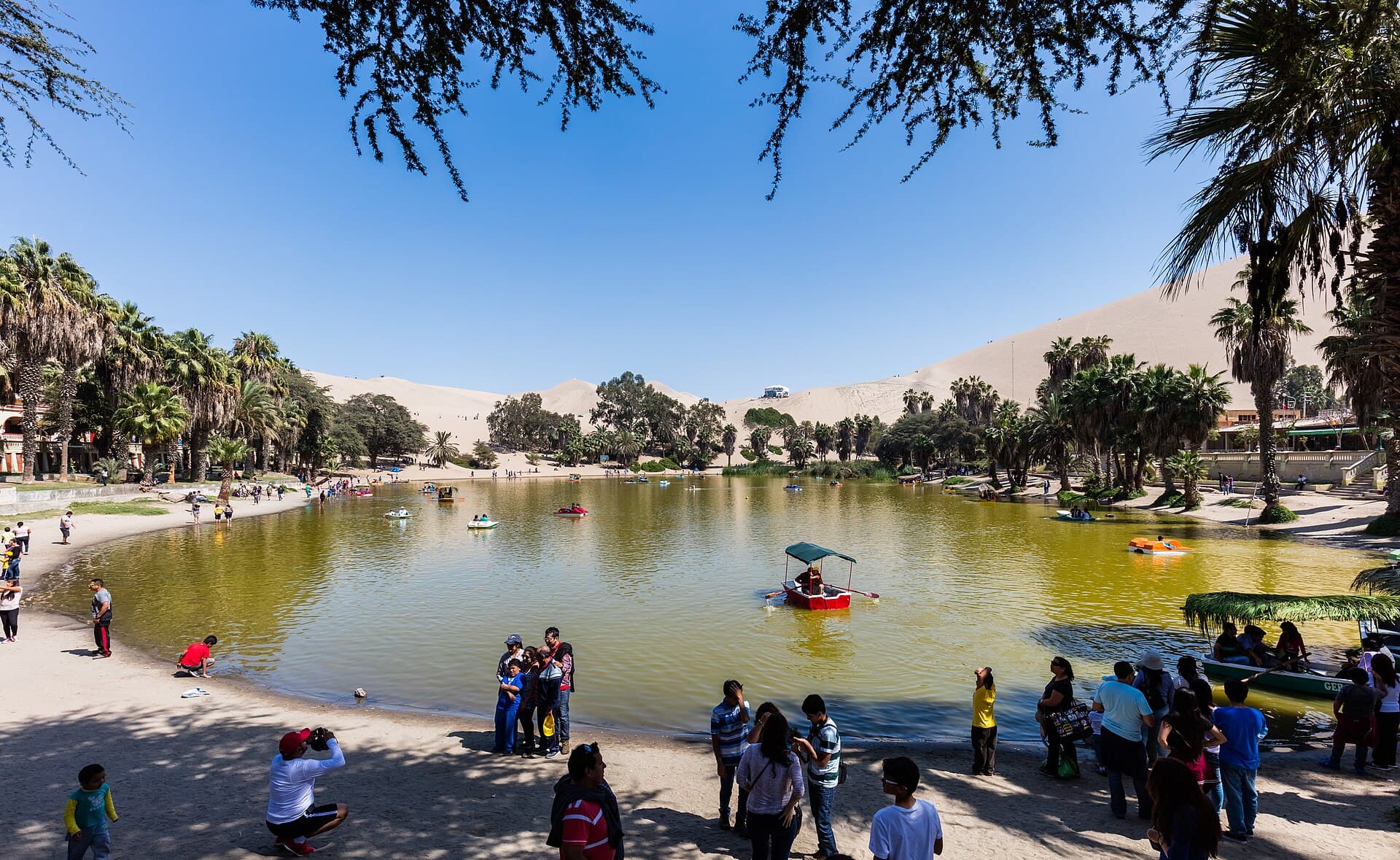
Ica, the capital of the Ica Region in southern Peru, is a captivating destination where arid desert landscapes converge with a profound cultural and agricultural heritage. Situated approximately 300 kilometers south of Lima along the Pan-American Highway, the city forms an oasis in one of the world's driest deserts, sustained by the Ica River. Known as the "Land of the Eternal Sun" due to its consistently dry and sunny weather, Ica offers a unique blend of adventure, history, and relaxation.
The region serves as a significant hub for Peru's wine and pisco production, with fertile valleys supporting extensive vineyards. Beyond its agricultural prowess, Ica acts as a gateway to extraordinary natural wonders and ancient mysteries. From the iconic Huacachina Oasis, a desert paradise embraced by towering sand dunes, to the enigmatic Nazca Lines etched into the desert floor, Ica promises a distinct Peruvian experience that extends far beyond the typical Andean treks.
The Ica region holds a deep history, with evidence of indigenous civilizations such as the Paracas and Nazca cultures inhabiting the area long before the arrival of Europeans. These pre-Columbian societies left behind a rich legacy, including intricate textiles, pottery, and the famous geoglyphs of the Nazca Lines. The Inca Empire also held sway over this territory starting in the 14th century.
The modern city of Ica was officially founded on June 17, 1563, by the Spanish conquistador Jerónimo Luis de Cabrera, initially named Villa de Valverde. This marked a pivotal moment in the Spanish colonization of Peru's southern coast. The Spanish introduced grapevines, transforming Ica into a vital agricultural center and the birthplace of pisco, Peru's national spirit. The city's layout, centered around the Plaza de Armas, reflects European regular planning, establishing an administrative and commercial core that endures today.
Ica's location within the Nazca Plate has made it susceptible to earthquakes throughout its history. A significant event occurred on August 15, 2007, when a magnitude 8.0 earthquake struck off the coast of Peru, causing extensive damage to Ica's buildings and infrastructure and resulting in loss of life. Despite the devastation, the city has demonstrated remarkable resilience, rebuilding and continuing to attract visitors with its natural beauty and cultural offerings.
Throughout the republican era, Ica maintained its role as an important agricultural region, with cotton, grapes, asparagus, avocado, mango, and olives among its key crops. The consistent sunshine earned it the moniker "Land of the Eternal Sun." In recent decades, tourism has flourished, with attractions like the Huacachina Oasis and proximity to the Nazca Lines drawing international and domestic travelers alike. The region continues to develop, blending its historical roots with a thriving tourism industry.
Begin your exploration at the Huacachina Oasis, a natural wonder surrounded by towering sand dunes. Here, you can rent paddle boats on the lagoon, enjoy sunset views, or embark on thrilling dune buggy rides and sandboarding adventures. A short drive from Ica leads to the enigmatic Nazca Lines, massive geoglyphs depicting figures like monkeys, spiders, and birds, best viewed from a scenic flight.
For a journey into the past, visit the Museo Regional de Ica "Adolfo Bermúdez Jenkins", which houses pre-Columbian artifacts, including mummies, textiles, and elongated skulls from the Paracas and Nazca cultures. The Plaza de Armas in Ica's city center, surrounded by old trees, features the Ica Cathedral, a prominent building despite damage from the 2007 earthquake. The fertile Ica Valley is also home to numerous wineries and pisco distilleries, such as Bodega El Catador and Tacama, where you can tour vineyards and sample local wines and Peru's national spirit.
Consider a day trip to Paracas, an hour and a half away, to explore the Ballestas Islands, often called the "poor man's Galapagos," for close encounters with sea lions, Humboldt penguins, and diverse seabirds. The Paracas National Reserve offers a unique desert-meets-ocean landscape, ideal for nature photography. For a lesser-known natural wonder, venture to the Cañón de los Perdidos (Canyon of the Lost), a geological formation in the desert with impressive depths and unique landscapes.
Ica's desert climate means it is generally sunny and dry year-round, with minimal rainfall. The warm season runs from December to April, with daytime temperatures reaching 30-35°C (86-95°F), ideal for those who enjoy intense heat and outdoor activities like sandboarding. This period coincides with Peru's peak tourist season, so expect larger crowds and higher accommodation prices.
For more moderate temperatures and fewer crowds, the shoulder seasons of March through May and September through November are recommended. Daytime temperatures during these times are comfortably warm, ranging from 25-28°C (77-82°F). The cooler, drier winter months from May to September, with temperatures between 18-22°C (64-72°F) during the day, are also excellent for exploring attractions without intense heat, though coastal fog (garúa) can occur from June to September.
Ica is approximately 300 kilometers (186 miles) south of Lima. The most common way to reach Ica is by bus from Lima, a journey that takes around 4 to 5 hours along the Pan-American Highway. Several comfortable bus companies operate frequent routes. There are no direct flights to Ica due to the absence of a major commercial airport.
While credit cards are accepted in many hotels and restaurants, it is advisable to carry Peruvian Sol (PEN) cash for taxis, small shops, and local markets. ATMs are available in the city. Tourist zones like Huacachina and the city center are generally safe during the day, but it is wise to exercise standard precautions, especially at night, and keep valuables secure. Ica sits at a low altitude of around 406 meters (1,332 feet), so altitude sickness is not a concern. Packing essentials include a sunhat, sunscreen, sunglasses, and plenty of water due to the dry desert climate.