Hvar Town Arsenal
Beneath Europe's oldest public theatre, a much older secret was recently unearthed.
Full story unlocks in the tour
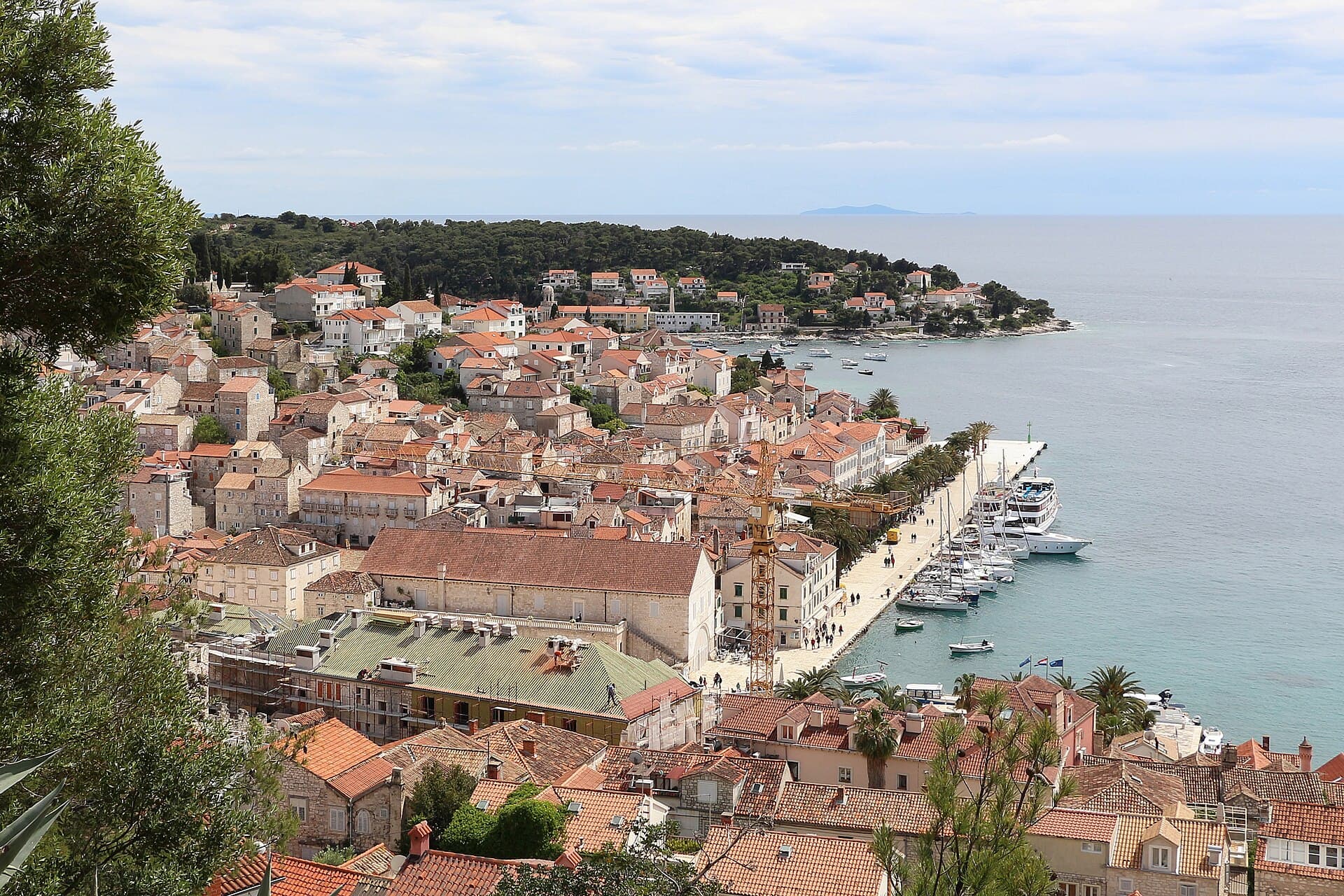 Bernard Gagnon / CC BY-SA 4.0, via Wikimedia Commons
“Where ancient stones meet the sun-drenched Adriatic, and history breathes through lavender-scented air.”
Not the postcards. The stories even locals don't know — whispered in your ear, right where they happened.
Beneath Europe's oldest public theatre, a much older secret was recently unearthed.
The delicate lace made by Hvar's Benedictine nuns holds a unique botanical origin.
A prehistoric cave on Hvar holds what might be Europe's earliest depiction of a boat.
Discover every secret of Hvar
Every address, every reveal in full — in your ear, right where it happened.
You pick your stops. You walk. The voice reveals what the others miss.
No tours available yet. Check back soon — we're preparing them.
Hvar, a Croatian island in the Adriatic Sea, lies off the Dalmatian coast, between the islands of Brač, Vis, and Korčula. Approximately 68 kilometers long, it features a prominent east-west ridge of Mesozoic limestone and dolomite. The island is celebrated for its abundant sunshine, often called 'the sunny Hvar,' with an annual average of over 2,700 hours of sun. This favorable climate supports thriving lavender fields, olive groves, vineyards, and pine forests.
Hvar's allure extends beyond its natural beauty, encompassing a profound cultural heritage and a history that spans millennia. The island has consistently been recognized as one of the most beautiful in Europe, drawing visitors with its crystal-clear waters, ancient towns, and lively waterfronts. Whether you are drawn to the animated atmosphere of Hvar Town or the serene character of its interior villages, the island offers a diverse range of experiences.
Hvar's history stretches back to prehistoric times, with archaeological finds indicating human habitation as early as the 7th millennium BC. The distinctive pottery of the Neolithic people on the island even gave rise to the term 'Hvar culture'. In the 4th century BC, ancient Greeks from the island of Paros established the colony of Pharos on the site of present-day Stari Grad, making it one of Europe's most ancient towns. These Greek settlers were also responsible for the geometric land divisions of the Stari Grad Plain, a UNESCO World Heritage Site that remains remarkably intact today.
Roman rule followed in 219 BC, expanding settlements and leaving behind a legacy of country mansions. The island's name evolved from the Greek 'Pharos' to the Roman 'Pharia', eventually becoming 'Hvar' with the arrival of Croatians in the early Middle Ages. During the 12th to 18th centuries, Venice played a dominant role, transforming Hvar into a crucial naval base and trade center in the eastern Adriatic. This period saw significant cultural development, with the construction of public buildings, noble palaces, and the establishment of one of Europe's first public theaters in Hvar Town in 1612.
Despite periods of prosperity, Hvar faced challenges, including a devastating Turkish naval attack in 1571 that laid waste to parts of the island. After the fall of Venice in 1797, Hvar experienced brief periods under Austrian and French rule before the Austrians retook control in 1813. Austrian rule brought stability and fostered the development of health tourism, with the founding of the Hvar Hygienic Society in 1868, marking the beginning of organized tourism in Europe. Today, Hvar continues to be a significant tourist destination, celebrated for its enduring history and lively culture.
Begin your exploration in Hvar Town, where the Spanish Fortress (Fortica) offers sweeping views of the town and the Pakleni Islands. Wander through St. Stephen's Square, known locally as Pjaca, the largest town square in Dalmatia. At its eastern end stands St. Stephen's Cathedral, a blend of Gothic, Renaissance, and Baroque styles, built on the site of a 6th-century Christian church. The Hvar Town Arsenal, a historic building dating back to the 14th century, once served as a maintenance shipyard for Venetian galleys and now houses Europe's oldest public theater, opened in 1612.
For a quieter experience, visit the Franciscan Monastery, a 15th-century refuge for sailors, which houses a museum with a notable 16th-century painting of 'The Last Supper'. Beyond Hvar Town, explore Stari Grad, one of Europe's oldest towns, and its UNESCO-listed agricultural plain. Consider a boat trip to the Pakleni Islands, an archipelago just off the coast, known for its clear lagoons and tranquil beaches.
Hvar enjoys a mild Mediterranean climate, making it a pleasant destination for much of the year. The peak season is July and August, characterized by high temperatures, a lively atmosphere, and busy beaches. For those seeking warm weather with fewer crowds and lower prices, the shoulder seasons of May, June, and September are ideal. During these months, the sea is still warm enough for swimming, and the island's natural beauty, including lavender fields, is in full bloom. April and October also offer pleasant conditions, though with a slightly cooler climate and occasional rainfall. From November to March, many hotels and restaurants close for the winter, and the island is very quiet.
Hvar is an island reachable only by boat. Most visitors fly into Split Airport (SPU) on the mainland, then take a ferry or catamaran to Hvar. Fast catamarans connect Split to Hvar Town in about 75 minutes, while car ferries to Stari Grad take around 2.5 hours. Booking ferry tickets in advance, especially during summer, is highly recommended. Once on the island, Hvar Town is walkable. For exploring further, consider renting a scooter, car, or using the local bus network, which connects Hvar Town with Stari Grad, Jelsa, Vrboska, and Sućuraj. Croatia uses the Euro (€), and while cards are widely accepted, it's advisable to carry some cash for smaller establishments or certain attractions like the Blue Cave. Pebble beaches are common, so water shoes can be beneficial. Travel insurance is also recommended, especially for medical emergencies that might require evacuation to mainland hospitals.