Huesca Museum
A specific room in the Huesca Museum holds a chilling legend from Aragonese history.
Full story unlocks in the tour
 Kent Wang / CC BY-SA 4.0, via Wikimedia Commons
“Where ancient legends echo in the shadow of the Pyrenees.”
Not the postcards. The stories even locals don't know — whispered in your ear, right where they happened.
A specific room in the Huesca Museum holds a chilling legend from Aragonese history.
Within this green oasis, you'll find a surprising tribute to a delicate art form.
This Romanesque monastery holds the final resting place of early Aragonese royalty, but one king's story is particularly dramatic.
Discover every secret of Huesca
Every address, every reveal in full — in your ear, right where it happened.
You pick your stops. You walk. The voice reveals what the others miss.
No tours available yet. Check back soon — we're preparing them.
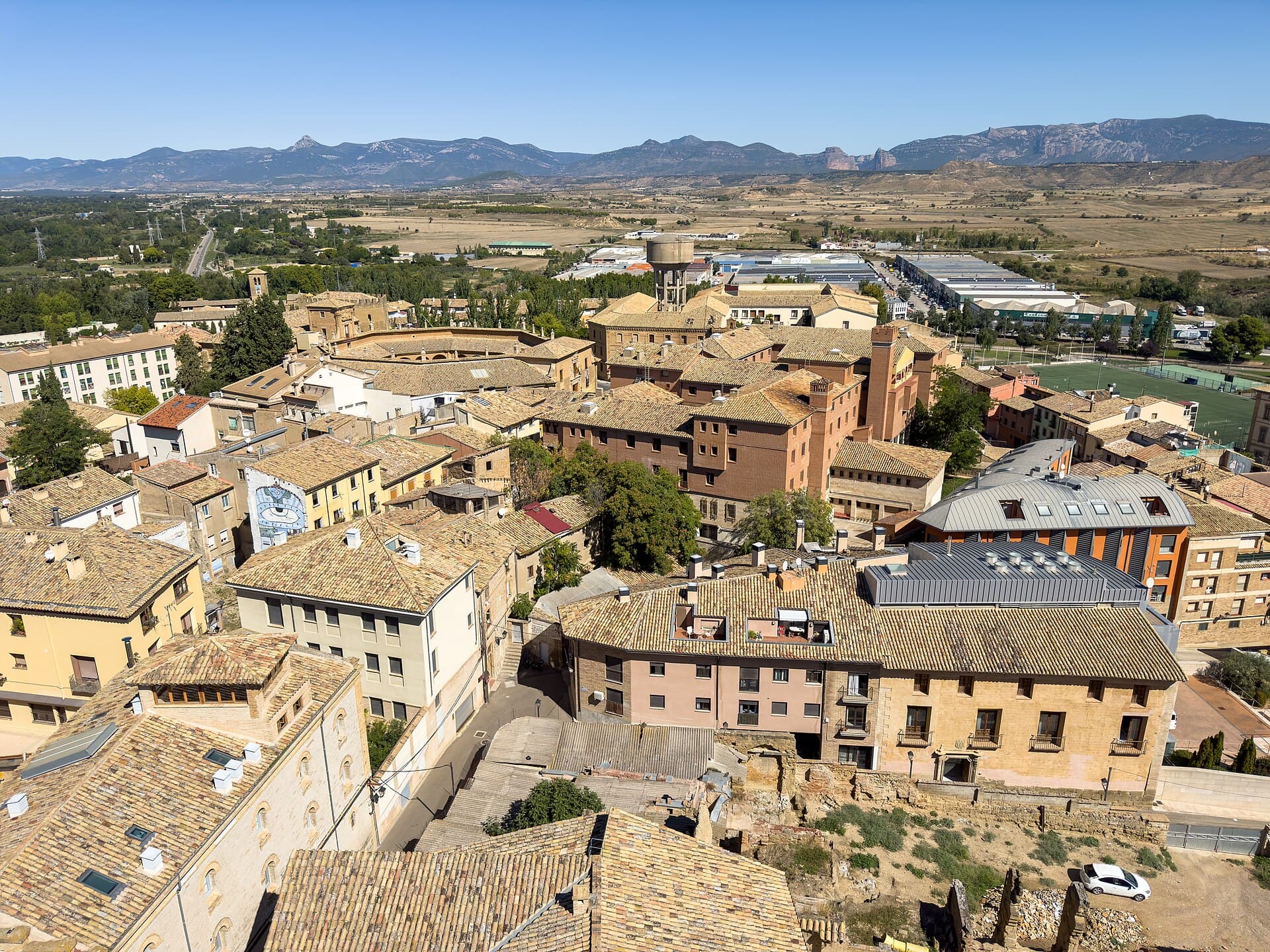
Huesca, a city in northeastern Spain, serves as the capital of its namesake province within the autonomous community of Aragon. It rests upon a plateau, 488 meters (1,601 feet) above sea level, offering sweeping views of the surrounding landscape and the nearby Sierra de Guara mountains. With a population of approximately 54,804 residents, Huesca maintains a welcoming, small-town atmosphere. It is often referred to as the 'Gate of the Pyrenees,' highlighting its role as a starting point for exploring the grand mountain range to its north.
The city's story stretches back over two millennia, from its Iberian origins as Bolskan to its time as the Roman settlement of Osca. This expansive past is reflected in its diverse architecture and well-preserved monuments found throughout the historic center. Huesca offers a blend of cultural experiences and a portal to natural beauty, making it an appealing destination for those seeking both history and outdoor adventure.
Huesca's story begins in pre-Roman times as Bolskan, an Iberian settlement and capital of the Vescetani tribe. The city was known for its mint, producing silver and bronze coins depicting a horseman, a figure that remains on the city's shield today. Around 77 BCE, the rebellious Roman general Quintus Sertorius established Osca, as it was then known, as his headquarters and capital, even founding a prestigious school to educate young Iberians in Latin and Roman customs. This academy, which later evolved into the University Sertoriana, was the first Spanish university and remained open until 1845. The city officially became a Roman municipium around 30 BCE under Emperor Augustus.
Following the Roman era, the Visigoths held sway before the Muslim conquest in the late 8th century, when the city was renamed Wasqa. The Muslims fortified the city with walls, remnants of which can still be seen around the old quarter. In 1094, Sancho Ramírez, King of Aragon, attempted to conquer Wasqa but was killed by a stray arrow during the siege. His son, Peter I of Aragon, finally succeeded in 1096, making Huesca the first capital of the Kingdom of Aragon until 1118 when the capital moved to Zaragoza. The Middle Ages left a significant architectural mark, with the construction of religious buildings like the Monastery of San Pedro el Viejo, an important example of Romanesque architecture.
King Peter IV of Aragon founded the University of Huesca in 1354, initially with a faculty of theology. Though it expanded, the university was eventually eclipsed by the University of Zaragoza and abolished in 1845. Huesca was also home to a significant Jewish community until the expulsion of the Jews in 1492. The 19th century brought progress with the opening of a railway line in 1864, and the 20th century saw the development of its main high street, modernist buildings like the Casino, and the construction of the Canfranc railway tunnel, connecting Spain and France. During the Spanish Civil War (1936–1939), Huesca became an important battleground, known as the 'Huesca Front,' and was surrounded by Republican forces, including George Orwell, though it was never captured.
Begin your exploration in Huesca's Old Town, where the Huesca Cathedral stands as a Gothic masterpiece, its intricate facade dominating the skyline. Inside, admire its beautiful carvings and the impressive high altar made from alabaster. Nearby, the Monastery of San Pedro el Viejo, a significant Romanesque structure from the 12th century, features a beautiful cloister and serves as a royal pantheon for early Aragonese monarchs.
For a glimpse of early 20th-century elegance, visit the Casino de Huesca, notable for its modernist design. Stroll along Calle Coso Alto, a lively pedestrian street filled with shops and cafes. Take a break in Parque Miguel Servet, one of the city's oldest parks, which features diverse plants and the distinctive 'Las Pajaritas' origami monument. The Huesca Museum, housed in a former university building, offers archaeological artifacts and art spanning from prehistoric times to the 20th century. Just outside the city, the imposing silhouette of Montearagón Castle offers a memorable sight.
Huesca experiences a humid subtropical climate with semi-arid influences, characterized by cool winters and warm, dry summers. The warmest months are July and August, with average daily highs around 31°C (88°F) and lows around 24°C (75°F), making it ideal for sun lovers. The coolest months are January and December, with average temperatures around 5-6°C (41-43°F) and nighttime lows near freezing. Spring and autumn offer comfortable temperatures for walking and sightseeing. While precipitation is distributed throughout the year, early summer (June) can be surprisingly rainy, with approximately 12 wet days. The driest month is July. For hot-weather activities, early July to late August is recommended. If you prefer cooler weather, December is a good time to visit, with temperatures ranging from 1-11°C (34-51°F).
Huesca is well-connected by road and rail networks. While the city does not have its own commercial airport with regular passenger traffic, the nearest major airport is Zaragoza Airport (ZAZ), located approximately 72 kilometers away. From Zaragoza, you can reach Huesca by bus in about 2 hours and 6 minutes.
The Huesca Railway Station is a modern intermodal complex that combines both the railway station and the bus terminal under one roof, providing convenient transfers. It offers high-speed (AVE) connections to Madrid (approximately 2 hours 20 minutes) and Zaragoza (around 40 minutes). The station is centrally located, about a 10-15 minute walk from the Cathedral and Parque Miguel Servet, or a 5-7 minute bus ride on route C1.
When packing, consider Huesca's distinct seasonal changes. Layers are recommended, especially during spring and autumn, which can have significant temperature fluctuations and occasional rain. Winters require warm clothing, including a coat, scarf, and gloves, while summers call for light, breathable fabrics and sun protection due to hot, dry conditions.