Beneath the ancient walls of Hildesheim Cathedral, a legendary rosebush has defied centuries, its roots intertwined with the city's very foundation. But the 'thousand-year-old rose' isn't quite what it seems.
Tilman2007 / CC BY-SA 3.0, via Wikimedia CommonsHildesheim
“Where a thousand-year-old rose blooms amidst a rebuilt medieval dream.”
Hildesheim, as no one tells it.
Not the postcards. The stories even locals don't know — whispered in your ear, right where they happened.
The half-timbered buildings of Hildesheim's Market Square present a picture of medieval charm, yet this picturesque scene is a relatively recent creation. The square holds a secret of remarkable rebirth.
St. Michael's Church, a UNESCO World Heritage site, is a masterpiece of Ottonian architecture, renowned for its intricate details. But one of its most famous treasures, the Bernward Doors, isn't actually found within its walls today.
Discover every secret of Hildesheim
Every address, every reveal in full — in your ear, right where it happened.
You pick your stops. You walk. The voice reveals what the others miss.
How long do you have in Hildesheim?
No tours available yet. Check back soon — we're preparing them.
The story of Hildesheim
Hildesheim, a city in Lower Saxony, north-central Germany, offers a compelling blend of ancient history and remarkable resilience. Situated southeast of Hannover on the Innerste River, it's a place where over a thousand years of history are etched into its stones and stories. While much of its medieval core was devastated during World War II, Hildesheim has undergone an extraordinary reconstruction, bringing its historic market square and two UNESCO World Heritage sites back to life.
Often overlooked in favor of larger German cities, Hildesheim holds its own as a cultural destination, inviting visitors to uncover its unique heritage. From the legendary 'thousand-year-old rosebush' blooming at the Cathedral to the meticulously rebuilt half-timbered houses, the city offers a tangible connection to its past. It's a compact city, easily explored on foot, where every corner reveals a piece of its enduring spirit.
From Bishopric to Hanseatic Powerhouse
Hildesheim's story begins in 815 CE, when Emperor Louis the Pious established a bishopric near a ford across the Innerste River, a strategic point on the Hellweg trade route. This foundational act is closely tied to the legend of the 'thousand-year-old rosebush' at the Cathedral, a symbol of the city's enduring roots. The settlement quickly grew around the cathedral, and by 983, King Otto III granted it market rights.
By 1249, Hildesheim had achieved city status and was one of the largest cities in Northern Germany. For four centuries, the clergy held sway, but the construction of a Town Hall in 1268 marked a shift, granting citizens more influence and independence. In 1367, Hildesheim joined the powerful Hanseatic League, transforming from a small town into a bustling trading city and a central economic hub in northern Germany. The 11th century was a period of significant cultural flourishing, particularly under bishops Bernward (993-1022) and Gotthard (1022-1038), who fostered Hildesheim's development into a renowned cultural center.
War, Destruction, and Rebirth
The city became Lutheran in 1542, with only the cathedral and a few other buildings remaining under Roman Catholic control. The Thirty Years' War in the 17th century brought economic turmoil and a loss of independence. Over the following centuries, Hildesheim became part of Prussia, then Westphalia, and finally the Kingdom of Hanover, before returning to Prussia in 1866.
Hildesheim's medieval character, with its picturesque half-timbered houses, largely survived until the final months of World War II. On March 22, 1945, a devastating air raid obliterated much of the historic city center, claiming over 1,500 lives. In the immediate aftermath, practical rebuilding took precedence, and some historic sites were replaced with modern structures. However, a significant turning point came in the 1980s. A concerted effort, fueled by donations and historical records, led to the meticulous reconstruction of the historic Market Square, including the iconic Butchers' Guild Hall. This ambitious project restored much of Hildesheim's lost splendor, allowing the city to reclaim its medieval charm.
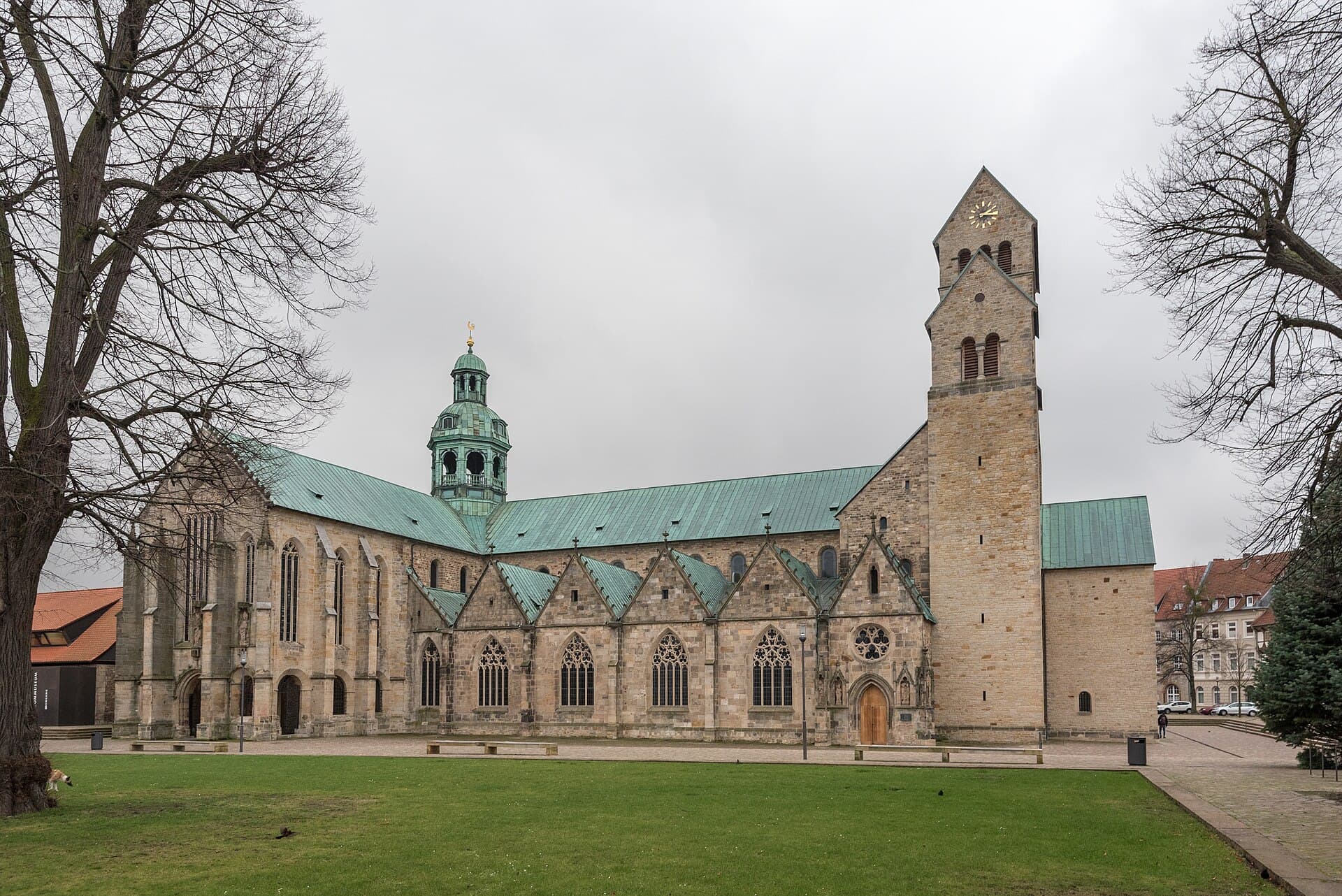
Hildesheim's main attractions are concentrated around its two UNESCO World Heritage sites and the reconstructed Market Square. Begin at the Historic Market Square (Marktplatz), an ensemble of meticulously rebuilt half-timbered houses. The Knochenhaueramtshaus (Butchers' Guild Hall), with its ornate facade and colorful paintings, is a highlight, now housing a restaurant and the City Museum. Nearby, the Bäckeramtshaus (Bakers' Guild Hall) and the Wedekindhaus also showcase impressive half-timbered architecture.
Just a short walk from the Market Square is St. Mary's Cathedral (Mariendom), a Romanesque masterpiece rebuilt after wartime destruction. It's home to significant art treasures, including the ancient bronze Bernward Doors and the Hezilo chandelier. In the cathedral courtyard, you'll find the legendary 'thousand-year-old rosebush', a symbol of the city's endurance.
The other UNESCO World Heritage site is St. Michael's Church (Michaeliskirche), an early Romanesque basilica known for its distinctive architecture and the oldest painted wooden ceiling in Europe, depicting the Tree of Jesse. For panoramic city views, consider climbing the tower of St. Andrew's Church (St. Andreas), which has the highest church steeple in Lower Saxony. Opposite St. Andrew's stands the Upended Sugarloaf (Umgestülpter Zuckerhut), an unusual half-timbered house. The Roemer- und Pelizaeus-Museum offers extensive collections of ancient Egyptian and Peruvian artifacts, considered among the most important worldwide.
The best time to visit Hildesheim for warm-weather activities is from late June to early September, when average daily temperatures range from 19°C to 24°C (66°F to 75°F). May and September also offer pleasant weather for sightseeing. While July is the warmest month, it also sees the most rainfall, so a light jacket or raincoat is advisable. April, considered shoulder season, offers moderate crowds and the chance to see the famous rosebush beginning to bud. For those interested in festive atmospheres, Hildesheim hosts a traditional Christmas Market in front of the Butchers' Guild Hall from late November through Christmas Eve.
Hildesheim is easily accessible by car or public transport. It's located just 30 kilometers southeast of Hannover, which hosts the nearest major international airport (HAJ). From Hannover Airport, you can take an S-Bahn train to Hannover Central Station, then a regional train to Hildesheim. Direct ICE train connections link Hildesheim to major German cities like Berlin, Frankfurt, and Munich.
Once in Hildesheim, the city center is compact and best explored on foot. A well-developed bus network (Stadtverkehr Hildesheim - SVHI) covers all main areas, with single tickets and day passes available. Taxis are also an option. The official currency is the Euro (EUR), and credit/debit cards are widely accepted. Hildesheim is generally a safe city, but standard precautions, such as being aware of your belongings in crowded areas, are always recommended.
- What are the main UNESCO World Heritage Sites in Hildesheim?
- Hildesheim is home to two UNESCO World Heritage Sites: St. Mary's Cathedral (Mariendom) and St. Michael's Church (Michaeliskirche), both recognized for their exceptional Romanesque architecture and art.
- Is Hildesheim's historic city center original?
- While Hildesheim has a long history, its historic Market Square and many half-timbered buildings were meticulously reconstructed in the 1980s after being largely destroyed during World War II.
- What is the 'thousand-year-old rosebush'?
- The 'thousand-year-old rosebush' is a legendary dog rose that grows on the apse of St. Mary's Cathedral. While its exact age is debated, it's a powerful symbol of the city's resilience and is estimated to be 300 to 500 years old.
- What is the best way to get around Hildesheim?
- Hildesheim's city center is walkable, and a local bus network (SVHI) provides convenient transportation to other areas. Renting a car isn't necessary for exploring the city itself.
- What currency is used in Hildesheim?
- The official currency in Hildesheim, and throughout Germany, is the Euro (EUR).
- Is Hildesheim safe for tourists?
- Hildesheim is generally considered a safe city with a low crime rate. It's advisable to take standard precautions, especially in crowded areas or less-lit parts of the city at night.