Kärnan
This medieval tower, a landmark of Helsingborg, once offered a private passage for royalty.
Full story unlocks in the tour
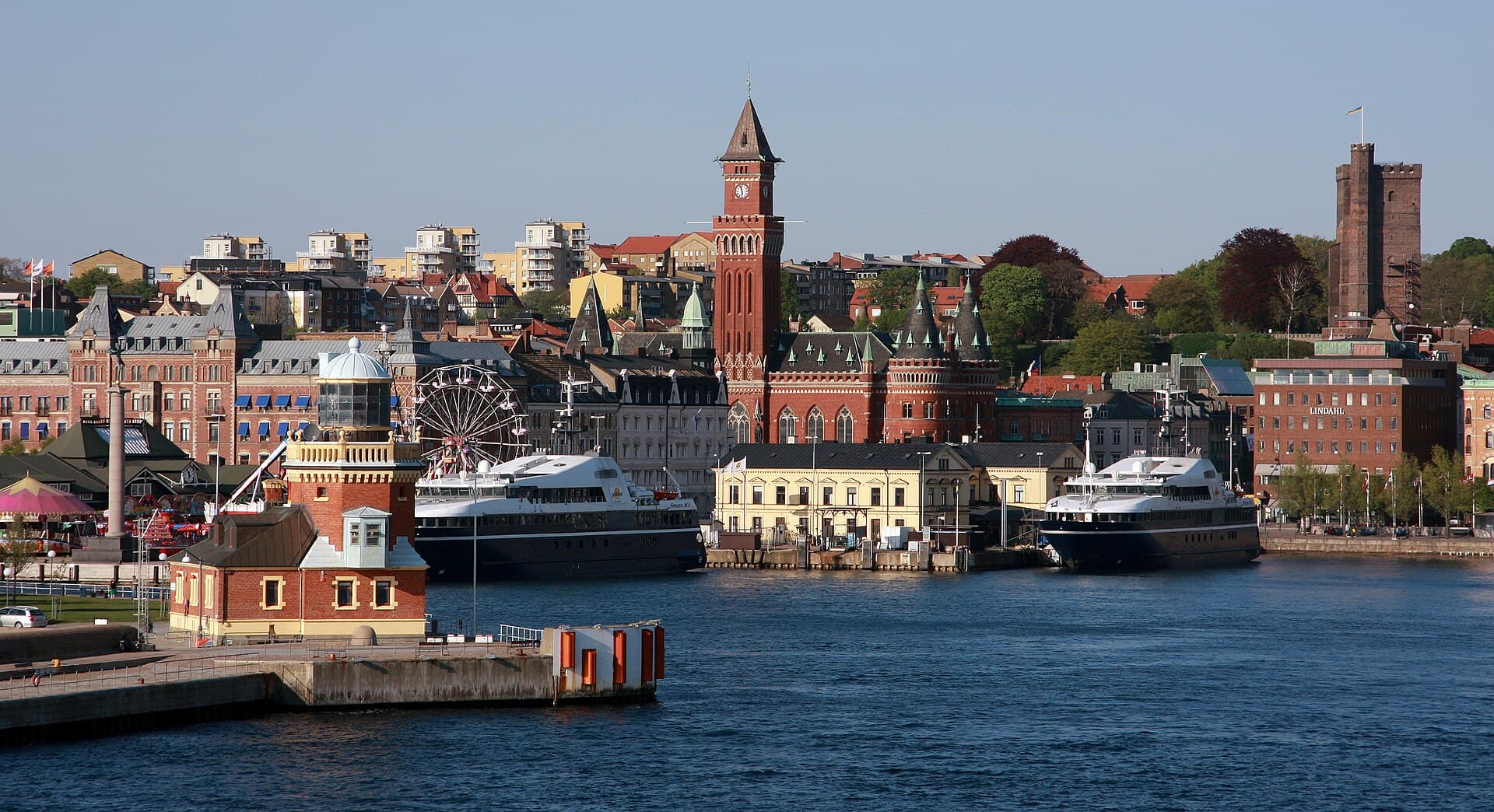 This image was produced by me, David Castor (user:dcastor). The pictures I submit to the Wikipedia Project are released to the public domain. This gives you the right to use them in any way you like, without any kind of notification. This said, I would still appreciate to be mentioned as the originator whenever you think it complies well with your use of the picture. A message to me about how it has been used would also be welcome. You are obviously not required to respond to these wishes of mine, just in a friendly manner encouraged to. (All my photos are placed in Category:Images by David Castor or a subcategory thereof.) / Public domain, via Wikimedia Commons
“Where ancient towers greet the narrow strait.”
Not the postcards. The stories even locals don't know — whispered in your ear, right where they happened.
This medieval tower, a landmark of Helsingborg, once offered a private passage for royalty.
Helsingborg holds a reputation as Sweden's coffee capital, thanks to a local roastery with a captivating origin.
Beyond its expansive open-air museum, Fredriksdal safeguards a distinctive living archive.
Discover every secret of Helsingborg
Every address, every reveal in full — in your ear, right where it happened.
You pick your stops. You walk. The voice reveals what the others miss.
No tours available yet. Check back soon — we're preparing them.
Helsingborg, a coastal city in southern Sweden, offers a convergence of ancient narratives and contemporary life. Positioned at the narrowest point of the Øresund strait, it gazes across at Helsingør, Denmark, merely four kilometers of water away. This pivotal location has shaped its character, establishing it as a significant port and a city with a profound past.
The city is the second-largest in the Scania region and the ninth-largest in Sweden, home to over 150,000 residents. Helsingborg is recognized for its meticulously preserved Old Town, where winding paths of stone meander past historic architecture. It is a place where one can explore medieval structures, enjoy serene waterfront strolls, and uncover a lively cultural landscape.
Acknowledged for its ingenuity, Helsingborg received the European Capital of Innovation Award in 2020, a testament to its intelligent, sustainable solutions and its commitment to equality and eco-friendly transport. The city's temperate oceanic climate, milder than much of inland Sweden, makes it an inviting destination for outdoor exploration through much of the year.
Helsingborg's story reaches back to May 21, 1085, making it one of Sweden's most ancient cities. Its position at the narrowest part of the Øresund strait was critically important, as Denmark initially controlled both shores of this waterway. This location propelled its significance as a military and political stronghold throughout the Middle Ages.
Beginning in 1429, Eric of Pomerania instituted the Sound Dues, a tax levied on all trading vessels navigating the strait between Helsingør and Helsingborg, which became a substantial source of revenue for the Danish Crown. However, following the Dano-Swedish War of 1657–1658 and the Treaty of Roskilde, Denmark ceded its territory on the southern Scandinavian Peninsula, and Helsingborg became part of Sweden.
The city was repeatedly devastated by Danish forces in subsequent conflicts before hostilities ceased in the early 18th century. The Battle of Helsingborg in 1710, where Danish forces faced defeat, marked a turning point in Danish-Swedish relations. By 1770, the city's population had significantly diminished, but from the mid-19th century onward, industrialization fueled rapid expansion, increasing its population from 4,000 in 1850 to 56,000 by 1930.
In 1892, a train ferry service commenced, linking Helsingborg with Helsingør, further solidifying its role as a transportation nexus. During World War II, Helsingborg played a crucial part in the rescue of Denmark's Jewish population, serving as a vital disembarkation point for those escaping persecution. The city's name, originally Helsingborg, was altered to Hälsingborg in 1912 following a Swedish orthography reform, but reverted to Helsingborg in 1971 when the city merged with surrounding areas. Today, Helsingborg continues to thrive, weaving its deep historical roots with a forward-looking, contemporary identity.
Begin your exploration at Kärnan, a medieval tower and the sole remnant of a formidable Danish fortress. Ascend its spiral staircase for sweeping views of the city and the Øresund strait, with Helsingør visible across the water.
Next, visit Stortorget, the main town square, where you will find the neo-Gothic Town Hall (Rådhuset), constructed in 1897, with its distinctive turreted design and stained-glass windows depicting local history. The square also features a monument commemorating Swedish general Magnus Stenbock's triumph in the Battle of Helsingborg in 1710.
A brief bus journey north of the city center leads to Sofiero Palace, a former royal summer residence. Its expansive gardens are celebrated, particularly for their impressive collection of nearly 500 varieties of rhododendrons.
For a journey into the past, explore Fredriksdal Museums and Gardens, one of Sweden's largest open-air museums. This 36-hectare site presents historic buildings, cultivated farmlands, botanical gardens, and heritage livestock, recreating life in southern Sweden from centuries gone by. Be sure to see the 14th-century Mariakyrkan (Church of St. Mary), one of the city's oldest structures, displaying Gothic architecture and a rich interior.
Finally, immerse yourself in culture at Dunkers Kulturhus by the North Harbour. This cultural center, designed by Danish architect Kim Utzon, offers exhibitions, concerts, theater, and an art museum.
The most agreeable time to visit Helsingborg for outdoor pursuits is during the summer months, from late June to late August. In this period, the city experiences comfortable temperatures, with July being the warmest month, averaging around 21°C (70°F). Extended daylight hours and a lively atmosphere make it perfect for enjoying beaches, open-air events, and the city's gardens. Spring and early autumn can also be pleasant, with fewer crowds, though the weather may be cooler. Even in summer, it is wise to bring a windproof jacket due to the coastal air.
Helsingborg is readily accessible through various transportation options. Copenhagen Airport (CPH) in Denmark serves as the largest international gateway, with trains connecting directly to Helsingborg Central Station (Knutpunkten) in approximately 90 minutes. Alternatively, Ängelholm Helsingborg Airport (AGH) offers domestic and some regional flights, situated about 30 km away. The city center is compact and easy to navigate on foot, but an efficient public transportation network of buses and ferries simplifies movement. Consider acquiring a Jojo card for reduced fares on public transport.
The local currency is the Swedish Krona (SEK). Sweden operates largely as a cashless society, so card payments are widely accepted, and cash withdrawals are seldom necessary. Tipping is not obligatory as service charges are often included, but rounding up for excellent service is appreciated. Helsingborg is generally a secure city, but it is always prudent to be aware of your surroundings. Tap water is safe for drinking.