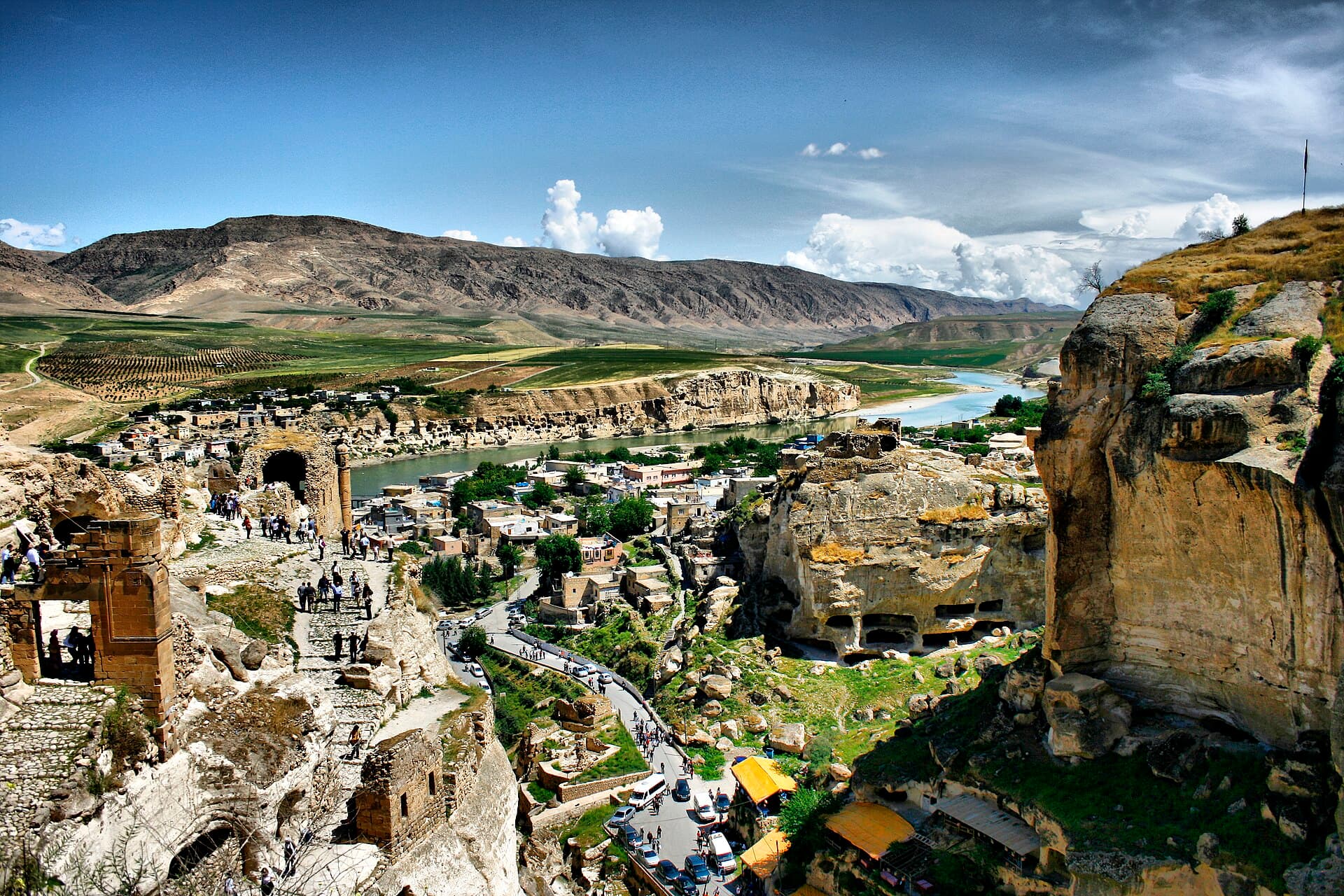
Hasankeyf, TurkeyOmer Unlu / CC BY 2.0, via Wikimedia Commons
TR

Hasankeyf

Where history sleeps beneath the Tigris, and ancient echoes rise to meet the sun.

The secrets of Hasankeyf

Hasankeyf, as no one tells it.

Not the postcards. The stories even locals don't know — whispered in your ear, right where they happened.

3 secrets below. Many more wait inside the tour.
The Old Tigris Bridge

Imagine a bridge so grand, it once spanned the Tigris with one of the largest arches in the medieval world. It held another secret, one that hints at its strategic importance beyond just crossing a river.

Full story unlocks in the tour
Hasankeyf Castle

High above the Tigris, Hasankeyf Castle was a formidable Byzantine fortress. Within its ancient walls lies a passage, vital for survival during sieges.

Full story unlocks in the tour
The Zeynel Bey Tomb

This striking mausoleum, with its distinctive turquoise tiles, is a rare example of Timurid-style architecture in Anatolia. Its journey to its current location is a story of modern engineering and a race against time.

Full story unlocks in the tour
The full tour

Discover every secret of Hasankeyf

Every address, every reveal in full — in your ear, right where it happened.

Get the key to Hasankeyf

You pick your stops. You walk. The voice reveals what the others miss.

Choose your time

How long do you have in Hasankeyf?

No tours available yet. Check back soon — we're preparing them.

About Hasankeyf

The story of Hasankeyf

Hasankeyf, a name that resonates with both profound history and poignant loss, is an ancient settlement in southeastern Turkey, along the Tigris River. For over 12,000 years, this area witnessed the ebb and flow of numerous civilizations, making it one of the oldest continuously inhabited sites on Earth. Carved into limestone cliffs, the area was once home to thousands of human-made caves, some serving as dwellings, churches, and even bazaars.

However, in 2020, the historic town of Hasankeyf was largely submerged by the waters of the Ilısu Dam, a hydroelectric project on the Tigris River. While the original town now rests beneath the reservoir, a new settlement, Yeni Hasankeyf, has emerged on higher ground. Efforts were made to preserve some of Hasankeyf's most significant monuments through relocation to a newly created cultural park, offering a glimpse into its extraordinary past.

Today, Hasankeyf stands as a powerful testament to human resilience and the complex choices between progress and preservation. Visitors can explore the relocated monuments and the remnants of the old town that remain above the waterline, contemplating the layers of history that define this unique landscape.

History

## A Crossroads of Civilizations Hasankeyf's strategic position on the Tigris River, bordering the Anatolian plateau and Mesopotamia, made it a coveted stronghold and commercial hub along the Silk Road. Its history stretches back to the Neolithic period, with evidence of organized human settlement dating to 9500 BC. The name "Hasankeyf" is believed to derive from the Arabic "Hisn Kayfa," meaning "rock fortress," a fitting description for a place where early inhabitants carved homes into the soft rock cliffs.

## Roman and Byzantine Eras During Roman and Byzantine times, Hasankeyf, then known as Kepha or Ciphas, served as a crucial frontier base for legionnaires patrolling the border with the Sasanian Persian Empire. A formidable castle, built by the Byzantines in 363 AD, became known as "the Rock Castle" due to its robust construction, making it one of the most secure fortresses in the eastern Byzantine Empire. It also functioned as a religious center for approximately 330 years during the Byzantine period.

## Islamic Dynasties and a Golden Age In 640 AD, Hasankeyf was conquered by the Arabs, who renamed it Hisn Kayfa. Over subsequent centuries, it was ruled by a succession of Islamic dynasties, including the Umayyads, Abbasids, Hamdanids, and Marwanids. The Artuqid period, from 1102 to 1232, marked a golden age for Hasankeyf. During this time, the Artuqids constructed significant architectural works, including the Old Tigris Bridge, considered one of the largest medieval bridges, and the Small and Great Palaces. The Ayyubids, who ruled from 1232 to 1462, also contributed to the city's architectural landscape, and Hasankeyf became a final stronghold for their dynasty. In the 15th century, Hasankeyf was recognized as an important scientific center in the Islamic world.

## Ottoman Rule and Modern Challenges The Aq Qoyunlu briefly controlled Hasankeyf before it was absorbed into the Ottoman Empire in 1515. Under Ottoman rule, it remained a small but culturally significant community. In 1981, Hasankeyf was declared a natural conservation area by Turkey, a designation intended to protect its historical assets. However, the construction of the Ilısu Dam, part of the larger Southeastern Anatolia Project (GAP), posed a significant threat to the ancient city. Despite widespread local and international opposition, the dam's construction proceeded, and by July 2020, the majority of Hasankeyf and its archaeological sites were submerged. While some monuments were relocated, the flooding irrevocably altered this ancient landscape, transforming a living city into a poignant open-air museum.
What to see

While much of old Hasankeyf now lies beneath the Ilısu Dam reservoir, a visit still offers a compelling journey through its past, primarily through the relocated monuments and the remaining visible structures. The Hasankeyf Cultural Park in Yeni Hasankeyf is where several key historical buildings have been moved. Here you can see the Zeynel Bey Tomb, a striking cylindrical mausoleum adorned with blue and turquoise tiles, a rare example of Timurid architecture in Anatolia. Also relocated are the Er-Rızk Mosque, known for its distinctive round minaret and intricate portal carvings, and the Süleyman Khan Mosque Complex. The Artuklu Bath, Imam Abdullah Zawiya, Orta Kapı, and Kızlar (Eyyubi) Mosque were also moved to this cultural park.

Above the waterline, the imposing Hasankeyf Castle, built by the Byzantines in the 4th century AD, still stands on a cliff 100 meters above the Tigris. From its ruins, you can gain a panoramic perspective of the Tigris Valley and the new settlement. Though largely submerged, the ruined piers of the Old Tigris Bridge, an impressive 12th-century Artuqid structure, can still be seen rising from the water, a poignant reminder of its former grandeur. While many of the ancient cave dwellings are now underwater or inaccessible, the surrounding limestone cliffs still bear witness to thousands of human-made caves, some of which were inhabited until the 1980s. The Hasankeyf Museum in the new town provides further context, showcasing archaeological and architectural remains from various periods, including Neolithic tools, Roman jewelry, and early Islamic gravestones.

When to visit

The most pleasant times to visit Hasankeyf for general outdoor activities are from mid-May to mid-June and from early September to mid-October, with a peak in the last week of September. During these periods, the weather is clear and rainless, with perceived temperatures between 65°F and 80°F (18°C and 27°C). Summers in Hasankeyf are sweltering, with average daily high temperatures often above 90°F (32°C) from early June to mid-September, making it suitable for hot-weather activities. Winters are very cold, with average daily high temperatures below 56°F (13°C) from late November to mid-March. Spring also offers a beautiful landscape, with rocky hills covered in yellow and green, and pleasant temperatures for exploration.

Practical

Hasankeyf is located in Batman Province, Turkey, approximately 45 kilometers from Batman city. Batman has direct flights from Istanbul and Ankara, making it a convenient starting point. From Batman, minibuses (dolmuşes) run regularly to Hasankeyf, with a travel time of about one hour. These minibuses often continue to nearby Midyat and Mardin.

For accommodation, the new town of Hasankeyf is still developing its options. The best choices are often found in nearby Batman, such as the Atlihanpark Hotel. Some hotels near Hasankeyf, like Şahmeran Otel Cafe Restoran and Seyri Asur Konağı, also offer good guest ratings. Within Hasankeyf itself, the Hasankeyf Hasbahçe offers motel-style rooms and a garden. Many of Hasankeyf's archaeological sites are outdoors and generally free to access. It is advisable to wear comfortable shoes for exploring the terrain. Local guides are available, and their insights can enrich your visit.

Good to know
What is the significance of Hasankeyf?
Hasankeyf is one of the oldest continuously inhabited settlements in the world, with a history spanning over 12,000 years. It served as a vital cultural and commercial center along ancient trade routes, hosting numerous civilizations including the Romans, Byzantines, Artuqids, and Ottomans.
Why was Hasankeyf submerged?
Hasankeyf was submerged due to the construction of the Ilısu Dam, a hydroelectric project on the Tigris River. The dam's reservoir began filling in 2019 and by 2020, most of the ancient town was underwater.
Can you still visit Hasankeyf?
Yes, you can still visit Hasankeyf. While the old town is largely submerged, a new settlement, Yeni Hasankeyf, has been built on higher ground. Several key historical monuments were relocated to a cultural park in the new town, and the Hasankeyf Castle remains above the waterline.
What historical sites were saved from the flooding?
Key monuments such as the Zeynel Bey Tomb, the Er-Rızk Mosque, the Süleyman Khan Mosque Complex, the Artuklu Bath, Imam Abdullah Zawiya, Orta Kapı, and Kızlar (Eyyubi) Mosque were relocated to the Hasankeyf Cultural Park in Yeni Hasankeyf. The Hasankeyf Castle also remains visible.
How do I get to Hasankeyf?
You can fly to Batman, Turkey, which has direct flights from Istanbul and Ankara. From Batman, minibuses (dolmuşes) provide regular transport to Hasankeyf, a journey of approximately one hour.
What is the best time of year to visit Hasankeyf?
The best times for outdoor activities are from mid-May to mid-June and from early September to mid-October, when the weather is pleasant and rainless. Summers are very hot, suitable for those who enjoy high temperatures.
Hasankeyf
From€9.00
No booking · activate anytime · 12h to walk it
Get the key to Hasankeyf