Marktkirche St. Nicolai
The earliest visual record of the Pied Piper legend was not a book, but a church window.
Full story unlocks in the tour
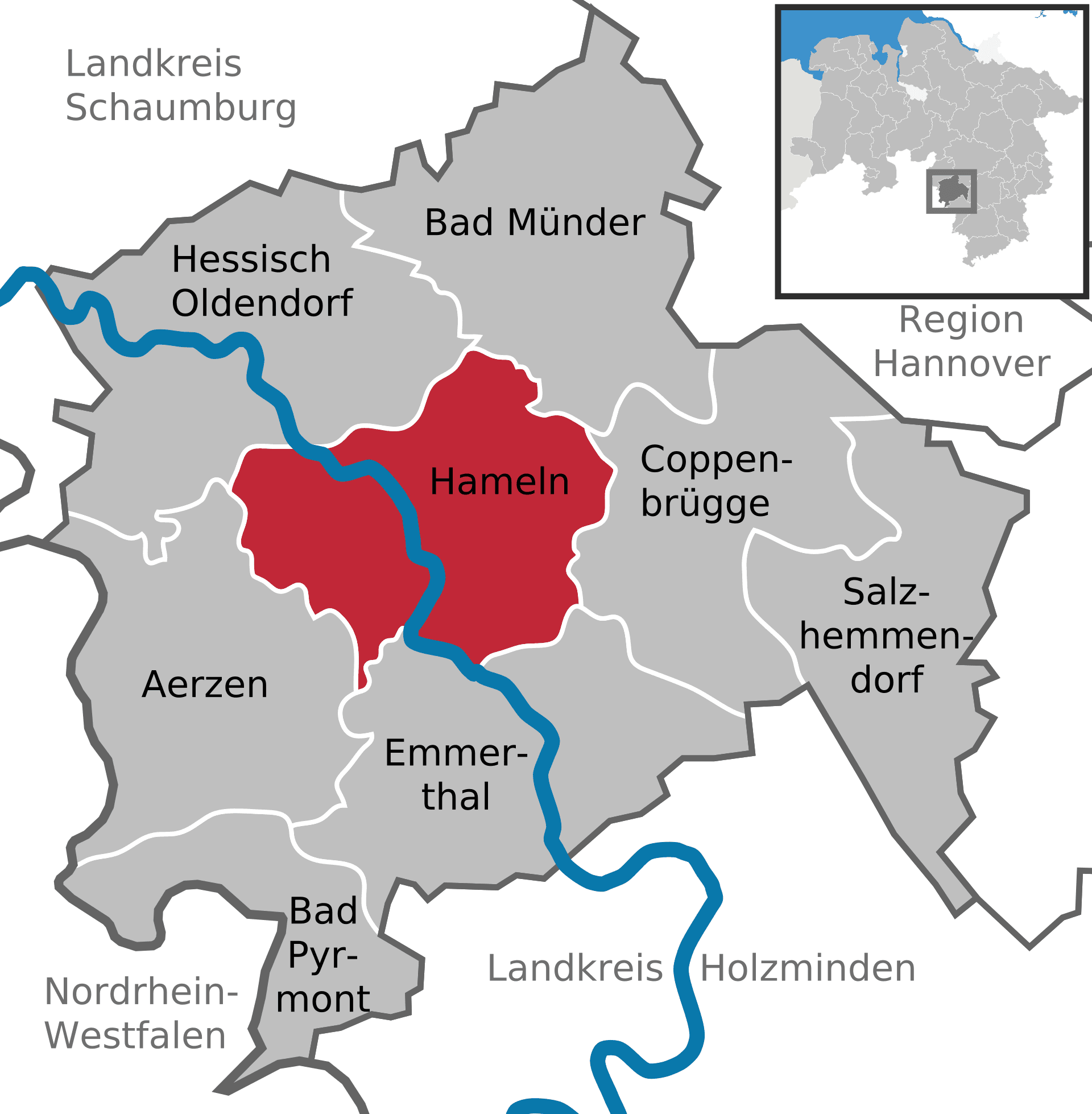 Hagar66 based on work of TUBS / Public domain, via Wikimedia Commons
“Where ancient stones hum with an old, haunting melody.”
Not the postcards. The stories even locals don't know — whispered in your ear, right where they happened.
The earliest visual record of the Pied Piper legend was not a book, but a church window.
A single, stark sentence in the town's ledger from 1384 hints at a real-life tragedy.
One of Hamelin's most ornate buildings carries a stone inscription that serves as a permanent, public memorial to the legend.
Discover every secret of Hamelin
Every address, every reveal in full — in your ear, right where it happened.
You pick your stops. You walk. The voice reveals what the others miss.
No tours available yet. Check back soon — we're preparing them.
Hamelin, or Hameln as it's known in German, is a city in Lower Saxony, Germany, forever entwined with the enigmatic tale of the Pied Piper. Situated on the Weser River, approximately 45 kilometers southwest of Hanover, Hamelin offers a captivating blend of medieval character and legendary intrigue. The city's historic old town is a living museum, characterized by beautifully preserved half-timbered houses and grand Weser Renaissance buildings with ornate facades that speak to centuries of prosperity.
Beyond the folklore, Hamelin is a regional center that maintains its distinct character, making it a compelling destination for those seeking an authentic German experience away from more heavily trafficked tourist routes. It's a place where the echoes of a haunting melody seem to linger in the winding alleyways, and where every corner reveals another connection to the world-famous legend. Whether you're drawn by the mystery of the Pied Piper or the architectural splendor, Hamelin promises a memorable journey through history and imagination.
Hamelin's documented history begins in 851 AD with the establishment of a Benedictine monastery. This monastic settlement gradually attracted craftsmen, merchants, and farmers, forming the nucleus of what would become a significant medieval trading town. By 1200, Hamelin had gained its charter, beginning its transition to an independent urban center with the construction of defensive walls.
The town prospered throughout the 13th and 14th centuries, particularly after joining the Hanseatic League, a powerful network of trading cities across northern Europe. Its strategic location on the Weser River provided merchants with access to markets stretching from inland regions to North Sea ports. Hamelin specialized in the trade of grain, milling, and brewing, and the wealth generated by these activities funded the construction of elaborate half-timbered houses that still define the old town today. This period of economic success, marked by the construction of St. Nicolai Church and the expansion of civic buildings, represents Hamelin's golden age, when it was one of Lower Saxony's most important commercial centers.
It was during this medieval period that the legend of the Pied Piper emerged. The earliest tangible mention of the legend appeared in a Hamelin church window dating from around 1300, which was destroyed in 1660. This window depicted a piper leading children away. Various theories attempt to explain the legend's origins, ranging from a children's crusade or the emigration of young people to Eastern European settlements, to connections with a plague outbreak or a tragic accident. The town's ledger from 1384 contains a chilling entry: 'It is 100 years since our children left,' providing a historical anchor to the mysterious disappearance of 130 children on June 26, 1284.
The Thirty Years' War (1618-1648) brought an abrupt end to Hamelin's prosperity, devastating much of Germany and leading to Hamelin's occupation, siege, and economic collapse. The town never regained its Hanseatic prominence, becoming a modest provincial center. This economic decline, however, had the unintended benefit of preserving much of its medieval architecture, which might otherwise have been demolished during periods of modernization in wealthier cities. Hamelin became part of the Kingdom of Hanover in 1866 and was less severely affected by the two world wars due to its lack of major industry.
Hamelin's historic old town is the focal point of any visit, with its well-preserved Weser Renaissance buildings and half-timbered houses. Start at the Market Square, dominated by the Wedding House (Hochzeitshaus), completed in 1617. This Renaissance building, originally for civic celebrations, features a mechanical Pied Piper clock that performs three times daily at 13:05, 15:35, and 17:35, with figures parading across the display.
Just a short walk away is the Rattenfängerhaus (Pied Piper's House) on Osterstrasse, a prominent Renaissance building from 1602 with an inscription referencing the legend. Follow the 'rat trail', where bronze rat symbols embedded in the paving stones guide you to key attractions related to the fable. The Hamelin Museum, housed in two historic buildings on Osterstrasse, offers a comprehensive insight into local history and the Pied Piper legend, including medieval artifacts and theories about the story's origins. For a peaceful escape, visit St. Boniface Minster, the oldest church in Hamelin, dating back to the 9th century. You can also stroll along the Weser River, or take a boat trip to enjoy the scenic landscape.
The best time to visit Hamelin for warm-weather activities and outdoor events, including the famous Pied Piper play, is from late June to early September. During these summer months, average temperatures are comfortable, ranging from 17-19°C (63-66°F) with highs reaching 22-23°C (72-74°F). May and September also offer pleasant weather with comfortable temperatures and are ideal for leisurely walks and sightseeing. While summer is lively, spring brings blooming flowers, and autumn offers colorful foliage and a quieter experience. Winter is serene and less crowded, suitable for exploring indoor attractions and cozy cafes.
Hamelin is easily accessible by train, with direct connections from Hanover taking approximately 45 minutes. From major cities like Berlin, you can take a train to Hanover and then transfer. The Hameln Bahnhof (train station) is about a 20-minute walk from the historic center, with frequent bus services also available. If driving, the A2 motorway provides access, but parking in the historic center can be challenging; it's best to use multi-storey car parks near the ring road.
The city center is compact and best explored on foot. Look for the 'rat trail' on the paving stones to guide you to main attractions. Many businesses embrace the Pied Piper theme, from souvenir shops to restaurants offering 'rat' themed dishes. The local currency is the Euro (€). While German is the primary language, English is often understood in tourist areas.