Hakone Open-Air Museum
Most museums guard their art behind velvet ropes, but one in Hakone invites you to literally step inside a masterpiece.
Full story unlocks in the tour
 Quercus acuta / CC0, via Wikimedia Commons
“Where volcanic landscapes meet serene lakes, and art finds its open-air canvas.”
Not the postcards. The stories even locals don't know — whispered in your ear, right where they happened.
Most museums guard their art behind velvet ropes, but one in Hakone invites you to literally step inside a masterpiece.
Beneath the tranquil surface of Lake Ashi lies a submerged forest with an ancient secret.
During the Edo period, a checkpoint in Hakone wasn't just looking for weapons; it was specifically designed to catch a particular group of people trying to escape.
Discover every secret of Hakone
Every address, every reveal in full — in your ear, right where it happened.
You pick your stops. You walk. The voice reveals what the others miss.
No tours available yet. Check back soon — we're preparing them.
Hakone, a captivating town within the Fuji-Hakone-Izu National Park, offers a respite from the bustle of Tokyo, less than one hundred kilometers away. This mountainous region is celebrated for its abundant hot springs, striking natural beauty, and the iconic views of Mount Fuji across Lake Ashi. Whether seeking relaxation in traditional onsen (hot springs), exploring diverse art museums, or embarking on scenic hikes, Hakone presents a memorable blend of experiences.
The area's volcanic origins have shaped its dramatic landscapes, from the steaming vents of Owakudani to the serene crater lake of Ashinoko. Easily accessible from Tokyo, Hakone is a popular destination for both day trips and overnight stays, often experienced through a circular sightseeing route that utilizes various modes of transport, including trains, cable cars, ropeways, and boats.
Hakone's history stretches back to ancient times, with the region being an important source of obsidian for stone tools during the Paleolithic period. The area's volcanic mountains were revered, becoming objects of worship. The Hakone Gongen, a significant Shinto shrine, is mentioned in Heian period literature and was founded in 757 CE by the Buddhist priest Mangan Shonin. Legend states that Mangan subdued a nine-headed dragon, Kuzuryu, that terrorized Lake Ashi, transforming it into a protective deity.
During Japan's Kamakura period (late 12th century), Hakone's importance grew as more people traversed its terrain. The area came under the control of the Hōjō clan of Odawara during the Sengoku period. With the start of the Edo period (1603-1868), Hakone-juku became a vital post station on the Tokaido highway, connecting Edo (modern-day Tokyo) with Kyoto. A major barrier and official checkpoint, known as the Hakone Checkpoint (Hakone sekisho), was established to control the movement of people and goods, particularly to prevent women from fleeing the capital.
Hakone's hot springs have a long history, with Yumoto hot springs dating back to the 8th century. By the latter half of the 17th century, seven hot spring resorts, known as Hakone Nanayu, were already established, transitioning from purely medicinal uses to leisure destinations. The Meiji Restoration brought new roads and transportation, diversifying Hakone's appeal as foreigners and influential individuals built holiday villas. The 20th century saw Hakone solidify its reputation as a premier tourist destination, with the development of railways, cable cars, buses, and pleasure boats. In 1969, the Hakone Open-Air Museum, Japan's first outdoor sculpture gallery, opened, further enhancing the region's cultural offerings.
Begin your exploration with the iconic Hakone Loop, a circular route that efficiently connects many of Hakone's highlights using various modes of transport. This journey often includes the scenic Hakone Tozan Railway, a mountain train with switchbacks, and the Hakone Ropeway, an aerial lift offering views of the volcanic Owakudani Valley and Lake Ashi. At Owakudani, an active volcanic zone, you can witness steaming vents and bubbling hot springs, and even try kuro-tamago (black eggs), said to extend one's life by seven years.
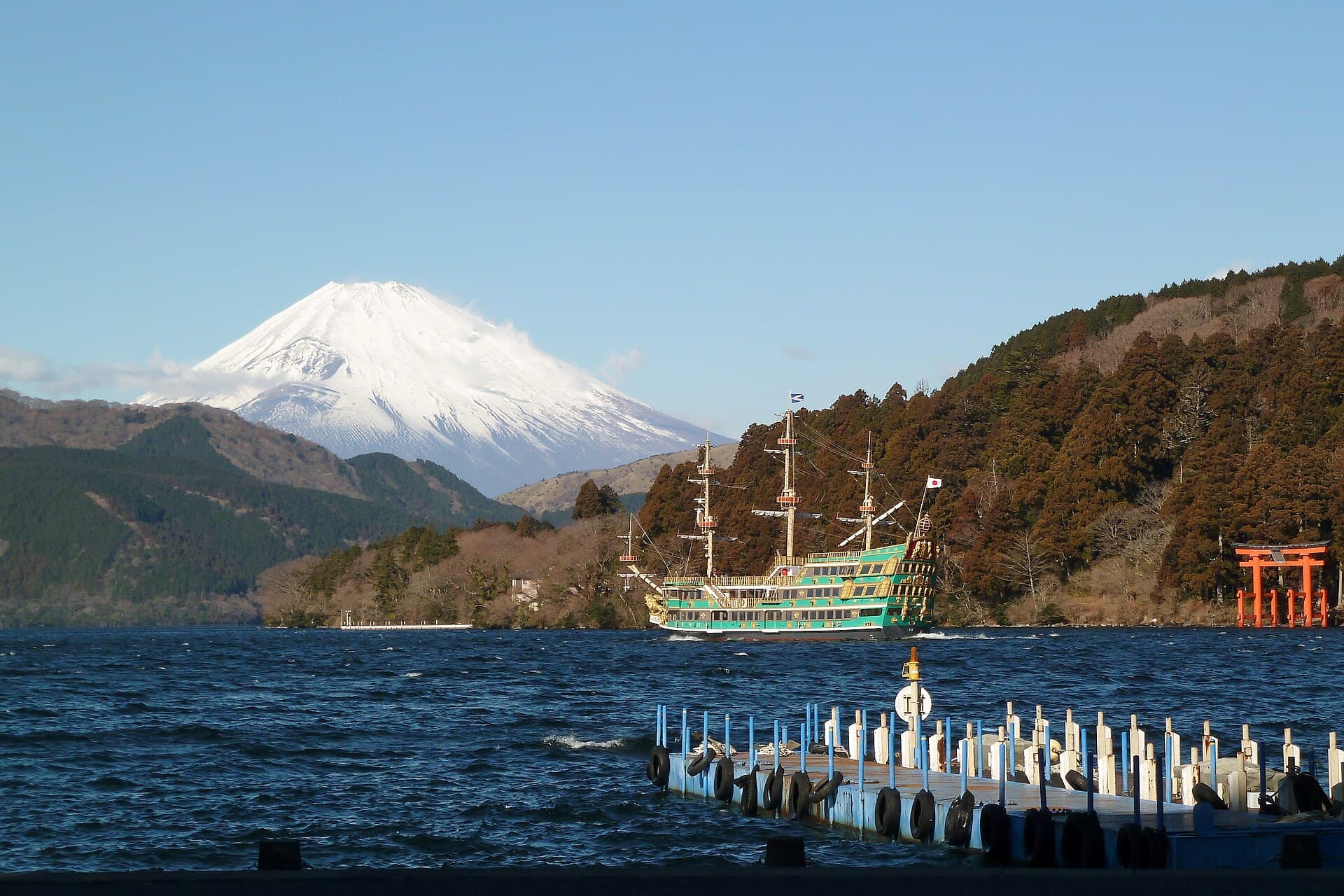
Cruise across Lake Ashi on one of the uniquely themed sightseeing boats, enjoying views of Mount Fuji on clear days. The lake is also home to the Hakone Shrine, known for its striking red torii gate standing in the water. For art enthusiasts, the Hakone Open-Air Museum presents a vast collection of modern and contemporary sculptures displayed outdoors against the natural landscape, alongside indoor galleries including the Picasso Pavilion. Other notable attractions include the Pola Museum of Art, the Hakone Venetian Glass Museum, and the reconstructed Hakone Checkpoint on the Old Tokaido Road.
Hakone is a year-round destination, each season offering distinct charms. Spring (March to May) brings cherry blossoms, first in lower areas like Yumoto and later around Lake Ashi. Summer (June to August) is ideal for hiking and enjoying Lake Ashi's cooler temperatures, with festivals and fireworks. Autumn (September to November) is a popular time for its vivid fall foliage and clearer views of Mount Fuji. Winter (December to March) offers crisp, clear air, excellent Mount Fuji visibility, and the serene experience of onsen amidst potentially snowy landscapes, often with fewer crowds and more affordable prices.
Getting to Hakone from Tokyo is straightforward, typically taking 1.5 to 2 hours by train. The Odakyu Romancecar offers a direct route from Shinjuku Station to Hakone-Yumoto Station. Alternatively, take the Shinkansen to Odawara Station and transfer to the local Odakyu service. Once in Hakone, the Hakone Free Pass is highly recommended, covering unlimited rides on most public transportation within the area, including trains, buses, cable cars, ropeways, and sightseeing boats, and offering discounts on attractions.
The Hakone area is spread out, encompassing various villages, lakes, and mountains. Consider an overnight stay in a ryokan (traditional inn) to fully experience the onsen culture and avoid rushing. While many restaurants are accommodating to dietary needs, specific vegetarian or halal options may require advance inquiry. Temperatures vary significantly with elevation; pack layers, especially for higher areas like Owakudani and Lake Ashi, which can be 3-4°C cooler than Hakone-Yumoto.