Hagi Castle Town
The traditional walls of Hagi's samurai and merchant districts hold a purpose beyond their visual charm.
Full story unlocks in the tour
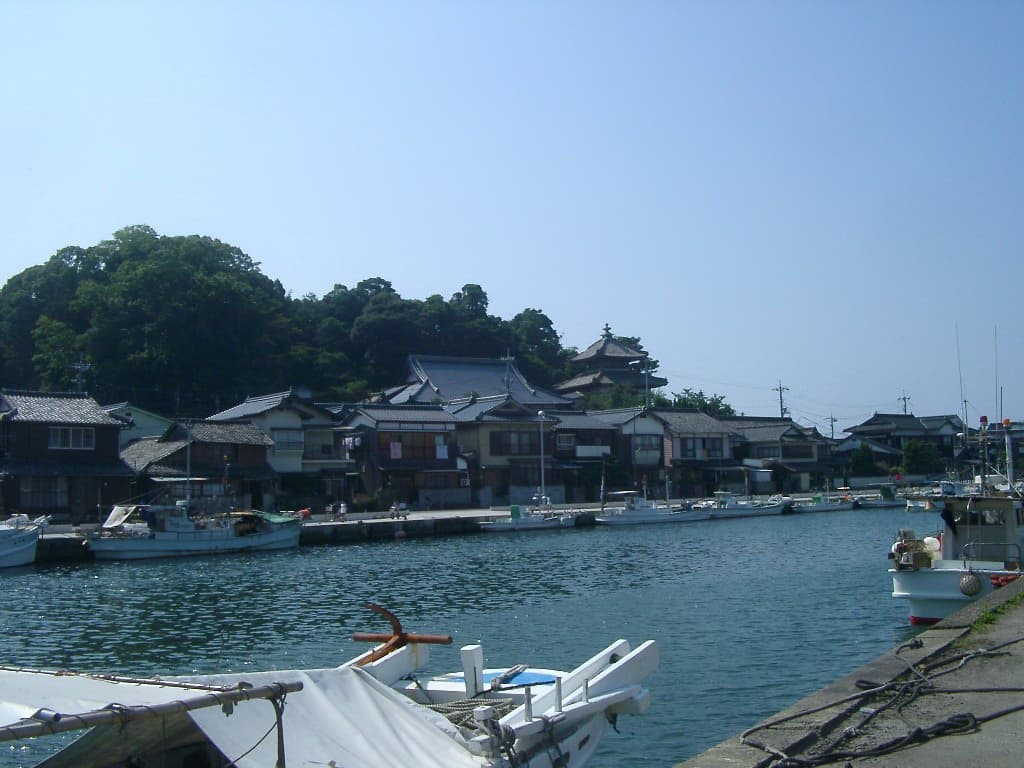 by User:Suhobei / Public domain, via Wikimedia Commons
“Where the spirit of samurai forged a modern nation, etched into clay and enduring streets.”
Not the postcards. The stories even locals don't know — whispered in your ear, right where they happened.
The traditional walls of Hagi's samurai and merchant districts hold a purpose beyond their visual charm.
A bronze statue of Yoshida Shoin gazes towards the sea, a poignant detail that suggests a forbidden aspiration.
Hagi ware is celebrated for its 'seven transformations,' a subtle evolution that deepens its character over time.
Discover every secret of Hagi
Every address, every reveal in full — in your ear, right where it happened.
You pick your stops. You walk. The voice reveals what the others miss.
No tours available yet. Check back soon — we're preparing them.
Hagi, a tranquil castle town on the Sea of Japan coast in Yamaguchi Prefecture, offers a rare window into Japan's momentous shift from feudalism to a modern industrial nation. Unlike many cities that have undergone extensive modernization, Hagi has largely retained its Edo-period townscape, allowing visitors to navigate its thoroughfares with maps from centuries past.
Embraced by the sea and mountains, Hagi's strategic placement and the foresight of its leaders played a pivotal role in shaping Japan's future. The city is celebrated for its well-preserved samurai and merchant districts, its distinctive Hagi-yaki pottery, and a collection of UNESCO World Heritage sites that chronicle the dawn of Japanese industrialization.
## The Mori Clan and the Edo Period Hagi's story as a castle town began in 1604 when the Mori clan, following their defeat at the Battle of Sekigahara, was relocated to this distant region and constructed Hagi Castle at the base of Mount Shizuki. For over 250 years, Hagi served as the capital of the Mori clan, one of the most formidable feudal families during the Edo period. The castle itself was an intricate structure, blending a flatland fortress with a mountain redoubt, and its expansive stone walls still bear evidence of the quarrying activities.
## Seeds of Revolution: The Bakumatsu Era Despite its apparent remoteness, Hagi became a crucible of change during the tumultuous Bakumatsu period (the final years of the Edo period). The forced relocation of the Mori clan fostered anti-Tokugawa sentiment, a resentment so profound that Mori lords reportedly slept with their feet pointed towards Edo (Tokyo) as a sign of disrespect. This sentiment eventually translated into action, as leaders from Hagi played a central role in the movement to overthrow the Tokugawa shogunate and restore imperial rule.
## Architects of Modern Japan: The Meiji Restoration Hagi is recognized as the birthplace of many influential figures who laid the groundwork for modern Japan during the Meiji Restoration (1868-1912). Among them was Yoshida Shoin, a samurai scholar whose private school, Shokasonjuku, educated numerous young men who would go on to hold important positions in the new Meiji government, including Japan's first Prime Minister, Ito Hirobumi. The city's dedication to modernization is further evidenced by its five UNESCO World Heritage sites, which are part of the 'Sites of Japan's Meiji Industrial Revolution.' These sites, including the Hagi Castle Town, Hagi Reverberatory Furnace, Ebisugahana Shipyard, Shokasonjuku Academy, and Ohitayama Tatara Iron Works, represent early efforts in industrialization.
The Hagi Castle Town is a well-preserved district where you can wander through streets laid out centuries ago, lined with traditional samurai and merchant residences. Observe the distinctive white-walled streets and the pervasive natsumikan orange trees. The Kikuya Residence, a former affluent merchant's home, offers a glimpse into Edo-period life with its rock garden and traditional architecture. Nearby, the Horiuchi Kaimagari street features 90-degree turns and high walls, a testament to the town's defensive design.
Explore the Hagi Castle Ruins (Shizuki Park), where only the stone walls and moats of the 1604 castle remain, but the park is particularly lovely during cherry blossom season. For a deeper understanding of Hagi's revolutionary past, visit the Hagi Meirin Gakusha, a repurposed elementary school that now serves as a museum and visitor center, providing insights into Hagi's role in the Meiji Restoration and its UNESCO sites.
Consider the Hagi Reverberatory Furnace, an experimental furnace built in 1856 for cannon production, and a key UNESCO World Heritage site illustrating Japan's early industrial ambitions. Finally, immerse yourself in the world of Hagi-yaki pottery by visiting local studios or even trying your hand at crafting your own piece.
Hagi experiences four distinct seasons. For agreeable sightseeing weather, consider visiting during spring (March-May) or autumn (September-November), when average temperatures range from 18°C to 24°C. Spring, particularly from late March to early April, is ideal for viewing the 600 cherry trees in Shizuki Park. In May, the city is filled with the sweet fragrance of natsumikan orange blossoms. Autumn offers comfortable temperatures and events like Kimono Week in October, when streets are adorned with bamboo lanterns. Summers (June-August) are warm and humid, with August peaking at around 32°C (90°F), and July being the wettest month. Winters (December-February) are cool, with average temperatures around 5-7°C.
Hagi is accessible by bus from Shin-Yamaguchi Station, with the fastest Hagi-go Bus taking one hour. While a private car offers flexibility for exploring the wider Yamaguchi Prefecture, Hagi's central attractions are largely walkable. The Hagi Tourist Information Center, situated next to the Hagi Bus Center, provides complimentary tourist information, maps, and Wi-Fi. They also offer a 'Hagi Wonder Pass' for free admission to select attractions like Hagi Meirin Gakusha, Hagi Museum, and Hagi Castle Ruins & Shizuki Park. For convenient sightseeing, consider the Tebura Hagi Tourism Service, which delivers luggage to your accommodation, allowing for hands-free exploration. Free public Wi-Fi is available at 26 locations throughout Hagi.