Fontana dei Matti (Fountain of the Madmen)
Gubbio extends a singular civic honor, not for courage or insight, but for embracing a particular local spirit.
Full story unlocks in the tour
 Labicanense / CC BY 4.0, via Wikimedia Commons
“Where medieval stone murmurs ancient stories and a touch of delightful eccentricity.”
Not the postcards. The stories even locals don't know — whispered in your ear, right where they happened.
Gubbio extends a singular civic honor, not for courage or insight, but for embracing a particular local spirit.
This formidable medieval palace, an emblem of Gubbio's past authority, contained an unexpected amenity for its era.
Just beyond Gubbio, a dramatic gorge conceals a discovery that helped reshape Earth's chronology.
Discover every secret of Gubbio
Every address, every reveal in full — in your ear, right where it happened.
You pick your stops. You walk. The voice reveals what the others miss.
No tours available yet. Check back soon — we're preparing them.
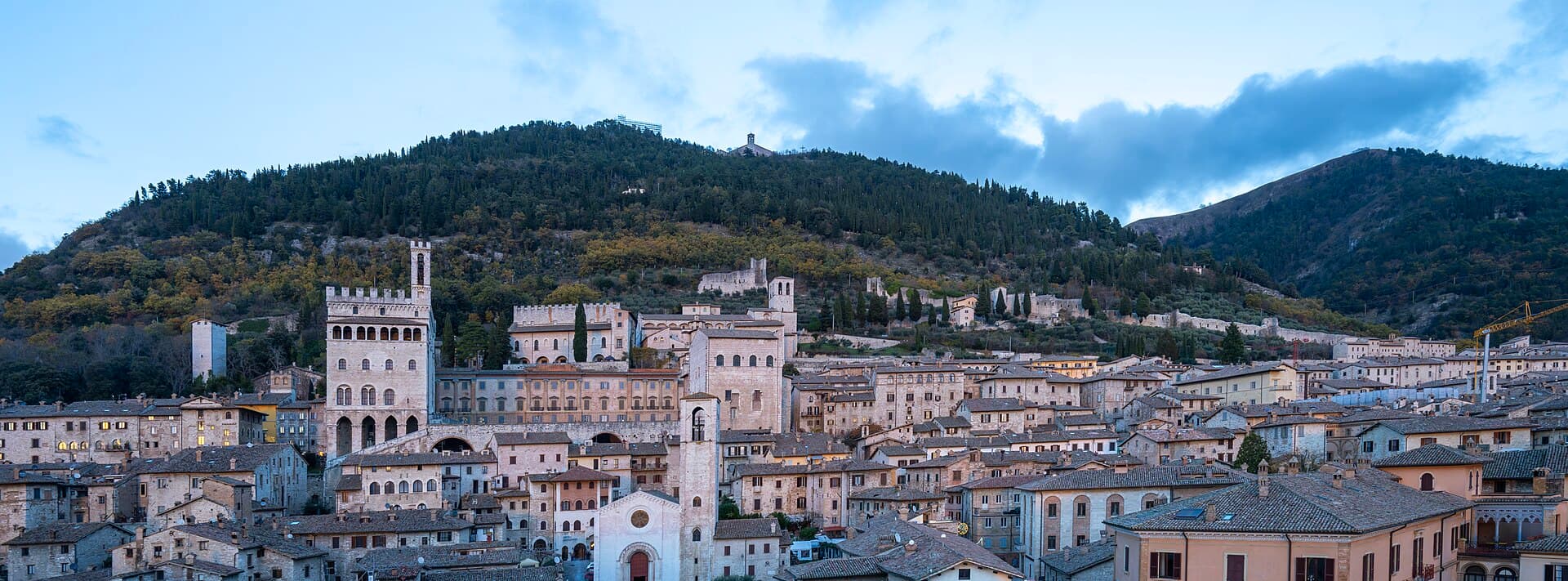
Gubbio, a compelling medieval town in Umbria, Italy, ascends dramatically on the slopes of Mount Ingino. Known as the 'City of Stone' or even the 'City of Fools,' it offers a journey through time with its well-preserved Gothic architecture and intricate stone-paved streets. The town's enduring allure resides in its capacity to retain its ancient character, where history is not merely exhibited but feels alive in every corner. From its Bronze Age beginnings to its Roman and medieval prominence, Gubbio has witnessed millennia of human activity, leaving behind layers of cultural and historical significance.
Stepping into Gubbio means immersing yourself in a landscape of terracotta rooftops and stone facades, framed by the green Umbrian hills. The town's singular identity is profoundly interwoven with its traditions, from ancient ceremonies to lively festivals that enliven its squares and alleys. Whether you are drawn to its archaeological treasures, its artistic heritage, or simply the appeal of its timeless atmosphere, Gubbio promises an authentic Italian experience that moves beyond the ordinary.
Gubbio's origins extend to the ancient Umbrian civilization, predating the Romans. Evidence of human habitation in the Gubbio valley dates to the Middle Paleolithic period, with more permanent settlements appearing in the Neolithic era. The town, then identified as Iguvium (or Eugubium), served as a significant center for the Umbri, contemporaries of the Etruscans. The renowned 'Eugubine Tablets,' a collection of seven inscribed bronze sheets from the 3rd to 1st century BC, represent the longest and most crucial documents of the ancient Umbrian language, offering invaluable insights into their religion and governance. These can be observed in the Civic Museum.
By the 3rd century BC, Iguvium became an ally of the Roman Republic, eventually integrating into Roman culture by the 1st century BC. The Roman presence remains visible today in the impressive Roman Theatre. Following the decline of the Roman Empire, Gubbio experienced a tumultuous period, enduring conquests by the Goths, Byzantines, and Lombards, and even suffering extensive destruction by the Hungarians in the 10th century.
The town's most prosperous period commenced around the year 1000, as it emerged as a formidable independent commune. Under the leadership of Bishop Ubaldo, Gubbio achieved a notable victory against Perugia and eleven other rival cities in 1151, securing its independence and prosperity. The 13th and 14th centuries saw the construction of many of Gubbio's most iconic buildings, including the magnificent Palazzo dei Consoli and Piazza Grande, affirmations of the town's political and institutional aspirations. Gubbio later came under the dominion of the Montefeltro and Della Rovere dukes of Urbino for approximately three centuries, transforming into a flourishing Renaissance center before its annexation by the Papal States in 1631. It remained under papal governance until its unification with the Kingdom of Italy in 1860.
Begin your exploration at Piazza Grande, a remarkable 'hanging' square that provides expansive views over the city's terracotta rooftops and the surrounding landscape. Dominating the piazza is the Palazzo dei Consoli, a grand Gothic palace constructed between 1332 and 1349. It now houses the Civic Museum, where you can examine the ancient Eugubine Tablets. Directly opposite, the Palazzo Ducale, a Renaissance-era dwelling of Federico da Montefeltro, offers beautiful gardens and further city views.
Just beyond the medieval walls, discover the Roman Theatre, built around 20 BC. It was once the second-largest theater in the Roman Empire, after the Theater of Marcellus in Rome, and remains a significant archaeological site. Take the unique Funivia Colle Eletto, an open-cage cable car, up Mount Ingino to reach the Basilica di Sant'Ubaldo. This basilica enshrines the body of Gubbio's patron saint and offers sweeping vistas. Wander through the town's narrow, stone-paved streets, where you will encounter the Fontana dei Matti (Fountain of the Madmen) in front of Palazzo del Bargello, and the Loggia dei Tiratori, a 17th-century structure erected by the weavers' guild.
The most favorable times to visit Gubbio are during the spring (April to June) and fall (September to October). During these seasons, the weather is mild and pleasant for exploring the town on foot, and there are generally fewer crowds. Summer months can be warm, with July being the hottest month, averaging 83°F (28°C) highs, but it is a lively time for outdoor activities. If you plan to visit in May, you can experience the historic Festa dei Ceri, but be prepared for larger crowds. Winter, particularly from November to February, can be chilly, foggy, and damp, making outdoor sightseeing less enjoyable.
Gubbio is a compact town best explored on foot, allowing you to fully appreciate its medieval character and intricate streets. While driving within the historic center is challenging due to narrow streets, free parking is available outside the city walls, notably at the Roman Theatre. Several elevators are also available to assist in navigating the town's different levels. For accommodation, options range from luxury hotels like Park Hotel ai Cappuccini and Relais Ducale Hotel to charming agriturismi in the surrounding countryside. Gubbio is celebrated for its truffles, so indulging in local cuisine featuring this delicacy is highly recommended. The town is generally a very safe destination for visitors. When considering souvenirs, look for hand-painted ceramics, leather goods, local wines, and truffle products.