Schlossberg Clock Tower
The iconic Graz Clock Tower, a symbol of the city, tells time in an unusual way.
Full story unlocks in the tour
 Nick Savchenko from Kiev, Ukraine / CC BY-SA 2.0, via Wikimedia Commons
“Where history wears a modern coat, and the Mur river shares its secrets.”
Not the postcards. The stories even locals don't know — whispered in your ear, right where they happened.
The iconic Graz Clock Tower, a symbol of the city, tells time in an unusual way.
Look closely at one of the stained-glass windows in the Stadtpfarrkirche, and you might spot some unexpected historical figures.
An artificial island floats in the middle of Graz's river, offering more than just an architectural marvel.
Discover every secret of Graz
Every address, every reveal in full — in your ear, right where it happened.
You pick your stops. You walk. The voice reveals what the others miss.
No tours available yet. Check back soon — we're preparing them.
Graz, Austria's second-largest city, offers a captivating blend of historical grandeur and contemporary innovation. Its historic center, a UNESCO World Heritage site since 1999, displays architectural styles from Gothic and Renaissance to Baroque and Art Nouveau. Yet, Graz is far from a city dwelling in the past; it is also recognized as a UNESCO City of Design, embracing modern architectural marvels like the futuristic Kunsthaus and the Murinsel.
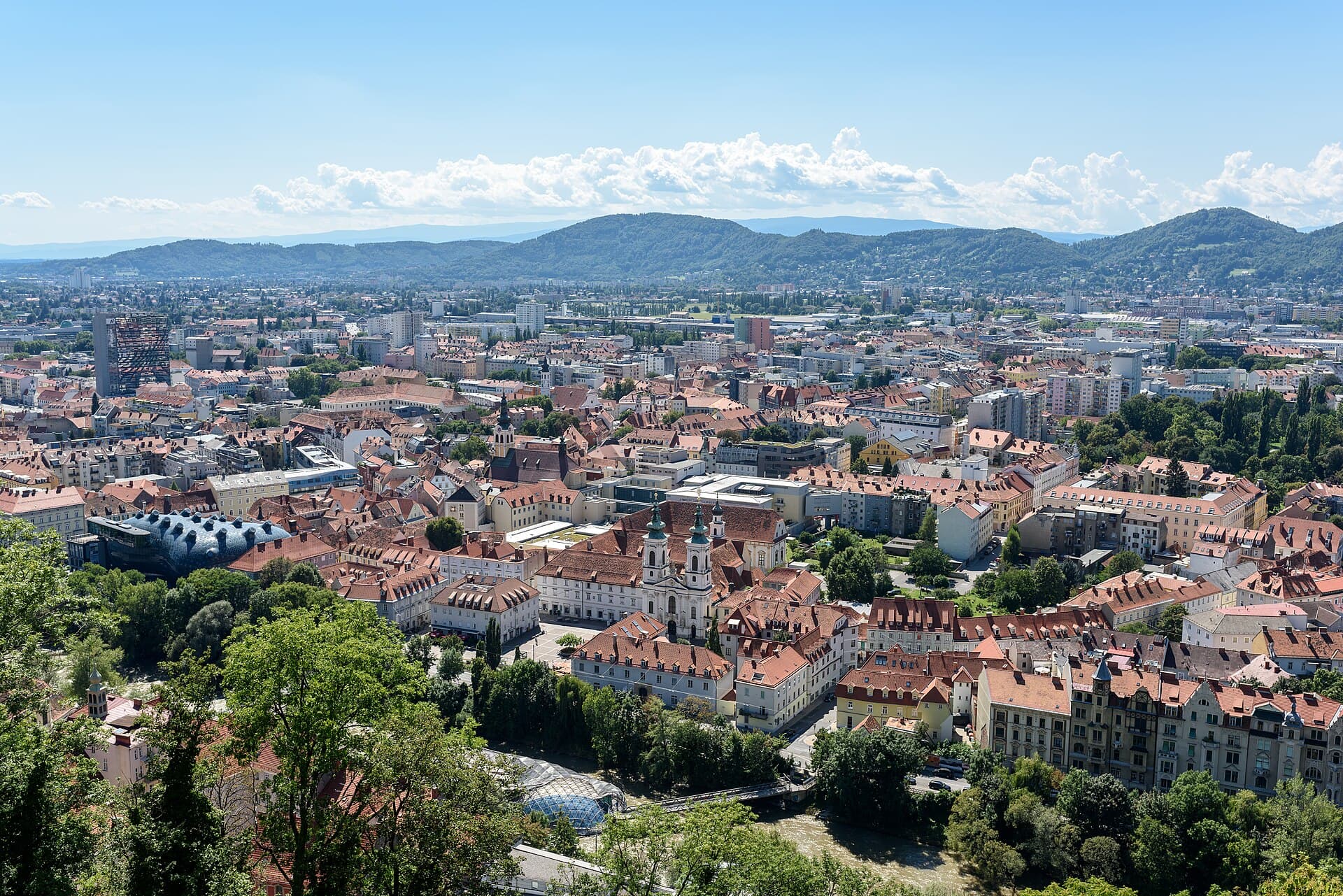
Situated on the Mur River in the Styria region, often called the 'Green Heart of Austria,' Graz presents a unique appeal with its red-tiled rooftops, green parks, and surrounding rolling hills. The city's relaxed pace, combined with a lively student population from six universities, creates an inviting atmosphere for exploration.
Graz is also celebrated as Austria's Culinary Capital, with a diverse food scene that emphasizes high-quality regional cuisine and numerous farmers' markets. This blend of history, design, natural beauty, and gastronomic delights offers a multifaceted experience for visitors seeking an authentic Austrian encounter beyond the more frequented tourist paths.
The story of Graz begins on the Schlossberg hill, where a small fortification gave the city its name, derived from the Slavic word "gradec," meaning "little fortress." The first written records of a settlement at its base date back to 1128, and by the 13th century, Graz had earned city status and became the administrative center of the Duchy of Styria.
Graz's strategic location on the Mur River, at the foothills of the Alps, made it a crucial trade hub connecting Italy with Central Europe. This position also made it a frequent target for invaders, including the Hungarians in 1481 and the Ottoman Turks in 1529 and 1532. The Schlossberg fortress, along with Riegersburg Castle, never fell to the Ottoman Turks.
From the late 13th century, Graz's destiny became intertwined with the powerful Habsburg dynasty. In the 14th century, it served as the capital of Inner Austria and the residence of the Leopoldinian line of the Habsburgs, ushering in a "Golden Age" of rapid growth and cultural development. During the 15th and 16th centuries, Italian Renaissance architects and artists significantly shaped the city's design, leaving behind a legacy of beautifully preserved Renaissance architecture, including the Landhaus.
The establishment of the University of Graz in 1585 by Archduke Karl II further solidified the city's status as a leading educational and scientific center. However, this period also saw religious strife, with Protestantism flourishing around 1530 until Archduke Karl of Inner Austria initiated oppressive measures to restore Catholic authority. The 19th century brought industrial growth, fueled by the railway connecting Graz with Vienna and Trieste, transforming it into an economic hub of the Austro-Hungarian Empire.
The city faced military challenges during the Napoleonic Wars, being occupied by French forces in 1797, 1805, and 1809. Despite a valiant defense of the Schlossberg, the fortress was ultimately demolished by explosives as stipulated in the Peace of Schönbrunn in 1809. In more recent history, Graz was designated the European Capital of Culture in 2003 and a UNESCO City of Design in 2011, recognizing its ongoing commitment to creativity and innovation.
Begin your exploration in the Hauptplatz, Graz's main square, a lively hub surrounded by elegant Baroque and Renaissance buildings, including the impressive Town Hall. From here, wander through the inviting streets of the Old Town, a UNESCO World Heritage site, admiring the colorful facades and discovering quiet courtyards.
Walk up the Schlossberg, the city's iconic hill, for sweeping views of Graz's red rooftops. You can reach the summit via a scenic climb, the Schlossbergbahn funicular, or the glass Schlossberglift elevator. Atop the Schlossberg, you'll find gardens, old bastions, and the famous Clock Tower (Uhrturm), a symbol of Graz.
Don't miss the Landeszeughaus (Styrian Armory), the world's largest historical armory, housing over 32,000 pieces of weaponry and armor. For a striking contrast, visit the Kunsthaus Graz, affectionately known as the "Friendly Alien," a futuristic art museum that stands out amidst the historic architecture. Another modern marvel is the Murinsel, an artificial island in the Mur River that serves as a cafe and event space.
Explore the Grazer Burg to discover the unique Double Spiral Staircase (Doppelwendeltreppe), a Renaissance optical illusion. Nearby, visit the Graz Cathedral and the Mausoleum of Emperor Ferdinand II. For a grand Baroque experience, take a trip to Eggenberg Palace, a UNESCO World Heritage site on the city's outskirts, known for its cosmic calendar design and extensive gardens.
Graz experiences a moderate continental climate with four distinct seasons. The most popular time to visit is from May through September, when the weather is pleasantly warm, with average daily temperatures ranging from 17°C to 19°C (63-66°F) and highs reaching 24°C (75°F). This period is ideal for outdoor activities, enjoying café culture, and attending festivals like Styriarte (classical music) and La Strada (street arts). Autumn, particularly September and October, is also highly recommended. The weather is mild, the fall foliage is colorful, and the city hosts the Steirischer Herbst contemporary arts festival and new wine season events. Winter, from December to February, brings cooler temperatures around 0°C (32°F) and the charm of Christmas markets.
Graz is a highly walkable city, especially its compact Old Town, making it easy to explore many attractions on foot. Public transport is efficient and well-connected, with a dense network of trams (affectionately called "Bim") and buses operated by Holding Graz. A unique feature is the "Altstadt Bim," allowing free tram rides within the historic city center. Tickets for public transport, including the Schlossberg funicular, can be purchased via the GrazMobil app, on vehicles (cashless on buses), at ticket machines, or in tobacconists. An hourly ticket costs €3.20, and a 24-hour ticket is €7.00.
Graz Airport (Graz-Thalerhof) is about 10 kilometers (6 miles) south of the city center, with connections via bus line 630 or the S1 suburban train to Graz Hauptbahnhof (main train station). The main train station is well-connected to other Austrian and European cities. While German is the official language, many Austrians, particularly in public life and tourist areas, speak English. The local dialect is Styrian, a subdialect of Bavarian-Austrian. The currency used is the Euro (€).