Basilica of Sant'Eufemia
The floor of this ancient basilica holds a secret that connects it to a much larger, lost city.
Full story unlocks in the tour
 Carsten Steger / CC BY-SA 4.0, via Wikimedia Commons
“Where ancient mosaics meet golden sands, Grado is the 'Island of the Sun.'”
Not the postcards. The stories even locals don't know — whispered in your ear, right where they happened.
The floor of this ancient basilica holds a secret that connects it to a much larger, lost city.
The tranquil waters of the Grado Lagoon conceal more than just fishing boats and small islands.
While Grado is celebrated for its sandy shores, there's a unique characteristic of the sand itself that was once considered therapeutic.
Discover every secret of Grado
Every address, every reveal in full — in your ear, right where it happened.
You pick your stops. You walk. The voice reveals what the others miss.
No tours available yet. Check back soon — we're preparing them.
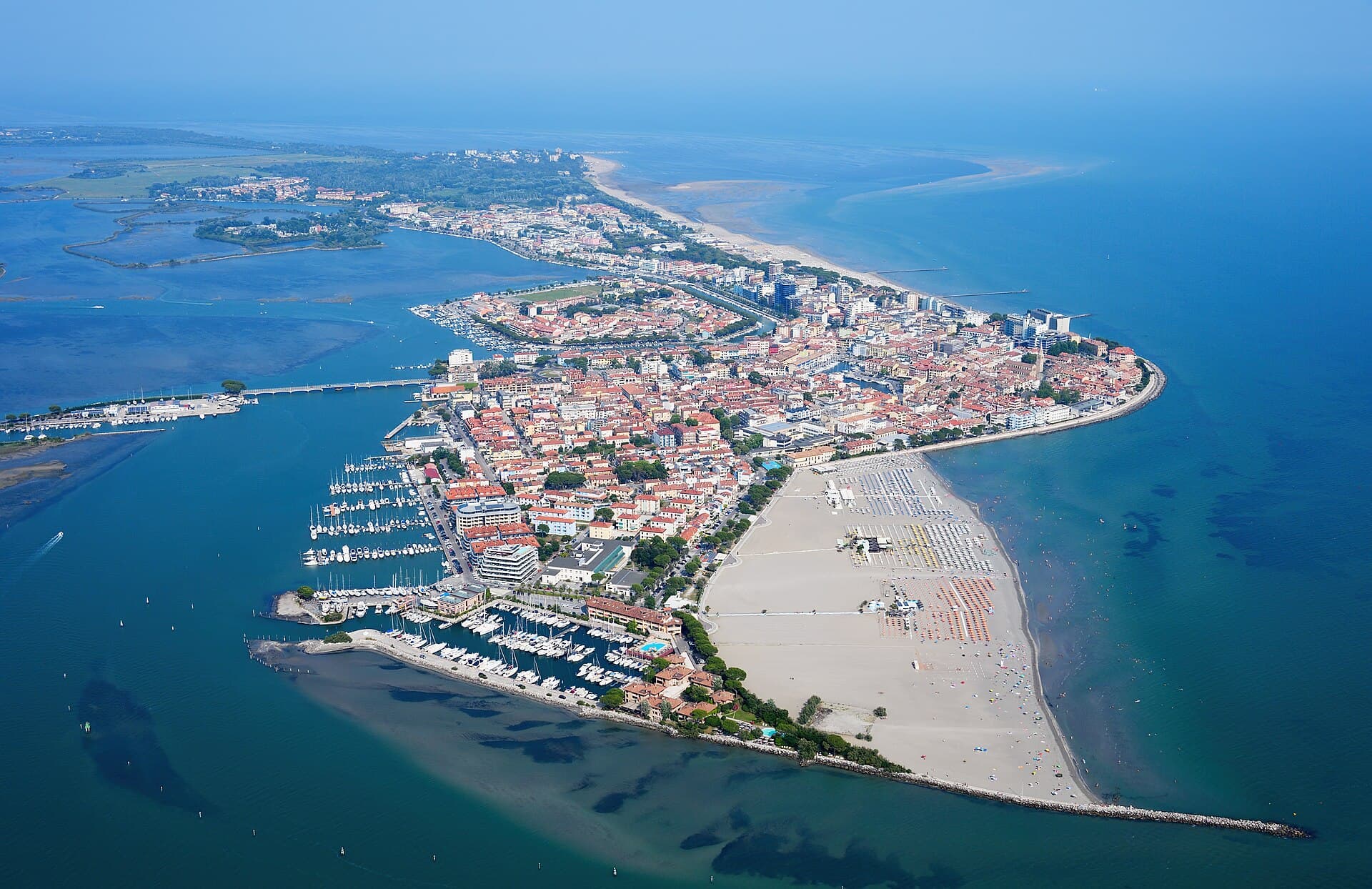
Grado, often called the "Island of the Sun" (L'Isola del Sole), is a captivating coastal town positioned on an island in Italy's Friuli Venezia Giulia region, between Venice and Trieste. A causeway connects this destination to the mainland. Its golden, sandy beaches and a calm, family-focused atmosphere draw visitors. Here, the Adriatic Sea offers gentle, clear, and shallow waters, making it especially appealing for families with young children and those seeking a serene seaside escape.
Beyond its reputation as a beach resort, Grado presents a deep historical narrative, evident in its well-preserved medieval core. The town's narrow passages and inviting squares encourage unhurried exploration, revealing ancient basilicas adorned with intricate mosaics and traces of its Roman heritage. Grado also serves as a gateway to the peaceful Grado Lagoon, a protected natural sanctuary dotted with small islands, providing opportunities for boat excursions and a closer connection with the natural world.
Grado's origins stretch back to Roman times, when it was known as Gradus, a vital port for vessels journeying upstream to Aquileia, a significant city of the East Roman Empire. Initially a castrum or fortress, Grado offered refuge to those escaping Aquileia during barbarian incursions, particularly after Attila the Hun's destruction of Aquileia in 452 AD. This influx of people and the subsequent relocation of the Patriarchate of Aquileia to Grado in 568 AD, prompted by the Lombard invasion, cemented its standing as a religious and ecclesiastical center. For centuries, Grado functioned as the metropolitan capital for churches in coastal cities, including Venice, wielding considerable influence until 1451.
During the Middle Ages, Grado played a central role in maritime trade, facilitating the exchange of goods like salt, seafood, and textiles across the Adriatic and into Northern Europe. The town's design, with its narrow passages and historic homes, still echoes its medieval past. However, with the ascendance of Venice and the eventual dissolution of the Patriarchate in the 15th century, Grado's prominence diminished, and it largely reverted to a small fishing village under the Republic of Venice.
The 19th century brought a notable resurgence for Grado. In 1815, it became part of the Habsburg Empire, and by 1892, the Austro-Hungarian State officially recognized it as a spa town, celebrated for its therapeutic marine air and the establishment of Europe's first sand-bathing facility. This era saw the construction of seaside resorts and villas, attracting Austrian aristocracy and establishing Grado as a favored tourist destination. After World War I and the dissolution of the Austro-Hungarian Empire, Grado became part of Italy in 1918. Its isolation as an island finally ended in 1936 with the construction of a swing bridge connecting it firmly to the mainland. Today, Grado continues to flourish as a cherished seaside resort, balancing its ancient legacy with contemporary tourism.
Begin your exploration in Grado's historic center, a maze of narrow calli (lanes) that recall Venice. Here, you will uncover the town's early Christian origins. The Basilica of Sant'Eufemia, dating from the 6th century, forms a cornerstone of Grado's Byzantine past, featuring impressive mosaics and frescoes. Next to it stands the smaller, yet equally important, Basilica di Santa Maria delle Grazie, one of Italy's oldest churches, also adorned with beautiful mosaics and Roman columns. In Piazza Biagio Marin, you can observe excavated mosaic remains from another 4th-6th century basilica.
Beyond the historical core, Grado's primary allure is its expansive coastline. The Spiaggia Principale is a three-kilometer-long sandy beach, known for its calm, clear, and shallow waters, ideal for families. Other popular beach areas include Costa Azzurra, a local favorite, and Grado Pineta, which offers shade from a pine forest. For a singular experience, take a boat trip across the lagoon to the Sanctuary of Barbana, an ancient shrine on an island. Grado is also a haven for cyclists, with a network of paths that allow you to explore the town and nearby nature reserves, including the Alpe Adria cycle route. Consider a visit to nearby Aquileia, a UNESCO World Heritage site with significant Roman ruins and striking basilica mosaics, just 14 kilometers away.
Grado awakens from May to September, with the summer months of July and August being the busiest for beach activities and when all businesses are fully operational. During this peak season, temperatures are warmest, averaging highs of 28°C (83°F) in July. For those who prefer fewer crowds and slightly milder temperatures, May, June, or September offer weather warm enough for the beach and swimming, without the intense humidity or the prevalence of mosquitoes that can accompany mid-summer. While Grado can be visited year-round, many seasonal businesses close in the fall and winter, when the town returns to a quieter fishing village with colder, damp, and windy conditions.
Grado is readily accessible, positioned between Venice and Trieste. The closest airport is Trieste (TRS), about 18 kilometers away, with bus connections directly to Grado. If arriving by train, the nearest station is Cervignano, from which a 25-minute bus ride will bring you to Grado. The town is compact and level, making it ideal for exploring on foot or by bicycle. Bike rentals are widely available, with many hotels offering them to guests. Public transportation includes local buses and ferries for lagoon excursions and trips to nearby islands like Barbana. The official currency is the Euro. Italian is the primary language, though the Gradese dialect is also spoken, and due to its history, German is frequently heard, with many menus and tourist information available in both Italian and German. European citizens only require a valid ID, while non-EU citizens may need a passport and potentially a visa for stays exceeding 90 days.