Gotha, GermanyPetar Milošević / Public domain, via Wikimedia Commons
DE

Gotha

Where Baroque grandeur meets quiet charm, Gotha unfolds stories of royalty, revolution, and remarkable artistry.

The secrets of Gotha

Gotha, as no one tells it.

Not the postcards. The stories even locals don't know — whispered in your ear, right where they happened.

3 secrets below. Many more wait inside the tour.
Ekhof Theatre, Friedenstein Castle

Imagine a stage where scenery shifts in mere seconds, not with modern technology, but with a complex system of ropes and wooden machinery that has been in continuous use for centuries.

Full story unlocks in the tour
Ducal Museum, Gotha

Among the masterpieces of European art, a single painting, often called the 'Mona Lisa of Thuringia,' depicts a couple whose identities remain a captivating mystery.

Full story unlocks in the tour
Friedenstein Castle's Kasematten

Beneath the serene castle park lies a labyrinth, a testament to Gotha's strategic past, offering a unique underground journey.

Full story unlocks in the tour
The full tour

Discover every secret of Gotha

Every address, every reveal in full — in your ear, right where it happened.

Get the key to Gotha

You pick your stops. You walk. The voice reveals what the others miss.

Choose your time

How long do you have in Gotha?

No tours available yet. Check back soon — we're preparing them.

About Gotha

The story of Gotha

Gotha, a city in the heart of Thuringia, Germany, offers a compelling blend of historical significance and cultural depth. First mentioned in 775 CE in a document signed by Charlemagne, Gotha is one of the region's oldest settlements. For centuries, it served as the residence of the Dukes of Saxe-Gotha and later the co-capital of the Duchy of Saxe-Coburg and Gotha, a lineage that includes the British royal family.

The city's well-preserved old town, with its Baroque and Renaissance architecture, invites exploration on foot. Historic market squares and inviting cafes create a tranquil atmosphere, often noted for its lack of overwhelming crowds. Gotha's cultural landscape is dominated by the imposing Friedenstein Castle, a monumental early Baroque palace that stands as a symbol of its ducal past.

History

From 'Good Waters' to Royal Connections

Gotha's origins trace back to 775 CE, when it was documented as 'Villa Gotaha,' meaning 'Good Waters,' by Charlemagne. Its strategic location at the junction of important trade routes, including the Via Regia, fostered its growth into a significant market town during the late Middle Ages. By the 12th century, Gotha had gained city status.

The city's ducal era began in 1640, when it became the capital of the Duchy of Saxe-Gotha. Duke Ernst I, known as 'the Pious,' initiated the construction of Friedenstein Castle between 1643 and 1654, naming it 'Rock of Peace' amidst the Thirty Years' War. This impressive palace, Germany's largest early Baroque castle, became the heart of the duchy, housing administration, military, a library, and extensive collections.

In 1826, Gotha merged with neighboring Coburg to form the Duchy of Saxe-Coburg and Gotha. This period saw Gotha's influence extend across Europe through strategic royal marriages. Notably, Prince Albert of Saxe-Coburg-Gotha married Queen Victoria of Great Britain in 1840, making their descendants the British royal family, initially styled the House of Saxe-Coburg-Gotha until 1917. Gotha also became a hub for the Enlightenment in the 18th century, fostering sciences and arts. The influential Almanach de Gotha, a definitive directory of European nobility, was first published here in 1763 and remains associated with the city. In 1875, Gotha played a crucial role in German political history by hosting the congress that founded the Socialist Labour Party of Germany, a precursor to one of the country's major political parties.
What to see

Your visit to Gotha will undoubtedly revolve around Schloss Friedenstein, Germany's largest early Baroque castle complex. Explore the opulent ducal apartments and the castle chapel, and delve into its diverse museums. Within the castle's west tower, you'll find the Ekhof Theatre, the world's oldest preserved Baroque theatre with its original, working 17th-century stage machinery. Outside of festival performances, tours and a multimedia exhibition bring its history to life.

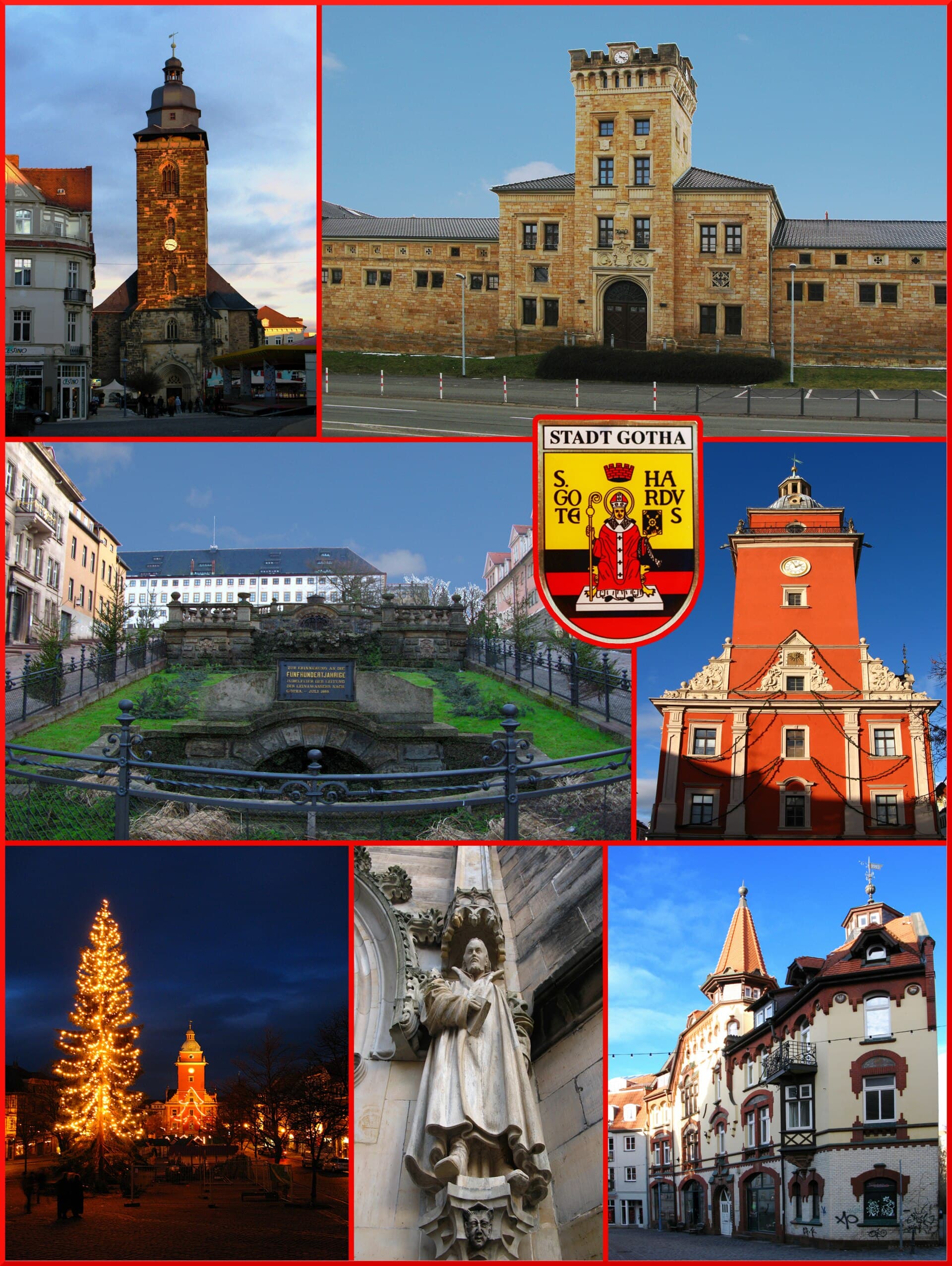
Just downhill from the castle, in the expansive park, stands the Herzogliches Museum (Ducal Museum), a magnificent Neo-Renaissance building. It houses the ducal art collection, featuring Egyptian mummies, ancient sculptures, and masterpieces by Old German and Dutch masters, including the intriguing 'Gotha Lovers' painting. The Museum of Nature, also within the castle complex, offers a varied collection of taxidermy and natural history exhibits. Do not miss the Kasematten, the impressive underground Baroque fortifications beneath the castle park. A stroll through the Schlosspark itself, one of Germany's oldest English landscape gardens, with its two ponds and ancient trees, is a delight. The Gotha Orangery, an elegant Baroque complex, also graces the park. The historic Hauptmarkt (Main Market Square) in the Old Town, with its historic Town Hall, offers an inviting setting for a coffee and people-watching.

When to visit

The most pleasant time to visit Gotha is during the warmer months, from May to September. During this period, daytime temperatures are comfortable, ranging between 18°C and 24°C (64°F and 75°F), ideal for exploring the city's outdoor attractions and gardens. While July is the wettest month, precipitation is generally moderate throughout the year. Summer also brings longer, sunnier days, with July averaging 7.5 hours of sunshine daily. For those who appreciate the beauty of castle gardens, spring and autumn are particularly recommended.

Practical

Gotha is conveniently located in central Germany, easily accessible by road and regional train services. Direct trains connect Gotha to Erfurt (approximately 20 minutes) and Weimar (approximately 40 minutes). The city is situated near the A4 and A7 motorways. For those arriving by air, Erfurt Airport (ERF) is just 25 km away, with Leipzig/Halle (LEJ) and Frankfurt am Main (FRA) also viable options.

Once in Gotha, the castle and old town are within walking distance or a short tram ride from the main train station. Friedenstein Castle and its associated museums typically have a combined entrance fee of around €10–12 and are generally open from 10 a.m. to 5 p.m., closed on Mondays. Comfortable shoes are recommended for navigating the historic streets. Parking facilities are available in and around the historic old town, with recommended options at the Ducal Museum and Friedenstein Palace.

Good to know
What is Gotha best known for?
Gotha is best known for Schloss Friedenstein, Germany's largest early Baroque castle, which houses the Ekhof Theatre, the world's oldest preserved Baroque theatre with original working stage machinery.
Is Gotha well-connected by public transport?
Yes, Gotha has good public transport links. It can be reached by regional and long-distance trains, with direct connections to cities like Erfurt and Weimar.
What are the opening hours for Friedenstein Castle?
Friedenstein Castle and its museums are generally open from 10 a.m. to 5 p.m., but are closed on Mondays.
Are there English tours available at the attractions?
While most exhibition information is in German, audio guides are often available, and guided tours of Friedenstein Castle are offered in both English and German.
What kind of art can I see at the Ducal Museum?
The Ducal Museum features a diverse collection, including Egyptian and Greco-Roman antiquities, Renaissance paintings (like the 'Gotha Lovers'), Chinese and Japanese art, and sculptures by artists such as Jean-Antoine Houdon.
Is Gotha suitable for a quiet trip?
Yes, Gotha is often praised for its quiet, uncrowded center, offering a peaceful atmosphere for travelers who appreciate history, architecture, and a slower pace.
Gotha
From€9.00
No booking · activate anytime · 12h to walk it
Get the key to Gotha