Görlitz Old Town
Walking through Görlitz feels like stepping onto a film set, and one particular building brought a whimsical Wes Anderson film to vivid life.
Full story unlocks in the tour
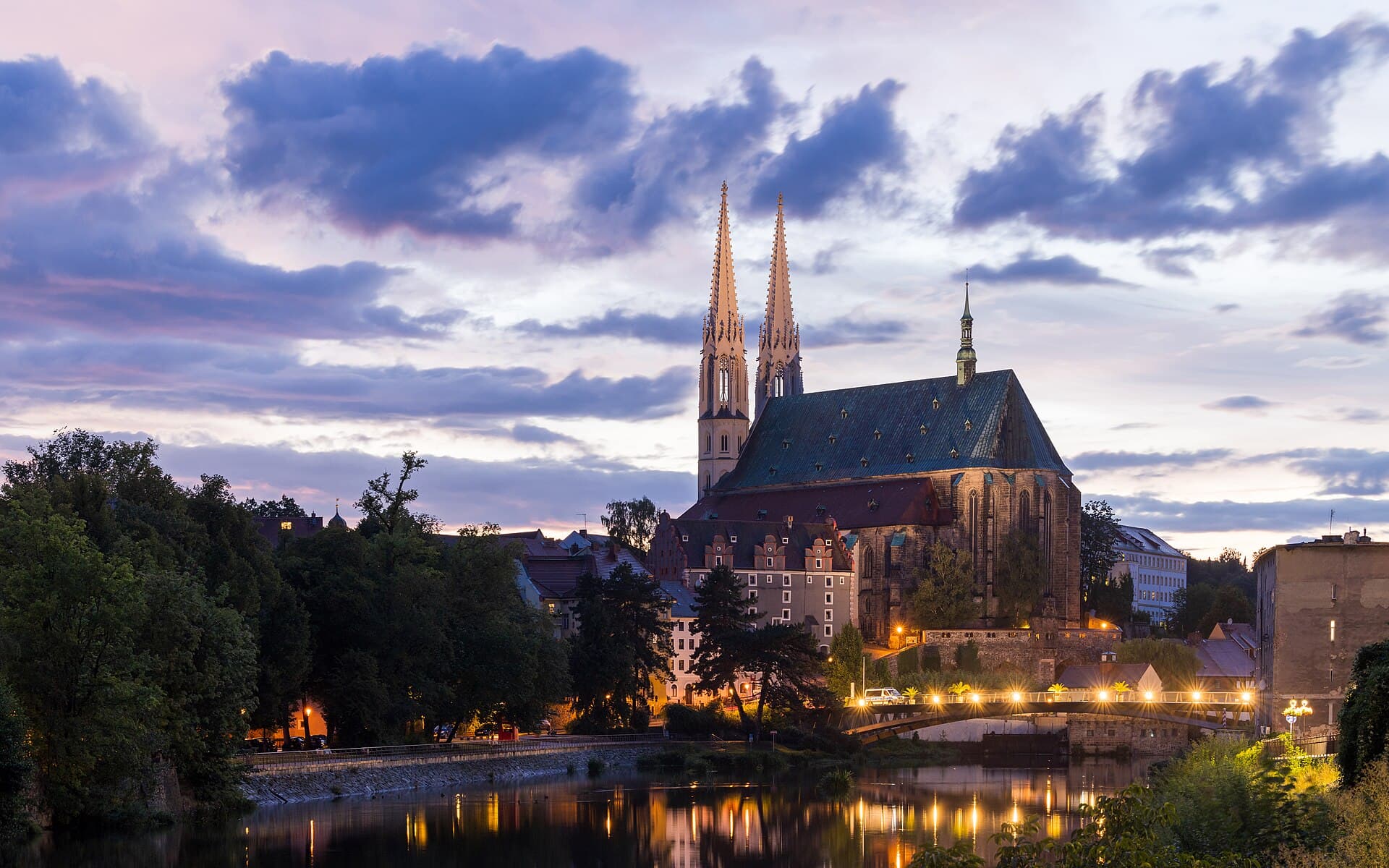 Martin Kraft / CC BY-SA 4.0, via Wikimedia Commons
“Where cinematic charm meets a thousand years of history, at Europe's eastern edge.”
Not the postcards. The stories even locals don't know — whispered in your ear, right where they happened.
Walking through Görlitz feels like stepping onto a film set, and one particular building brought a whimsical Wes Anderson film to vivid life.
This bridge does more than span a river; it crosses a former boundary, linking two nations that were once one city.
There is a precise location in Görlitz where, for a significant portion of Europe, time itself begins.
Discover every secret of Görlitz
Every address, every reveal in full — in your ear, right where it happened.
You pick your stops. You walk. The voice reveals what the others miss.
No tours available yet. Check back soon — we're preparing them.
Görlitz, Germany's easternmost city, stands as a living architectural museum, encompassing over 4,000 protected historic buildings that span Gothic, Renaissance, Baroque, and Art Nouveau styles. Unlike many German cities, Görlitz emerged from World War II largely unharmed, preserving its extensive historical fabric. Its remarkably intact old town, with its stone-paved lanes and grand merchant houses, has earned it the moniker 'Görliwood,' drawing numerous international film productions.
Situated on the Neisse River, Görlitz shares a distinctive cross-border identity with its Polish counterpart, Zgorzelec. What was once a unified city, divided after 1945, now flourishes as a European City, demonstrating a remarkable spirit of cooperation. Visitors can easily wander across the Altstadtbrücke to experience both cultures in a single visit.
Görlitz, initially a Slavic settlement known as Gorelić, was first documented in 1071. Its strategic location at the intersection of the Via Regia, an ancient trade route connecting Kiev to Santiago de Compostela, and the Salt Road, linking Prague to the Baltic Sea, fueled its early growth. The town was granted city privileges in 1303 by the King of Bohemia, allowing it to mint coins, store salt and woad, and brew beer.
In 1346, Görlitz joined the Upper Lusatian Six City League, a powerful alliance with Bautzen, Löbau, Zittau, Kamenz, and Lauban, established to secure trade routes. This league, which lasted until 1815, contributed significantly to Görlitz's wealth, with over a thousand wagons passing through its markets daily. The city experienced periods of prosperity, particularly through the cloth trade in the Late Middle Ages. Over the centuries, Görlitz came under Bohemian, Austrian, and Saxon rule before becoming part of Prussia in 1815 after the Congress of Vienna.
Remarkably, Görlitz largely escaped destruction during World War II. However, the post-war redrawing of borders in 1945 divided the city, with its eastern districts becoming the Polish town of Zgorzelec. During the East German era, Görlitz was a border town with limited cross-border interaction, and many of its historic buildings fell into disrepair. After German reunification and Poland's accession to the EU, significant investment, including a substantial anonymous donation, breathed new life into the city, restoring its architectural treasures. Today, Görlitz, together with Zgorzelec, forms the Euro City of Görlitz/Zgorzelec, a symbol of cross-border cooperation and a testament to its enduring historical and cultural significance.
Begin your exploration in the Untermarkt (Lower Market), considered one of Germany's finest squares, featuring the historic Rathaus with its astronomical clock and the distinctive Whispering Arch. Nearby, the Schönhof, Germany's oldest private Renaissance house, now hosts the Silesian Museum, offering insights into the region's history. Wander along Brüderstraße, part of the ancient Via Regia trade route.
Continue to the Obermarkt (Upper Market), a grand square lined with Baroque buildings and home to the Reichenbacher Turm, which provides expansive city views. The Peterskirche (St. Peter and Paul Church), with its prominent twin towers overlooking the Neisse River, houses the magnificent Sun Organ, known for its 17 suns and ability to mimic animal sounds. For a tranquil experience, visit the Nikolai Cemetery, the city's oldest graveyard, featuring Gothic monuments. Do not miss the opportunity to simply walk across the Altstadtbrücke to Zgorzelec, Poland, experiencing two countries in moments. Film enthusiasts can follow the 'Walk of Görliwood' to discover locations from movies like 'The Grand Budapest Hotel' and 'Inglourious Basterds'.
The best time to visit Görlitz is from May to September, when the weather is generally pleasant for sightseeing and outdoor activities, with average daytime temperatures ranging from 19°C to 25°C. Spring offers blossoms and fewer crowds, while summer provides long evenings and open-air concerts. Autumn brings atmospheric golden light and harvest markets. December is also a good time to visit, as the squares transform with a magical Christmas market. While winters are quieter and cold, with temperatures around 3°C, they can be beautiful for a peaceful city break.
Görlitz is easily reached by train from major German cities like Dresden (1.5 to 2 hours) and Berlin (3 to 4 hours with changes). The Görlitz train station is about a 10-minute walk from the old town. Dresden Airport (DRS) is the closest, approximately 90 km away, with other international airports in Wrocław (Poland) and Berlin also viable options. Within Görlitz, the historic center is entirely walkable. Public transport includes buses and trams. The local currency is the Euro, but having some Polish Złoty is useful if you plan to cross into Zgorzelec. Note that many establishments in Görlitz are closed on Mondays.
For visitor information, the Görlitz Tourist Office is located at one end of the Obermarkt square.