Gori Fortress
The Gori Fortress, a sentinel for centuries, holds a secret about its original purpose that goes beyond defense.
Full story unlocks in the tour
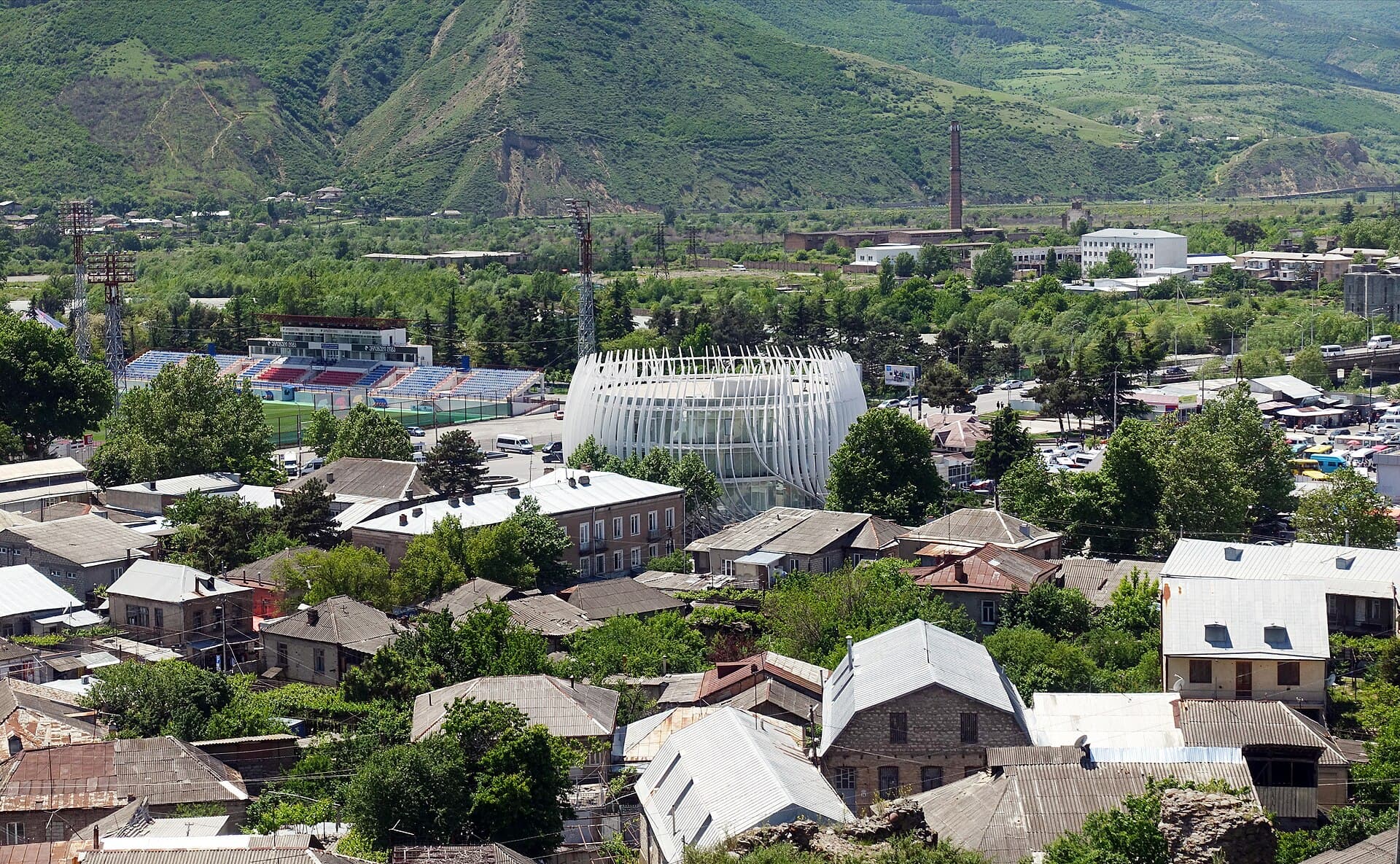 Tiia Monto / CC BY-SA 3.0, via Wikimedia Commons
“Gori: Where history’s shadows lengthen and ancient stone murmurs its past.”
Not the postcards. The stories even locals don't know — whispered in your ear, right where they happened.
The Gori Fortress, a sentinel for centuries, holds a secret about its original purpose that goes beyond defense.
Beneath the grand facade of the Stalin Museum, the humble dwelling where the Soviet leader was born reveals a surprising aspect of its preservation.
The ancient rock-hewn city of Uplistsikhe, with its intricate carvings, conceals a clever architectural detail designed for survival.
Discover every secret of Gori
Every address, every reveal in full — in your ear, right where it happened.
You pick your stops. You walk. The voice reveals what the others miss.
No tours available yet. Check back soon — we're preparing them.
Gori, the administrative capital of Georgia's Shida Kartli region, invites a thoughtful journey through layers of time. Approximately 80 kilometers west of Tbilisi, the city is perhaps most recognized as the birthplace of Joseph Stalin, a legacy explored in its dedicated museum. However, Gori's narrative extends far beyond this singular figure, inviting visitors to uncover a dynamic city with a profound past and a distinct Soviet-era atmosphere.
At its heart, Gori presents a unique blend of ancient fortifications, intriguing museums, and lively local existence. The city's strategic location on a major highway connecting eastern and western Georgia has made it an important waypoint for centuries, including along the historic Silk Road. From the commanding heights of Gori Fortress to the ancient rock-hewn city of Uplistsikhe just a short drive away, Gori provides a compelling glimpse into Georgia's diverse cultural heritage and enduring spirit.
The territory of Gori has been inhabited since the early Bronze Age, with archaeological evidence suggesting an urban community existed in Classical Antiquity. The city's name, 'Gori', derives from the Georgian word 'gora', meaning 'heap', 'hill', or 'mountain'. According to medieval Georgian chronicles, King David IV (r. 1089–1125) founded the town of Gori, settling refugees from Armenia there. The Gori Fortress, a significant military stronghold, appears in records from the 13th century, although fortifications were present as early as the 7th century.
Throughout the Middle Ages, Gori's strategic importance meant it was frequently contested, with Georgians, Ottomans, and Persians vying for control. The fortress itself was renovated multiple times, notably by King Rostom in 1642 and King Erekle II in 1774. Following Russia's annexation of Georgia in 1801, Gori was granted town status and saw growth throughout the 19th century. However, a devastating earthquake in 1920 destroyed most of the city.
During Soviet rule, particularly due to its status as Joseph Stalin's birthplace, Gori was extensively rebuilt. This period left a distinct architectural imprint, and many of the city's approximately 50,000 residents still live in Soviet-era buildings. In 2008, Gori experienced a brief occupation by Russian and South Ossetian military forces during the Russo-Georgian War, before control was returned to Georgia. Today, Gori continues to evolve, balancing its complex past with a youthful energy and a commitment to showcasing its broader history beyond its most famous son.
Begin your exploration at the Joseph Stalin Museum, a controversial yet undeniably significant site that delves into the life of the Soviet leader. The complex includes his humble birth house, an exhibition building with over 60,000 artifacts, and Stalin's personal armored railway carriage. For sweeping city and mountain views, ascend to the Gori Fortress (Goris-Tsikhe), a medieval citadel with origins dating back to the 1st millennium BCE.
A short drive from Gori lies Uplistsikhe Cave Town, an ancient rock-hewn settlement that dates back to the Early Iron Age. This multi-story city, carved into a rocky cliff, served as an important pagan and later Christian center, with remnants of dwellings, workshops, and temples. Back in Gori, discover the Memorial of Georgian War Heroes, an impactful sculptural park featuring eight larger-than-life soldiers, some limbless, symbolizing the irreversible losses of war. Wander the Gori Bazaar for a taste of local life and consider a visit to the Gori Museum of History and Ethnography to explore archaeological collections dating from the 4th-3rd millennium BCE.
The best time to visit Gori for pleasant weather and outdoor activities is from April to October. During these months, temperatures range from a mild 15°C to a warm 25°C, providing comfortable conditions for exploring historical sites and natural beauty. The peak tourist season falls between June and August, with average daily high temperatures above 21°C and clearer skies. For fewer crowds and milder weather, consider the shoulder seasons of April to June and September to October.
Gori is easily accessible, approximately 1.5 hours by marshrutka (minibus) or shared taxi from Tbilisi. Within Gori, many of the main attractions are walkable, including the Stalin Museum and Gori Fortress. To reach Uplistsikhe Cave Town, a taxi from Gori costs around 50 GEL for a round trip, including wait time, or you can take a minibus from the Gori Bus Station for a lower fare. The local currency is the Georgian Lari (GEL). While credit cards are accepted in larger establishments, it's advisable to carry some cash for smaller purchases. Georgian is the official language, but Russian is also understood by many locals due to the city's history.