Gliwice Radio Tower
This seemingly innocuous wooden structure holds a secret that ignited a global conflict.
Full story unlocks in the tour
 Ebielmaj / CC BY-SA 3.0 pl, via Wikimedia Commons
“Where history's quiet corners echo with monumental shifts.”
Not the postcards. The stories even locals don't know — whispered in your ear, right where they happened.
This seemingly innocuous wooden structure holds a secret that ignited a global conflict.
Beneath the arcades and lively cafes of Gliwice's Market Square lies a connection to a global household name.
The lush, tropical greenery of the Municipal Palm House has a surprising, widespread influence beyond its glass walls.
Discover every secret of Gliwice
Every address, every reveal in full — in your ear, right where it happened.
You pick your stops. You walk. The voice reveals what the others miss.
No tours available yet. Check back soon — we're preparing them.
Gliwice, a city in southern Poland's Upper Silesia region, offers a compelling blend of industrial heritage and historic appeal. With a population of nearly 200,000, it stands as one of the oldest towns in Upper Silesia, having been granted municipal rights before 1276. Despite its reputation as an industrial center, Gliwice maintains a well-preserved Old Town, appealing parks, and a variety of cultural attractions.
Situated on the Kłodnica River, a tributary of the Oder, Gliwice is part of the larger Metropolis GZM conurbation and the Katowice-Ostrava metropolitan area. The city's past is reflected in its architecture, showcasing influences from the various rulers it has seen over the centuries, including Poles, Czechs, Austrians, Prussians, and Germans. This rich, albeit turbulent, history contributes to Gliwice's unique character, making it a destination that often surprises visitors with its diverse offerings.
Gliwice's origins trace back to the 13th century, officially becoming a town before 1276. Initially under the rule of Opole Dukes, it later became the capital of the Duchy of Gliwice from 1322 to 1342. Over the centuries, the city's sovereignty shifted dramatically. In 1335, it fell under the suzerainty of the Bohemian Crown, which subsequently passed to the Austrian Habsburgs in 1526. For nearly 200 years, Gliwice remained outside Polish rule.
The 17th and 18th centuries saw Gliwice transition from a trade and craftsmanship center, known for beer production, to a hub for cloth manufacturing. However, this industry declined after the Silesian Wars, which resulted in Gliwice's incorporation into Prussia in 1741. The late 18th century marked the beginning of significant industrial development, with an iron foundry established in 1794 and a coke furnace in 1798. The foundry became particularly renowned for its specialized artistic castings.
The 20th century brought some of Gliwice's most pivotal and tragic moments. On August 31, 1939, the infamous 'Gleiwitz incident' occurred at the city's radio station—a false-flag operation staged by Nazi Germany to justify its invasion of Poland and the start of World War II. During the war, Gliwice hosted several subcamps of Auschwitz, where many prisoners perished. On January 24, 1945, the Red Army occupied the city, and in the aftermath of Germany's defeat, the Potsdam Conference dictated that Gliwice would once again become part of Poland, officially incorporated on March 18, 1945. Following an economic transformation in the 1990s, Gliwice shifted its focus from traditional heavy industries like steelworks and coal mining to the automotive and machine industries, while also developing as a significant educational and scientific center.
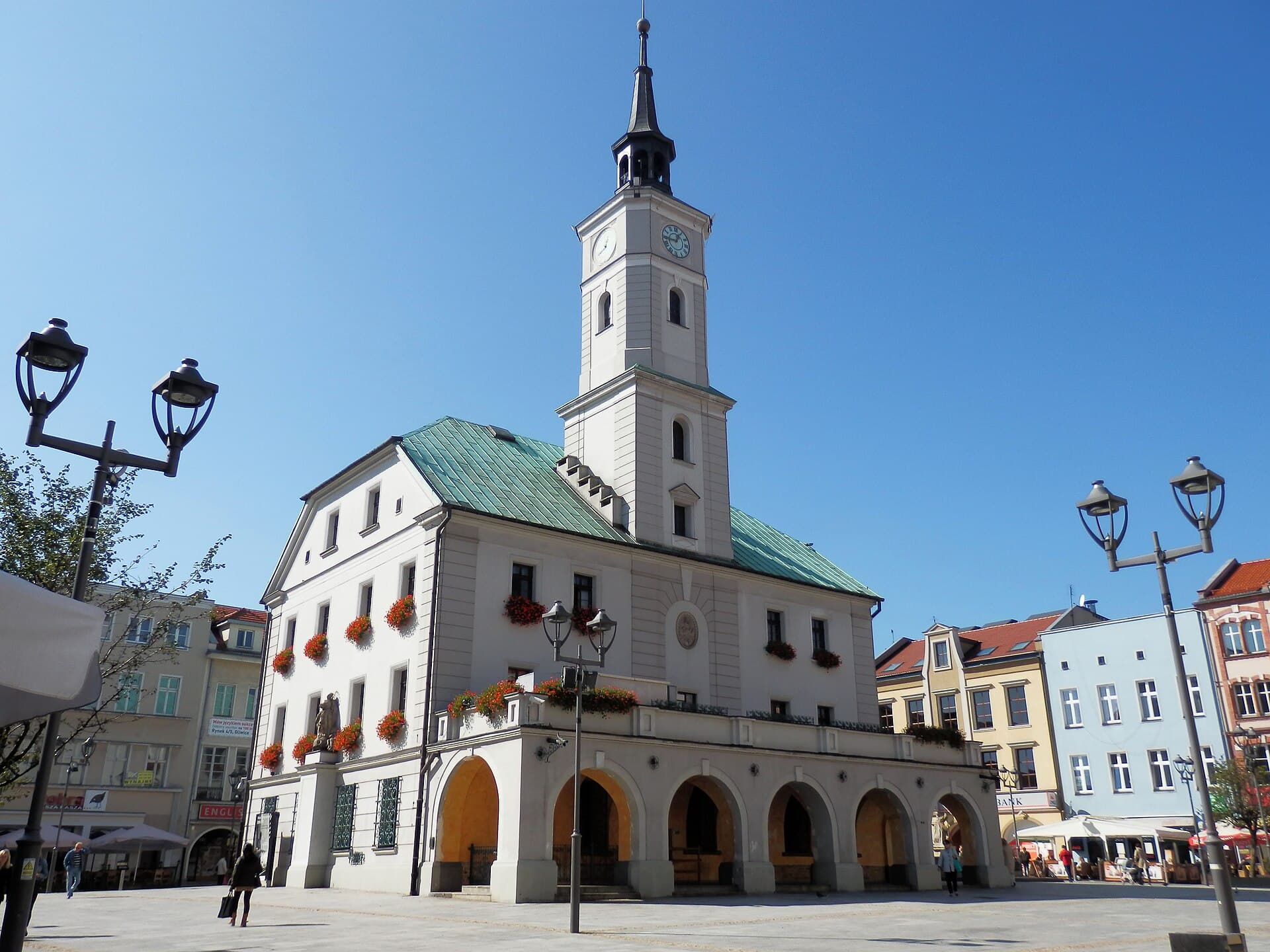
Begin your exploration in the Market Square (Rynek), the core of Gliwice's Old Town. Here, you'll find the historic Town Hall and colorful tenement houses, some with arcades, creating a lively atmosphere with cafes and restaurants. Not far from the Market Square stands the All Saints' Church, a 15th-century Gothic structure whose 63-meter-tall tower offers wide views of the city, and on clear days, even the Beskid, Jeseniky, and Tatra mountains.
A visit to the Gliwice Radio Tower is essential for its historical significance and impressive architecture. This 111-meter-tall wooden structure is considered the tallest wooden structure in Europe and one of the tallest wooden structures in the world. It houses a branch of the Museum in Gliwice, offering insights into its pivotal role at the outset of World War II.
For a change of pace, explore the Municipal Palm House in Chopin Park, home to exotic plants, colorful fish, and a recently added section with fish tanks. The Piast Castle, one of Gliwice's oldest monuments dating back to the 14th century, now houses a department of the Museum in Gliwice, featuring archaeological findings and historical exhibitions. Finally, the 19th-century Caro Villa, once the residence of industrialist Oscar Caro, now serves as a museum showcasing the lifestyle of Upper Silesian industrialists.
The ideal time to visit Gliwice is during late spring (May and June) or early autumn (September and October). During these months, the weather is mild and pleasant, making it perfect for exploring the city's outdoor attractions and parks. Summers can be warm, with average daytime temperatures reaching 26°C (79°F) in July, while winters are cold and snowy. July is also the wettest month, with the most precipitation.
Gliwice is well-connected by train to major Polish cities like Krakow, Warsaw, and Wroclaw, making it an accessible destination. The Gliwice railway station is a key transportation hub. For those arriving by bus, Flixbus offers routes from cities such as Berlin, Vienna, and Prague to Gliwice's Centrum Przesiadkowe bus station.
While generally considered a safe city for tourists, it's always advisable to be aware of your surroundings, especially at night. The local currency is the Polish Złoty (PLN). Gliwice is part of the Silesian Voivodeship, and Polish is the primary language spoken, though some residents may also speak Silesian or German due to the region's historical background.
Tourist information is available at the Tourism and Culture Information Centre, located in the transfer center (ul. Składowa 8a), or at the Tourist Information Centre within the Gliwice Radio Station.