The Great Pyramid of Khufu
The Great Pyramid held a record for millennia, though not for its original soaring height.
Full story unlocks in the tour
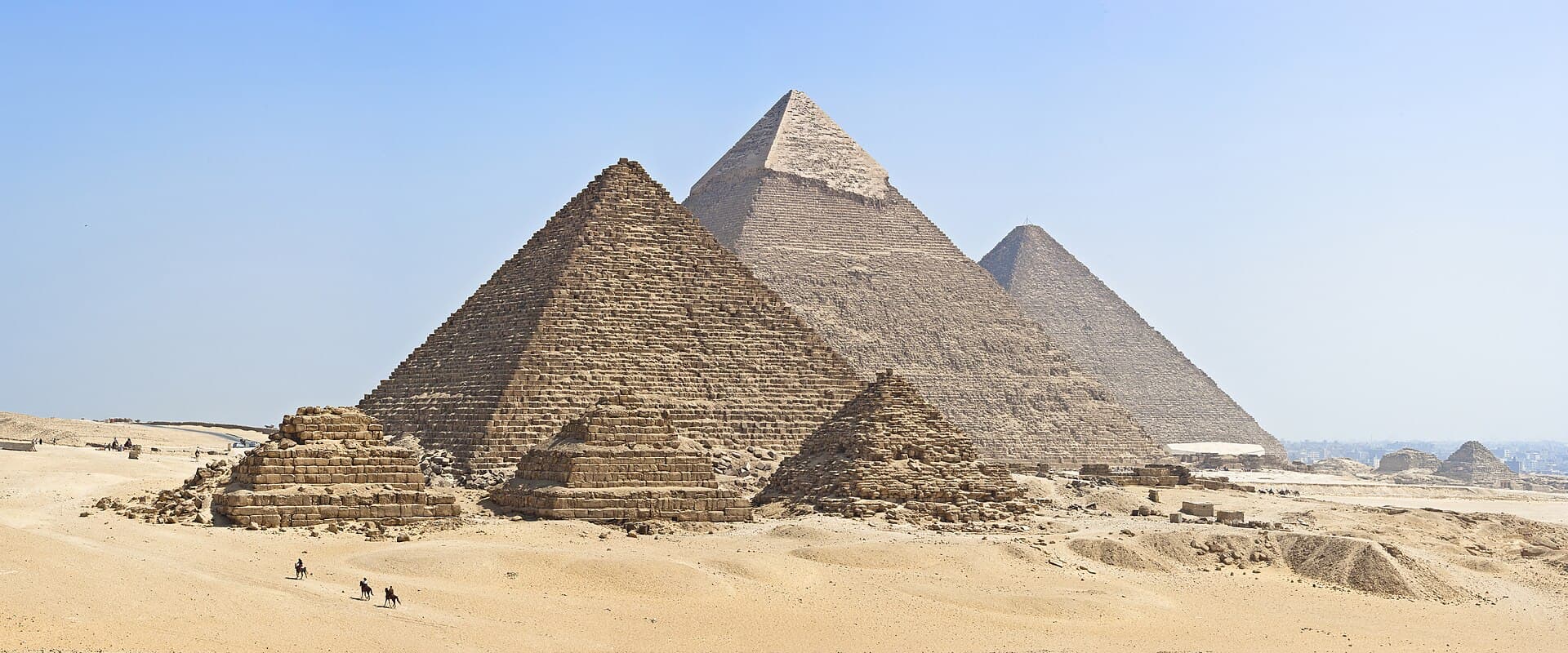 KennyOMG / CC BY-SA 4.0, via Wikimedia Commons
“Where ancient ambition meets the endless desert sky.”
Not the postcards. The stories even locals don't know — whispered in your ear, right where they happened.
The Great Pyramid held a record for millennia, though not for its original soaring height.
The pyramids did not always bear the sandy hue we observe today.
Despite the desert's fiery embrace outside, the temperature within the pyramids remains remarkably constant.
Discover every secret of Gizeh
Every address, every reveal in full — in your ear, right where it happened.
You pick your stops. You walk. The voice reveals what the others miss.
No tours available yet. Check back soon — we're preparing them.
Gizeh, often known as Giza, unfolds on the Nile River's west bank, merging into the sprawling Cairo metropolis. It is known across the globe as the home of the Giza Plateau, an ancient necropolis cradling some of humanity's most enduring structures: the Pyramids of Giza and the Great Sphinx. These monumental testaments to ancient Egyptian ingenuity continue to draw visitors, millions each year arriving to witness their grandeur and contemplate their persistent enigmas.
The Giza Plateau is an expansive open-air desert expanse, offering sweeping views across the arid landscape. While the pyramids themselves are the principal allure, the surrounding area also embraces smaller tombs, the Valley Temple, and the Solar Boat Museum, which safeguards a meticulously reconstructed ancient vessel. A journey to Giza is an immersion into the very heart of ancient history, promising an unforgettable encounter that transcends the boundaries of time.
The story of the Giza Plateau is woven into the fabric of ancient Egypt's Old Kingdom, a period of extraordinary architectural and cultural blossoming. The most prominent structures, the three great pyramids, were raised as eternal resting places for pharaohs of the 4th Dynasty. The oldest and grandest, the Great Pyramid of Khufu (also called the Pyramid of Cheops), took form around 2560 BCE. It is estimated that its completion demanded 15 to 20 years of labor from thousands of skilled workers, not slaves, who received compensation for their efforts.
After Khufu, his son, Pharaoh Khafre, commissioned the second largest pyramid, finished around 2570 BCE. The third and smallest of the principal pyramids was built for Menkaure, Khafre's son. The diminishing scale of the pyramids is thought to reflect the decreasing resources available for such grand endeavors as state spending on other structures grew.
For nearly 3,800 years, the Great Pyramid stood as the tallest human-made edifice in the world. Its construction involved an estimated 2.3 million limestone blocks, some weighing as much as 80 tons. The precision of its alignment with the cardinal directions, deviating by less than 0.05 degrees, continues to perplex modern scientists, who theorize that ancient Egyptians achieved this through celestial observations of stars like Thuban, or by employing shadows and geometric measurements.
The enigmatic Great Sphinx, with its lion's body and human head, stands as a silent sentinel over Khafre's pyramid complex. Its famously absent nose resulted from intentional damage long after its creation. By the New Kingdom (1570-1069 BCE), the Giza Plateau had largely been left to the elements, and the pyramids endured damage and plunder. However, figures like Khaemweset, son of Ramses II, dedicated themselves to the study, restoration, and preservation of Giza, efforts that continued until the Roman conquest in 30 BCE.
The Giza Plateau unfurls a remarkable collection of ancient marvels. The three main pyramids—Khufu, Khafre, and Menkaure—are the primary draw. Visitors can approach closely to appreciate the sheer scale of the limestone blocks, some weighing many tons. For an additional fee, entry into one of the pyramids is possible; typically, the Great Pyramid of Khufu is always accessible, while Khafre and Menkaure's pyramids are opened on an alternating schedule. The passage within the Great Pyramid leads to the King's Chamber.
Beyond the pyramids, the Great Sphinx, a colossal sculpture with the head of a pharaoh and the body of a lion, defines Giza and serves as a popular backdrop for photographs. The Panoramic Point presents an expansive vista where all three principal pyramids, and often several smaller ones, can be seen, creating an iconic photographic moment. The Solar Boat Museum, situated near the Great Pyramid, shelters the meticulously reassembled Khufu ship, an ancient vessel discovered in fragments. For those seeking deeper exploration, the Tombs of the Nobles and the workers' area offer further glimpses into ancient Egyptian life and burial customs. Consider a camel or horse ride across the plateau for an immersive experience.
The most agreeable time to journey to Giza is during the cooler months, spanning from October to April. Temperatures during this period are pleasantly mild, ranging from 15 to 20 degrees Celsius (59-68 degrees Fahrenheit), making outdoor exploration comfortable. December is often considered ideal, balancing comfortable temperatures with clear skies and manageable crowds. While this marks the peak tourist season, arriving at 8 AM when the complex opens can help circumvent the largest crowds and the intense midday heat. The morning light also provides excellent conditions for photography.
General entry to the Giza Plateau costs 700 EGP for adults, with interior access to the Great Pyramid requiring an additional 1,500 EGP. Purchasing tickets via credit card at the official gates or online beforehand is advised to save time. The Giza Plateau is an expansive open-air desert site with minimal shade, so bring sunscreen, a hat, sunglasses, and ample bottled water (at least 1.5-2 liters per person). Comfortable, closed-toe walking shoes are essential due to the sandy and uneven terrain. Modest clothing that covers shoulders and knees is recommended out of respect for local customs and for sun protection.
While generally secure, the area surrounding the pyramids can present aggressive vendors and touts. Booking a licensed guide can significantly lessen hassle and offer valuable historical context. If hiring a car, an Uber is often preferred over a traditional taxi for its fixed pricing. Photography for personal use is permitted, but flash is prohibited inside the pyramids, and drones require special permits. Carry small Egyptian pound bills for tips and purchases.