The Onyar River Houses
The colorful houses along the Onyar River, now iconic, were not always considered beautiful.
Full story unlocks in the tour
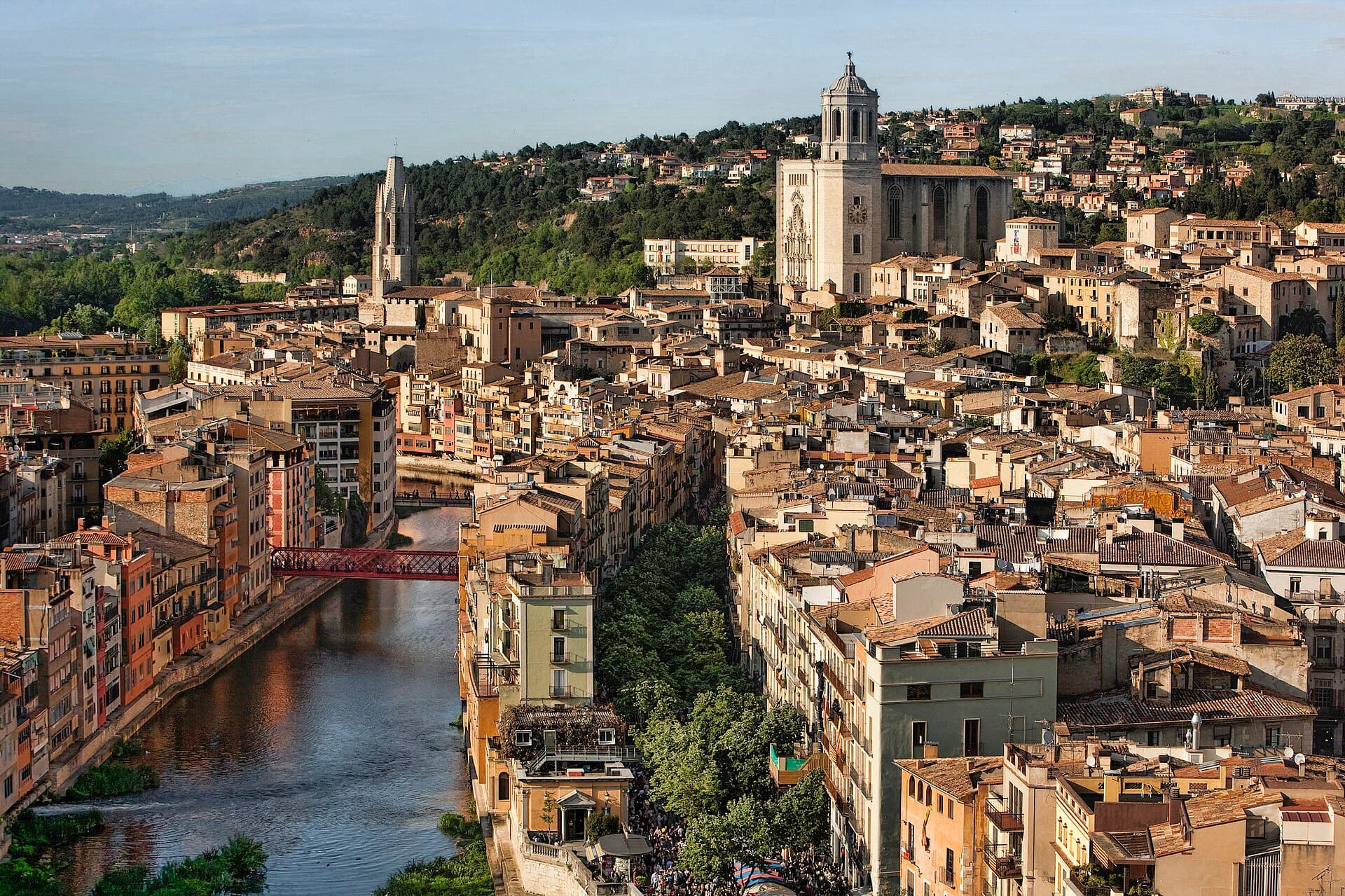 Patronat de Turisme Costa Brava Pirineu de Girona / CC BY-SA 3.0, via Wikimedia Commons
“Where ancient stones recount eras and painted facades mirror centuries of lives.”
Not the postcards. The stories even locals don't know — whispered in your ear, right where they happened.
The colorful houses along the Onyar River, now iconic, were not always considered beautiful.
Girona once served as a vital center for a mystical Jewish tradition.
The grand staircase of Girona Cathedral played a dramatic part in a global fantasy series.
Discover every secret of Girona
Every address, every reveal in full — in your ear, right where it happened.
You pick your stops. You walk. The voice reveals what the others miss.
No tours available yet. Check back soon — we're preparing them.
Girona, a city in Catalonia, Spain, reveals layers of history visibly etched into its stone streets and ancient walls. Positioned at the confluence of four rivers—the Ter, Onyar, Galligants, and Güell—it is often called the 'City of the Four Rivers.' Just 99 kilometers northeast of Barcelona, Girona offers a distinct atmosphere, blending medieval allure with a spirited contemporary feel.
The city's well-maintained Old Town, known as Barri Vell, invites exploration with its intricate cobblestone alleys and architectural treasures spanning Roman, Gothic, Renaissance, and Baroque periods. From the colorful houses lining the Onyar River to the imposing Cathedral, Girona presents a captivating visual narrative. It is a destination that rewards unhurried walks, offering a sense of discovery around every turn.
Beyond its historical appeal, Girona has gained recognition as a filming location for Game of Thrones, drawing fans to identify familiar scenes within its ancient settings. The city also features a flourishing culinary scene and a strong cycling culture, making it an appealing spot for both gourmands and active travelers.
Girona's narrative begins with the Iberians, specifically the Ausetani tribe, who were the first historical inhabitants of the region. Around 77 BC, the Romans established a citadel here, naming it Gerunda, a strategic fortress during the war against Sertorius. This Roman foundation laid the groundwork for the city's enduring defensive character, with remnants of their original city walls still visible today.
Following Roman rule, the Visigoths governed Girona until the arrival of the Moors in 715 AD. The city was then reconquered by Charlemagne in 785, becoming one of Catalonia's original fourteen counties. Throughout the 9th and 10th centuries, Girona faced repeated sacks by the Moors but was eventually incorporated into the County of Barcelona in 878 by Wilfred the Hairy.
The medieval period marked a significant era for Girona, particularly with the flourishing of its Jewish community. From the 9th century until their expulsion in 1492, Jews lived in the city, with the Jewish Quarter, known as El Call, becoming a prominent center for Jewish culture and Kabbalah studies between the 13th and 14th centuries. The city's Gothic Cathedral, begun around 1292, also stands as a testament to this period, featuring one of the widest aisleless naves in the world.
Girona played an active role in the 17th and 18th-century conflicts between Spain and France, enduring several sieges. During the Peninsular War, the city famously withstood a siege by 35,000 French Napoleonic troops in 1809 for several months before capitulating due to disease and famine. The 19th century saw the city expand beyond its medieval walls, particularly with the development of the Mercadal district on the left bank of the Onyar River, transforming Girona into a more modern city with wider squares. The arrival of the railway further boosted its economic importance, connecting it to Barcelona and the French border. In the late 20th and early 21st centuries, efforts were made to reconstruct and preserve the city's ancient walls, creating the popular walking route known as el Passeig de la Muralla.
Begin your exploration in the Barri Vell, Girona's Old Town, where a maze of stone streets and ancient buildings awaits. A highlight is the Girona Cathedral, notable for its immense Gothic nave, one of the widest globally, and its dramatic 90-step Baroque staircase. Nearby, the Jewish Quarter (El Call) offers a journey back in time with its narrow, winding alleys and preserved medieval architecture. The Museum of Jewish History within El Call provides insight into the community's past.
For expansive views of the city, walk along the Passeig de la Muralla, the reconstructed medieval city walls. This route offers perspectives of the Old Town, the Cathedral, and the colorful houses along the Onyar River. The Houses on the Onyar River (Cases de l'Onyar), with their vivid facades reflected in the water, are an iconic image of Girona. Do not overlook the Pont de les Peixateries Velles, also known as the Eiffel Bridge, a red iron bridge designed by Gustave Eiffel's company.
Other notable sites include the Arab Baths, a Romanesque building with a unique octagonal pool, and the Basilica of Sant Feliu, one of the city's most representative Gothic buildings. For Game of Thrones enthusiasts, many locations throughout the Old Town will be recognizable, including the Cathedral steps and various streets that stood in for King's Landing and Braavos.
Girona is agreeable year-round, but spring (April to June) and autumn (September to October) are particularly recommended. During spring, temperatures are mild (14°C to 20°C), and the city hosts the Temps de Flors (Flower Festival) in the second week of May, transforming courtyards and monuments with floral displays. Autumn offers similar comfortable temperatures (18°C to 25°C) with fewer crowds, making it ideal for exploring and enjoying the local gastronomy. Summer (July and August) is warm and busy, while winter (November to February) is quieter with cooler evenings.
Girona is a very walkable city, especially its historic Old Town, making it easy to explore the main attractions on foot. Public transportation within the city is infrequent, and a car is not advised for navigating the Old Town due to limited parking. However, if you plan to explore the surrounding Costa Brava or Pyrenees, renting a car from the main train station is an option.
Girona-Costa Brava Airport (GRO) serves budget airlines, with shuttle buses connecting directly to the city center in about 25 minutes. High-speed trains provide a quick 38-minute journey from Barcelona, while regional trains offer a more economical, though longer, option. The local currency is the Euro (€). While Spanish is widely understood, Catalan is the primary language spoken by locals. Many residents also speak French or English, particularly in tourist areas.