Hohes Schloss (High Castle) courtyard
The elaborate embellishments gracing the inner courtyard of Füssen's High Castle hold a delightful deception.
Full story unlocks in the tour
 Wolkenkratzer / CC BY-SA 3.0, via Wikimedia Commons
“Where ancient Roman pathways converge with storybook fortresses and alpine reveries.”
Not the postcards. The stories even locals don't know — whispered in your ear, right where they happened.
The elaborate embellishments gracing the inner courtyard of Füssen's High Castle hold a delightful deception.
Within the confines of the former Benedictine monastery of St. Mang resides a haunting artistic tradition, singular to Bavaria.
The powerful Lechfall waterfall conceals a legendary secret, intertwined with Füssen's revered patron saint.
Discover every secret of Füssen
Every address, every reveal in full — in your ear, right where it happened.
You pick your stops. You walk. The voice reveals what the others miss.
No tours available yet. Check back soon — we're preparing them.
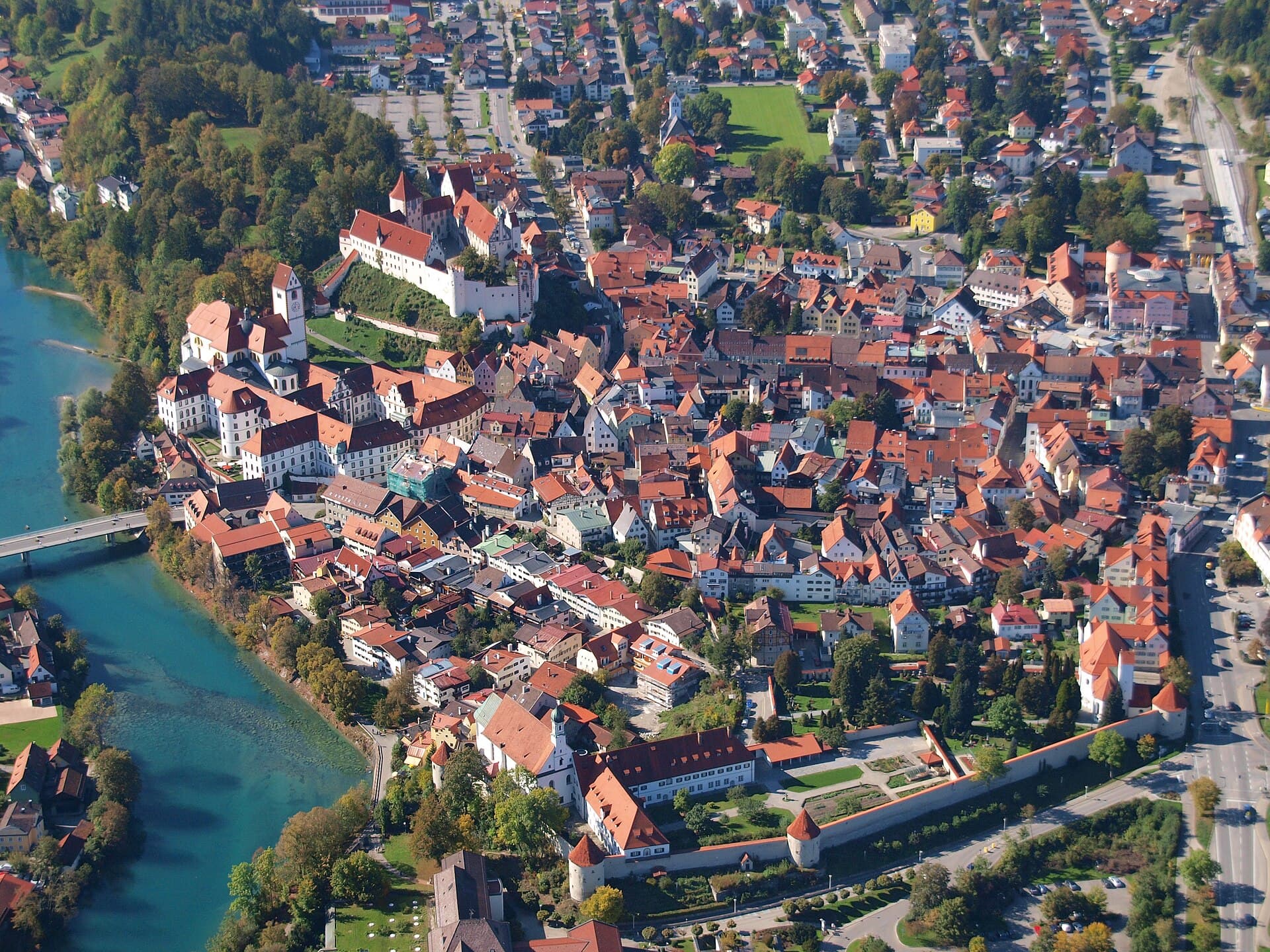
Füssen, a Bavarian town at the foot of the Alps near the Austrian border, serves as the southern entrance to Germany's Romantic Road. With the Lech River flowing through its center, Füssen offers a blend of historical allure and natural splendor. The town is recognized as the entry point to the iconic Neuschwanstein and Hohenschwangau castles, which are a short journey away in the neighboring village of Schwangau. However, Füssen itself holds many attractions, from its medieval old town with pastel-colored buildings to its impressive High Castle and the former Benedictine monastery of St. Mang.
Füssen's strategic position, embraced by mountains, lakes, and forests, makes it a center for both cultural exploration and outdoor adventures. Visitors can explore ancient Roman origins, delve into the town's history as a hub for lute and violin making, or simply absorb the picturesque alpine scenery. Whether wandering through ancient lanes or embarking on a mountain ascent, Füssen provides a captivating experience that extends beyond its renowned royal neighbors.
Füssen's story begins long before its medieval character took shape. Its origins stretch back to Roman times, when a way-station and fort called Foetibus was established on the Via Claudia Augusta, a crucial trading route connecting Italy to Augsburg. This Roman settlement, strategically positioned at the entrance to the mountains and on the Lech River, was vital for guarding the river crossing. The name Füssen itself is thought to derive from the German word for 'feet' and first appeared in the 12th century, with the town's coat of arms featuring three joined legs.
The 8th century marked a significant spiritual development with the arrival of St. Magnus, or St. Mang, a missionary from Switzerland. He is credited with establishing a monastic cell that later evolved into the Benedictine Abbey of St. Mang. This monastery became a center of education, spirituality, and art during the Middle Ages. Füssen received its town charter in the 13th century, though it remained under the control of Augsburg rulers rather than achieving Imperial Free City status.
A unique craft brought Füssen international recognition in the 15th and 16th centuries: lute and violin making. In 1562, Europe's first lute makers' guild was founded here, solidifying the town's reputation as a musical capital. The imposing Hohes Schloss (High Castle), which still surveys the town, was constructed between 1486 and 1505 and served as the summer residence for the Prince-Bishops of Augsburg. The town's commercial life for centuries revolved around trade, acting as a transhipment point for goods crossing the Alps and traveling down the Lech River by raft.
Füssen's modern identity is closely tied to its role in the "Königswinkel" or "Kings' Corner," a reference to the many castles and ruins in the area, most notably King Ludwig II's Neuschwanstein and Hohenschwangau castles. Ludwig II spent much of his childhood at Hohenschwangau Castle, and the dramatic natural landscape and romantic murals within the castle profoundly influenced his interest in nature and culture. Today, Füssen continues to draw visitors with its blend of ancient history, medieval character, and proximity to these storybook palaces.
Begin your exploration in Füssen's Altstadt, a pedestrian-friendly area with medieval character and pastel-colored buildings. Dominating the skyline is the Hohes Schloss (High Castle), a late Gothic masterpiece that once served as the summer residence of the Prince-Bishops of Augsburg. Explore its courtyard to admire the illusion paintings and visit the branch gallery of the Bavarian State Collections of Paintings and the Municipal Picture Gallery inside.
Adjacent to the old town is the former Benedictine Monastery of St. Mang, a significant cultural landmark. The monastery complex includes the Baroque-style St. Mang Basilica and the Gothic cloister, housing the Museum of Füssen. Here, you can delve into the town's history, including its unique tradition of lute and violin making.
Just a short drive from Füssen are the world-renowned Neuschwanstein Castle and Hohenschwangau Castle. Neuschwanstein, often cited as the inspiration for Disney's Sleeping Beauty castle, offers guided tours of its opulent interiors. Hohenschwangau, King Ludwig II's childhood home, also provides guided tours.
For natural splendor, visit the Lechfall Waterfall, where the turquoise Lech River cascades into a gorge. A bridge, the Maxsteg, offers excellent views. Consider a cable car ride up Tegelberg Mountain for expansive views of the castles and surrounding Alps, and opportunities for hiking or paragliding. The area also includes several beautiful lakes, including Alpsee and Forggensee, ideal for boat tours or swimming.
Füssen is captivating throughout the year, with the ideal time to visit depending on your preferences. For warm-weather activities like hiking and exploring, early July to late August offers average daily high temperatures above 65°F (18°C) and clearer skies. However, this is also peak tourist season, especially for the castles, so anticipate larger gatherings.
Spring (April–June) brings blooming alpine meadows, milder weather, and fewer tourists, making it suitable for hiking. Autumn (September–October) features crisp mountain air and vivid foliage, with potentially lighter crowds if you avoid Oktoberfest in Munich. Winter (November–March) transforms Füssen into a snowy wonderland, offering Christmas markets, cozy inns, and dramatic views of the castles against snow-capped peaks, with fewer visitors.
Füssen is easily reached by various modes of transport. The closest regional airport is Memmingen (FMM), with Innsbruck (INN) and Munich (MUC) also viable options. The town has a railway station on the edge of the old town center, offering regional services that connect to Munich and Augsburg.
For navigating Füssen and reaching the nearby castles, public transport is available. Buses, such as the 78 or 73 lines, connect Füssen to Hohenschwangau, where Neuschwanstein and Hohenschwangau castles are located. Tickets for these buses can be purchased at the central ticket office in Hohenschwangau, and booking in advance is highly recommended, especially during summer. Taxis are also an option for the short drive.
Parking in Füssen's city center is managed by a parking guidance system, directing visitors to numbered parking spaces and garages. Parking tickets can also be purchased via the Parkster app. For electric vehicles, the first three hours of parking in designated public metered spaces are free with a parking disk.
Consider obtaining a FüssenCard upon arrival at your accommodation, which allows free use of public transport in the castle park and reduced admission to some leisure providers. Some accommodations also offer the KönigsCard, providing free access to over 200 services.