Fulda Cathedral Crypt
Beneath the opulent Baroque cathedral lies a much older, starker secret.
Full story unlocks in the tour
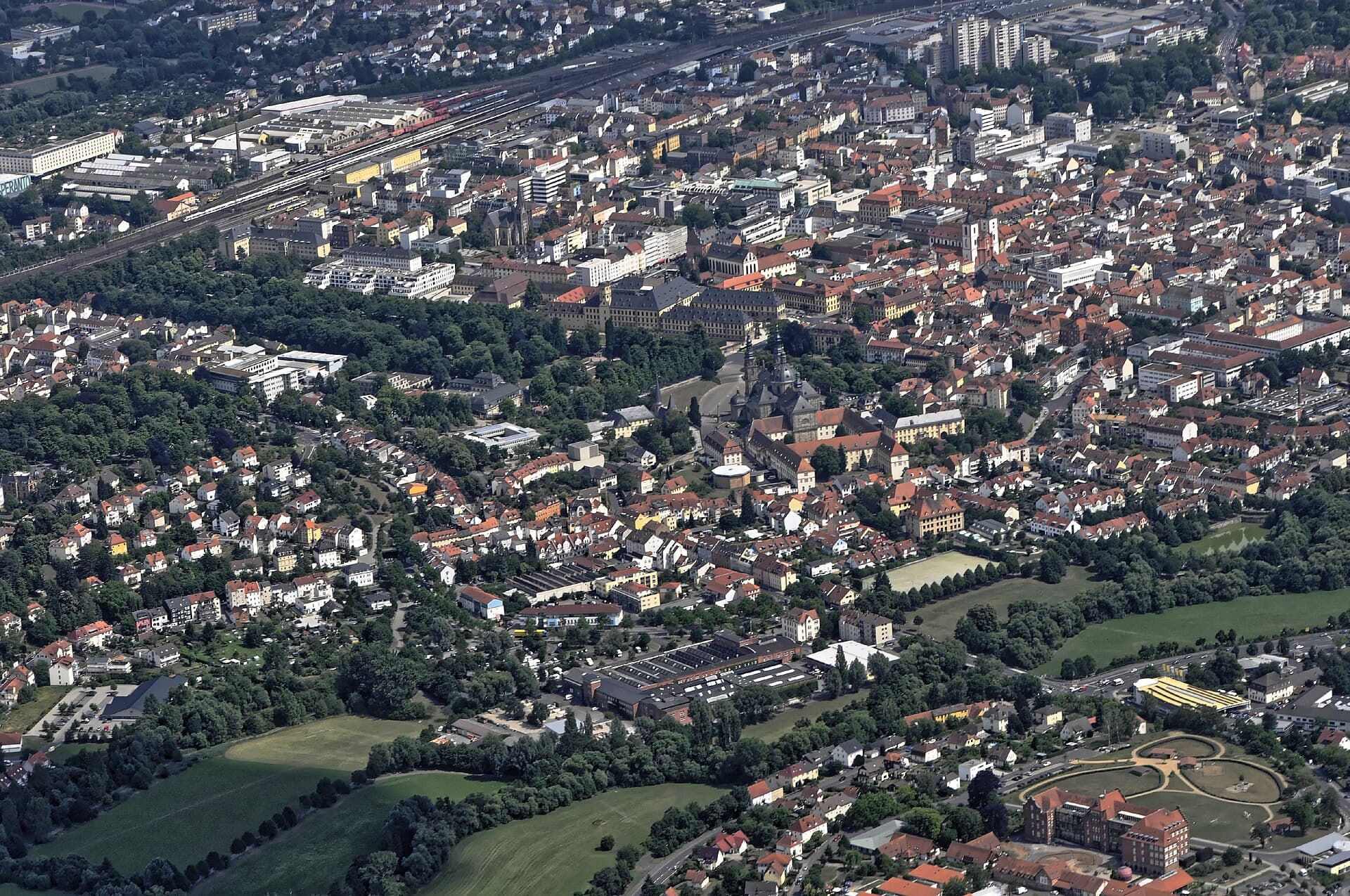 © Ra Boe / Wikipedia / CC BY-SA 3.0 de, via Wikimedia Commons
“Where Baroque grandeur meets ancient devotion.”
Not the postcards. The stories even locals don't know — whispered in your ear, right where they happened.
Beneath the opulent Baroque cathedral lies a much older, starker secret.
One of Germany's oldest churches holds a surprising architectural inspiration.
The opulent Baroque palace of Fulda holds a subtle clue to its past rulers' power.
Discover every secret of Fulda
Every address, every reveal in full — in your ear, right where it happened.
You pick your stops. You walk. The voice reveals what the others miss.
No tours available yet. Check back soon — we're preparing them.
Fulda, a city in the German state of Hesse, offers a journey through over 1200 years of cultural heritage, where Baroque architecture and ancient religious sites stand in remarkable harmony. The city developed around a Benedictine monastery founded in 744 CE by Sturmius, a disciple of Saint Boniface. This origin story has shaped Fulda's identity, making it a significant pilgrimage destination and a repository of early medieval learning.
Today, Fulda is celebrated for its well-preserved Baroque Quarter, featuring grand buildings like the Fulda Cathedral and the Stadtschloss, alongside charming half-timbered houses in its Old Town. Situated in a valley framed by the scenic Rhön and Vogelsberg mountains, the city provides a relaxed atmosphere, inviting visitors to explore its quiet streets, enjoy local cafés, and delve into its profound past.
Beyond its historical core, Fulda's central location in Germany has historically made it an important transport hub, and it continues to be well-connected by rail and road. It's a city that blends its profound religious and architectural legacy with a lively cultural scene, including a notable carnival tradition and historical musicals.
Fulda's story begins in 744 CE with the establishment of a Benedictine monastery by Sturmius, a disciple of Saint Boniface, on the banks of the Fulda River. This monastery quickly became a pivotal center for religious, educational, and cultural life within the Carolingian Empire. Its importance grew further in 751 when it was placed directly under papal authority, granting it autonomy. Following Saint Boniface's martyrdom in 754, his burial in Fulda transformed the abbey into a renowned pilgrimage site, attracting scholars and pilgrims from across Europe.
By the Middle Ages, Fulda had blossomed into a prosperous settlement, officially chartered as a city in 1157. It gained imperial privileges, including market and customs rights, and its abbots, later prince-bishops, wielded significant spiritual and secular power. This era saw Fulda become a leading intellectual center, particularly under Abbot Rabanus Maurus in the 9th century, with a large scriptorium and a significant library. The city's strategic location on trade routes further fueled its economic development.
The 18th century marked a period of ambitious Baroque architectural transformation, largely under Prince-Abbot Adalbert von Schleifras. This era saw the construction of the Fulda Cathedral and the Stadtschloss, which redefined the city's character and created the impressive Baroque Quarter. Unlike many German cities, Fulda largely escaped heavy damage during the Second World War, preserving its historic center. During the Cold War, Fulda gained strategic significance as part of the 'Fulda Gap,' a potential invasion route between West and East Germany, leading to a notable military presence. Today, Fulda is recognized for its architectural heritage, religious importance, and lively cultural life, continuing to evolve as a modern transport and congress hub.
Fulda's historic core is easily explored on foot, with its key landmarks concentrated in the Baroque Quarter and the Old Town. The majestic Fulda Cathedral (Dom St. Salvator), an 18th-century Baroque masterpiece, is the city's most prominent landmark and the burial place of Saint Boniface. Its twin towers dominate the skyline, and the crypt offers a glimpse into its ancient origins.
Adjacent to the cathedral is St. Michael's Church (Michaelskirche), one of Germany's oldest religious buildings, dating back to 820-822 CE. Its Carolingian rotunda and crypt are particularly noteworthy. A short stroll leads to the Stadtschloss (City Palace), the former residence of the prince-abbots and prince-bishops. Visitors can explore its lavishly decorated historic state rooms, including a grand hall of mirrors, and the collections of Fulda porcelain.
The Schlossgarten (Palace Garden), directly beside the Stadtschloss, offers formal lawns, fountains, and the elegant Orangerie. In the Old Town, discover the Altes Rathaus (Old Town Hall), a half-timbered building, and the lively market square. For those interested in local history and art, the Vonderau Museum provides insights into Fulda's past. Just outside the city, Schloss Fasanerie is another impressive Baroque palace with period furnishings and extensive gardens.
The most favorable weather in Fulda occurs from May through September, with temperatures typically ranging between 18°C and 23°C. This period is ideal for sightseeing, outdoor walks, and enjoying the city's gardens. Spring (March-May) offers mild temperatures, suitable for exploring historical buildings and seeing flowers. Autumn (September-November) brings cooler weather, with September still pleasant for outdoor activities. While there is moderate rainfall throughout the year, the summer months generally have comfortable conditions for visitors.
Fulda is well-connected and easy to navigate. The city is a major rail junction, with frequent high-speed ICE trains linking it to cities like Frankfurt, Hamburg, Munich, and Berlin. The main railway station is centrally located, making it convenient for exploring. For those traveling by car, Fulda is accessible via the A7 and A66 motorways, with parking available in the city center. Frankfurt Airport (FRA) is the most practical option for air travel, with excellent rail connections to Fulda.
Within the city, the historic Baroque quarter is compact and best explored on foot. Local buses are available from the central train station for longer distances or trips to nearby villages. While credit cards are accepted in many places, it's advisable to carry some cash, as smaller shops and restaurants may prefer it. Standard electrical outlets in Germany are 220 volts, so an adapter may be necessary for international visitors.