Piazzale della Vittoria
A towering bronze figure of Icarus, a mythological aviator, commands attention in this prominent square. Its presence in Forlì, however, carries a significance beyond mere artistic display.
Full story unlocks in the tour
 Malp89 / CC BY-SA 4.0, via Wikimedia Commons
“Forlì: Where ancient Roman pathways converge with the stark lines of Rationalist design, and the echoes of a formidable past resonate.”
Not the postcards. The stories even locals don't know — whispered in your ear, right where they happened.
A towering bronze figure of Icarus, a mythological aviator, commands attention in this prominent square. Its presence in Forlì, however, carries a significance beyond mere artistic display.
This formidable medieval stronghold has witnessed centuries of conflict, yet one defense, led by a woman whose ferocity earned her the moniker 'Tiger of Romagna,' remains particularly vivid.
This elegant palace, adorned with 19th-century frescoes and a grand staircase, conceals a story of its very genesis, a narrative of architectural fusion.
Discover every secret of Forlì
Every address, every reveal in full — in your ear, right where it happened.
You pick your stops. You walk. The voice reveals what the others miss.
No tours available yet. Check back soon — we're preparing them.
Forlì, a city in Italy's Emilia-Romagna region, offers an engaging fusion of ancient history and 20th-century architectural ambition. Established as Forum Livii by the Roman consul Gaius Livius Salinator around 188 BC, its origins are deeply entwined with the construction of the Via Aemilia, a vital Roman artery. This strategic placement solidified Forlì's position as an important urban and agricultural center through the ages.
Beyond its Roman foundations, Forlì bears the indelible marks of the Renaissance, with a compact historic core showcasing Romanesque abbeys and Renaissance palaces. Yet, it is the city's substantial Rationalist architecture from the Fascist period that truly distinguishes it, reflecting its designation as 'La Città del Duce' during the 1920s and 30s. Forlì invites visitors to uncover its layers of history, from its ancient beginnings to its more recent, transformative periods.
## From Roman Forum to Renaissance Powerhouse Forlì's narrative commences in 188 BC, when the Roman consul Gaius Livius Salinator founded Forum Livii along the Via Aemilia, a critical route connecting Rimini to Piacenza. This strategic positioning fostered its development as an agrarian and commercial hub, with early production of ceramics and bricks. The city's original Roman urban planning, characterized by a clear rectangular street grid, can still be discerned within its historic core.
Following the decline of the Western Roman Empire, Forlì experienced periods under Odoacer, the Ostrogothic Kingdom, and the Byzantine Exarchate, before its incorporation into the Papal States in 757 AD. By the 9th century, Forlì asserted its autonomy, becoming a free commune and a bastion of the Ghibellines, frequently aligning with the Holy Roman Emperors in their Italian campaigns. The city thrived during the Signoria era, particularly under the Ordelaffi family from 1315, who transformed it into a formidable citadel. This period saw the construction and reinforcement of structures like the Rocca di Ravaldino. In 1500, Cesare Borgia captured Forlì, and it was annexed to the Papal States in 1504, remaining under Church administration for centuries and further developing as a significant agricultural center.
## The Risorgimento and the Rationalist Era The 19th century drew Forlì into the Italian unification movement, the Risorgimento, with citizens inspired by figures like Giuseppe Garibaldi. However, post-unification agrarian reforms presented challenges, leading to the emergence of republican and socialist movements. A pivotal, and often debated, chapter in Forlì's history unfolded in the 1920s and 30s. Benito Mussolini, born in nearby Predappio, took a keen interest in Forlì, initiating a substantial architectural renewal of the city. This era witnessed the construction of numerous Rationalist buildings, reshaping the urban landscape and earning Forlì the appellation 'La Città del Duce.' World War II inflicted considerable devastation, obliterating monuments and artworks, including frescoes by Melozzo da Forlì in the Church of San Biagio. After the war, the city embarked on a period of swift economic recovery and democratic governance.
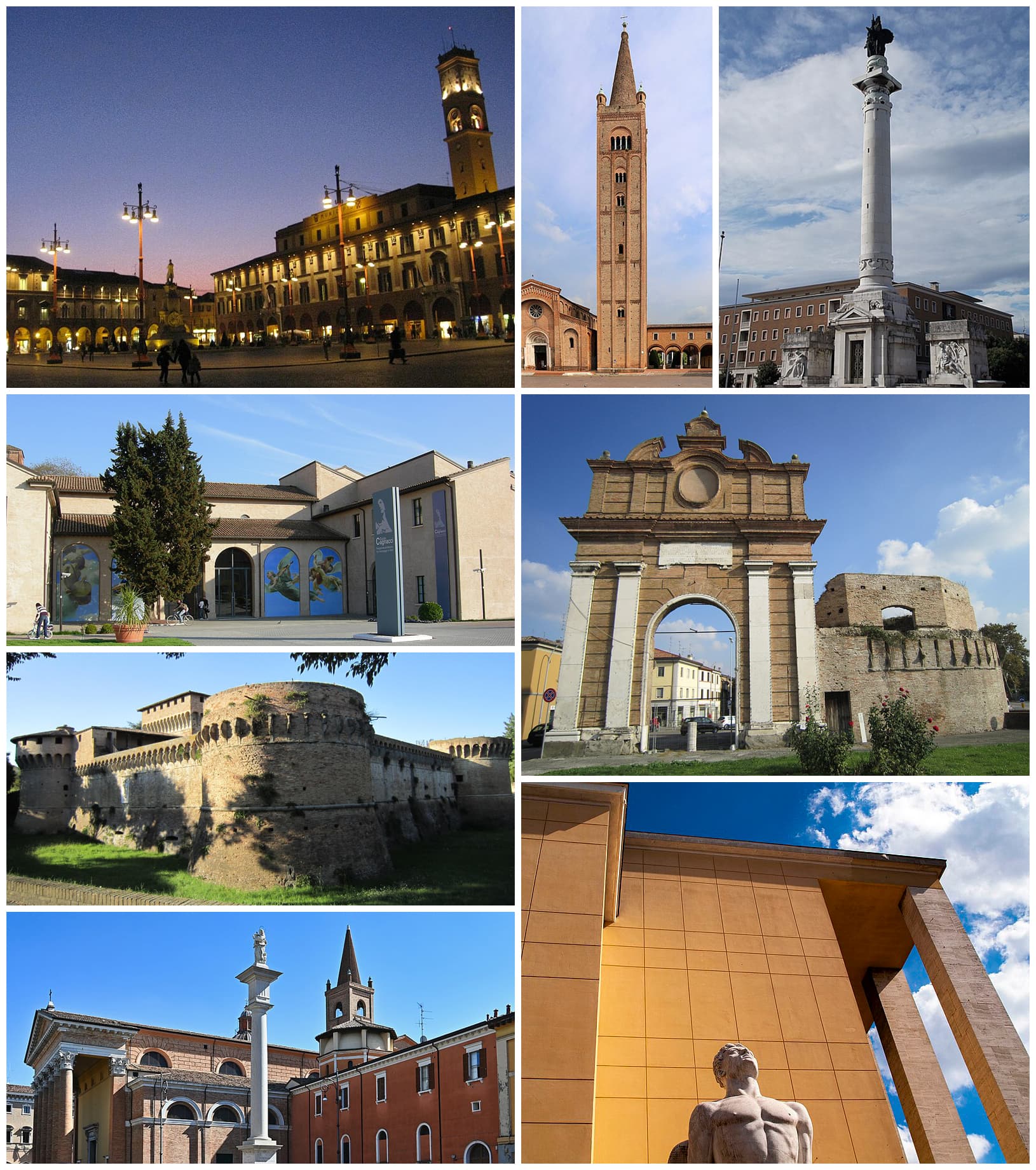
Begin your exploration in Piazza Aurelio Saffi, the trapezoidal heart of Forlì, where four main avenues converge. Here, you will encounter the Romanesque Basilica of San Mercuriale, with its distinctive 12th-century bell tower, and the Palazzo Comunale (Town Hall). The square also features the Renaissance-era Palazzo del Podestà and Palazzo Albertini, alongside the 20th-century Palazzo delle Poste. Observe the monument to Aurelio Saffi, a key figure in Italian unification, at the center of the square.
A brief walk leads to the San Domenico Museums, situated within a former 13th-century Dominican convent. This complex houses the Civic Art Gallery, displaying works from the 13th to 18th centuries by artists such as Melozzo da Forlì and Marco Palmezzano, and hosts international temporary exhibitions. For a glimpse into the city's defensive past, visit the Rocca di Ravaldino, a 14th-century fortified citadel that underwent significant expansion in the 15th century. For a different architectural perspective, explore Piazzale della Vittoria, featuring the imposing Icarus statue and examples of Rationalist design. For a green respite, the Parco Urbano Franco Agosto, the city's primary public park, offers walking paths, a tranquil lake, and various recreational amenities.
The most agreeable times to experience Forlì are spring and early summer, from mid-April to mid-June, and during September. In these months, temperatures are comfortable, making them ideal for exploring the city's historical sites and engaging in outdoor pursuits. While summers (June to August) are warm and humid, with average daily highs often surpassing 31°C (88°F), a sea breeze can offer some relief. Winters (December to February) are cooler and damp, with average temperatures around 5-7°C (41-45°F), necessitating warmer attire.
Forlì is readily accessible, positioned on the main railway and road linking Milan to Bari and Brindisi, and it maintains its own airport. The historic center is compact and easily navigated on foot, making it perfect for walking tours. Many attractions, including the Parco Urbano Franco Agosto, are also conveniently reached by bicycle from the city center. Public transportation, including buses, connects the train station to the San Domenico Museums and other key areas. For dining, be sure to savor local Romagna cuisine, including specialties like piadina romagnola and passatelli.