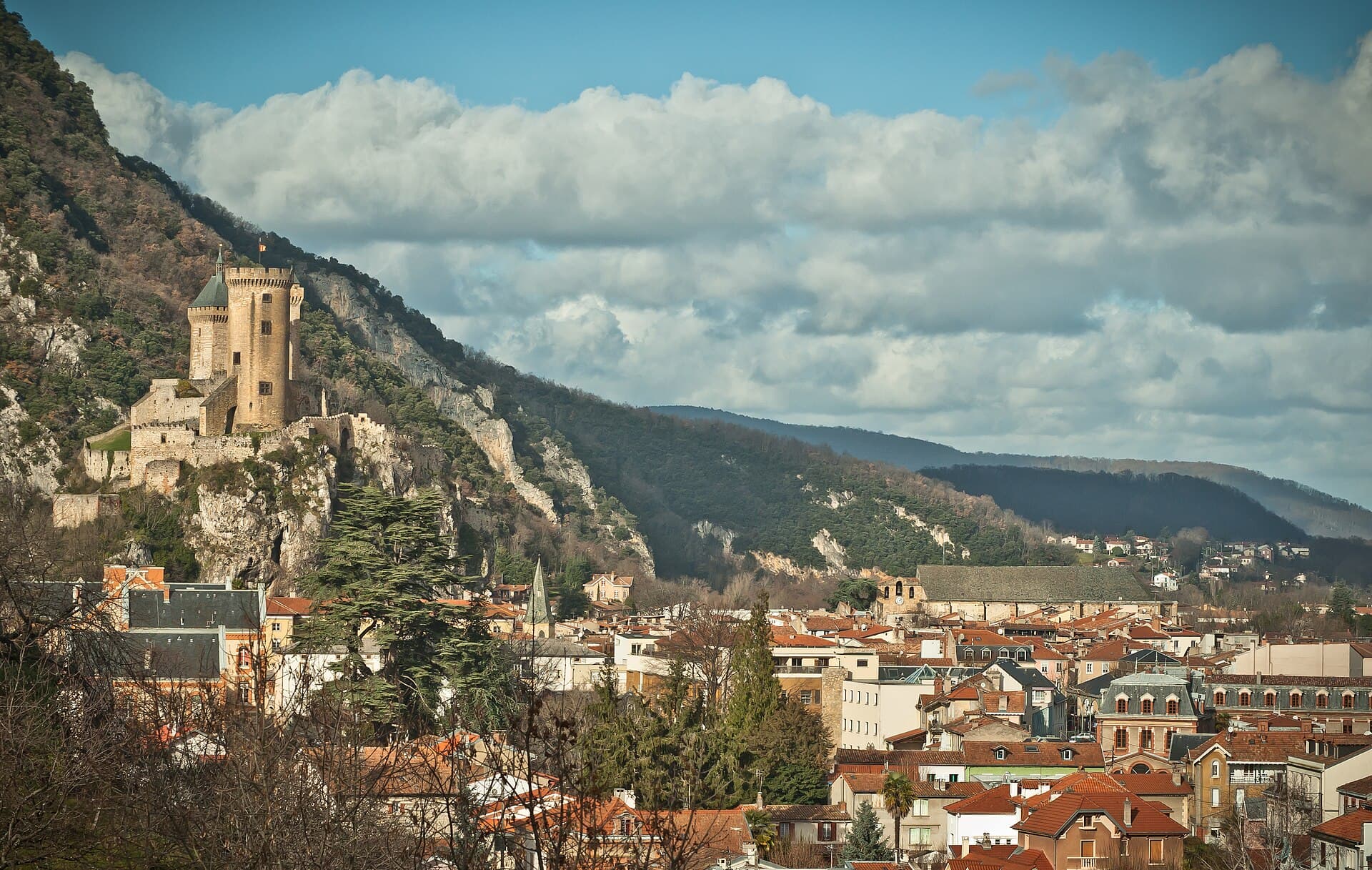
Château de Foix's round tower
The castle's three towers narrate an evolving saga of warfare, yet one commands attention for an unexpected distinction.
Full story unlocks in the tour
 BastienM / CC BY-SA 3.0, via Wikimedia Commons
“Where medieval towers meet Cathar echoes.”
Not the postcards. The stories even locals don't know — whispered in your ear, right where they happened.
The castle's three towers narrate an evolving saga of warfare, yet one commands attention for an unexpected distinction.
Foix's very beginnings are intertwined with a religious foundation, though its early days were far from tranquil.
Beyond the castle, the town's very layout offers a clue to its enduring past.
Discover every secret of Foix
Every address, every reveal in full — in your ear, right where it happened.
You pick your stops. You walk. The voice reveals what the others miss.
No tours available yet. Check back soon — we're preparing them.
Foix, the departmental capital of Ariège in southwestern France, is a town where the medieval past feels vibrantly present, dominated by its dramatic castle. Positioned at the confluence of the Ariège and Arget rivers, in the foothills of the Pyrenees, the town's natural setting is as compelling as its long history. With a population of approximately 9,700 people, Foix offers a blend of historic allure and serves as a gateway to the wild beauty of the Pyrenees.
Travelers to Foix often find themselves drawn to two distinct realms: the historic town center, with its medieval dwellings and narrow passageways, and the formidable Château de Foix, which stands sentinel on a rocky outcrop high above. This former seat of power for the Counts of Foix has witnessed centuries of conflict and cultural transformation, from Roman fortifications to a refuge for Cathar dissenters. Today, Foix functions as a market town and a center for visitors, offering a glimpse into traditional southern French life alongside opportunities for outdoor pursuits in the surrounding mountains.
The story of Foix extends back to Roman times, with a fort established on the very rock where the Château de Foix now stands. The town itself likely grew from an oratory founded by Charlemagne, which later became the Abbey of Saint Volusianus in 849. The creation of this abbey spurred urban development between the 10th and 12th centuries, and Foix reached its zenith in the 14th century.
The Château de Foix, with foundations dating to the early 10th century, became the capital of the County of Foix in 1034. For centuries, it served as a formidable stronghold, governing access to the upper Ariège valley. The Counts of Foix played a central role in medieval military history, particularly during the Albigensian Crusade (1209-1229) against the Cathars.
The county of Foix became a significant sanctuary for persecuted Cathars, a dualist Christian movement considered heretical by the Catholic Church. The castle famously resisted numerous sieges by Simon de Montfort, the leader of the Albigensian Crusade, between 1211 and 1217. A local saying of the period declared, "El castels es tant fortz que el mezis se defent" (the castle is so strong that it defends itself). While never conquered by storm, the castle was eventually yielded to King Philip the Bold of France in 1272 when the Count of Foix declined to acknowledge the king's sovereignty.
From the 14th century, the Counts of Foix began to spend less time in the castle, preferring more comfortable residences. Notably, Gaston III, known as Fébus, governed the region from 1343 to 1391, maintaining careful neutrality during the Hundred Years' War. By 1479, the Counts of Foix had become Kings of Navarre, and the last of them, Henry of Navarre, was crowned King Henry IV of France in 1589, incorporating his Pyrenean lands into France. The castle then functioned as a prison until 1864. Since 1930, it has housed the Ariège departmental museum, preserving the region's expansive past.
The most striking landmark in Foix is the Château de Foix, a medieval castle with three distinct towers that affords sweeping views of the town and the Ariège valley. The castle now contains the Ariège departmental museum, with exhibitions on prehistory, Gallo-Roman, and medieval archaeology, recreating daily life during the era of the Counts of Foix. Self-guided audio tours are available in several languages.
Below the castle, wander through the historic town center with its narrow, curving streets, medieval dwellings, and appealing squares. Seek out half-timbered houses on Rue de la Faurie and Place Parmentier, and the Maison des Cariatides with its sculpted figures. The Abbey Church of Saint-Volusien, though rebuilt multiple times due to conflicts, features 17th-century carved stalls and a Romanesque transept.
For a glimpse of local life, visit the Halle aux Grains, a covered market structure in the Baltard style. On Tuesdays, Wednesdays, and Fridays, Foix awakens with markets, particularly the Friday market at Place Saint Colusien and Allée de Vilotte, recognized for its array of cheeses and honey.
The most agreeable time to visit Foix is during the warmer months, from May to September. Temperatures are comfortable, typically ranging between 18°C and 25°C. July is the sunniest month, offering approximately 9.2 hours of sunshine daily. For warm-weather outdoor pursuits, late June to early September is ideal, with a peak in the third week of July. While September offers mildly cool temperatures, the town also hosts its annual celebrations on the first weekend of September with a funfair, dancing, and concerts.
Foix is accessible by train, with regular services from Toulouse taking just over an hour. The train station is a 10-minute walk from the city center. If driving, Foix is on the N20 between Toulouse and Andorra. While the city center can experience congestion on market days (especially Friday mornings), various parking options exist, including free parking near the cultural center, a 5-minute walk from the center.
Within the town, the historic center is best explored on foot. The Château de Foix requires a significant uphill walk, but the vistas are rewarding. The castle offers interactive activities and workshops on medieval life. Many shops, galleries, and restaurants can be discovered in the medieval quarter.