Tomb of Amyntas
This most impressive Lycian rock tomb in Fethiye bears an inscription that has puzzled historians for centuries.
Full story unlocks in the tour
 Alexander Annenkov from Moscow, Russia / CC BY 2.0, via Wikimedia Commons
“Where ancient echoes meet turquoise waters.”
Not the postcards. The stories even locals don't know — whispered in your ear, right where they happened.
This most impressive Lycian rock tomb in Fethiye bears an inscription that has puzzled historians for centuries.
This eerie village of abandoned stone houses holds a silent story of a significant historical event.
Beyond the lively displays of fresh produce and textiles, this bustling market offers a unique local interaction that many visitors miss.
Discover every secret of Fethiye
Every address, every reveal in full — in your ear, right where it happened.
You pick your stops. You walk. The voice reveals what the others miss.
No tours available yet. Check back soon — we're preparing them.
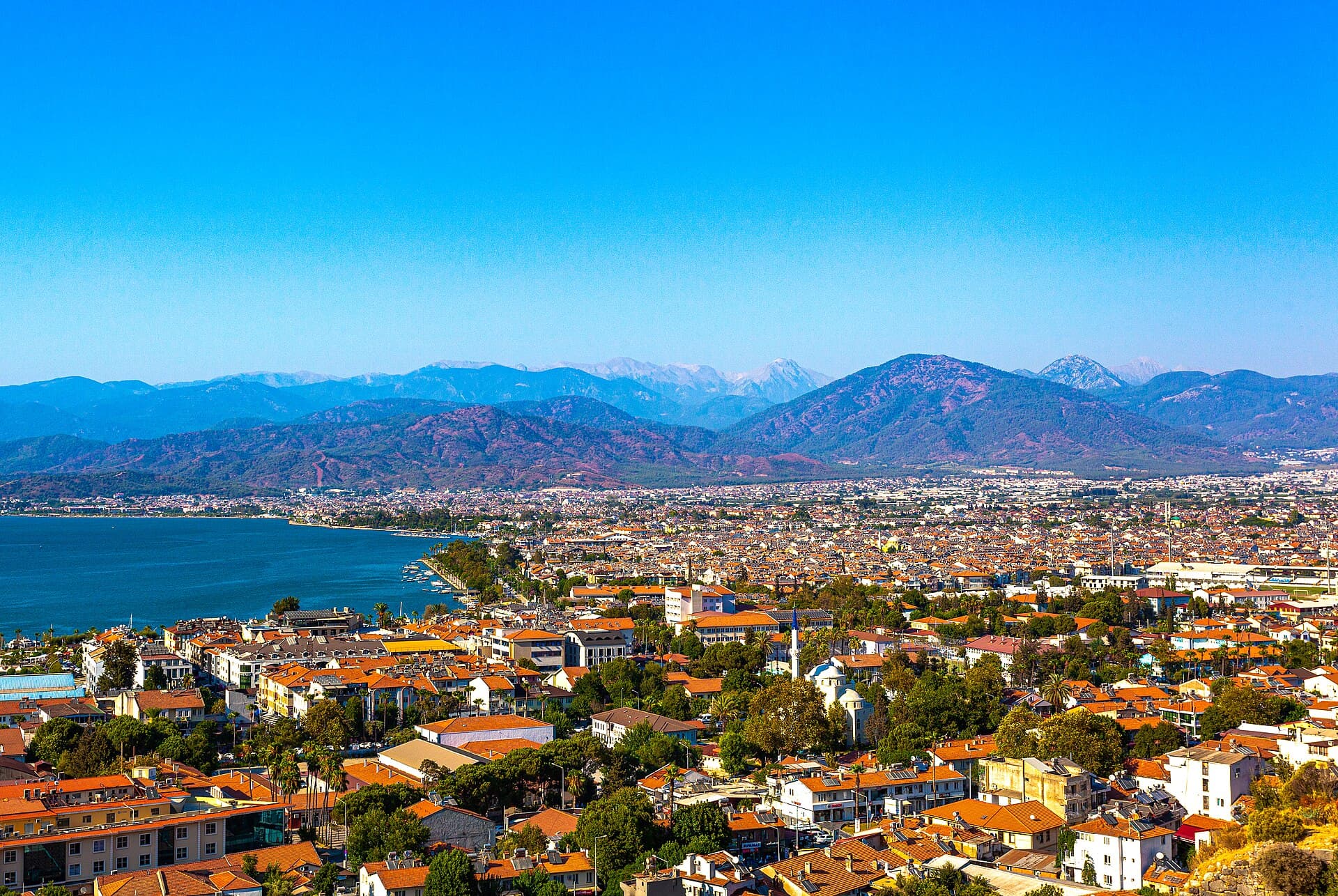
Fethiye, a port city on Turkey's southwestern Turquoise Coast, offers a captivating blend of natural beauty, ancient history, and lively local life. The city is set within a lovely bay, sheltered by green pine and cedar forests, and backed by grand mountains. It serves as a gateway to some of the region's celebrated natural wonders, including the Ölüdeniz Blue Lagoon, known for its calm, azure waters. Fethiye's landscape is characterized by its rugged coastline, numerous islands, and secluded coves, making it a popular departure point for yacht tours and boat excursions.
The city itself is built upon the ancient Lycian city of Telmessos, meaning remnants of past civilizations are woven into the modern urban fabric. From the dramatic Lycian rock tombs carved into the cliffs above the city to the bustling local markets, Fethiye provides a diverse range of experiences for travelers seeking both relaxation and adventure.
The history of Fethiye stretches back thousands of years, with its origins rooted in the ancient Lycian city of Telmessos. Evidence of Telmessos dates back to the 5th century BC, and it was considered one of the most important cities of the Lycian civilization. Lycia was an independent civilization known for its distinct funerary architecture, particularly rock-cut tombs carved into cliffs. According to a Lycian legend, the name Telmessos originated from the god Apollo, who transformed into a small dog to win the love of the King of Phoenix's youngest daughter, Agenor. Their son was named Telmessos, meaning "the land of lights."
Telmessos was renowned as a center of prophecy, with its priests known for dream interpretation. The city fell under Persian rule in 547 BC and later became a member of the Delian League, a confederacy of Greek city-states. It maintained close ties with Greece, even after gaining independence, until Alexander the Great took control in the 4th century BC. During the Byzantine era, Fethiye is believed to have prospered, but was eventually abandoned due to the Arab-Byzantine wars between the 7th and 8th centuries.
From the 12th century, the area began to flourish again, with the city walls expanding and perfume production increasing. The city was later captured by the principality of Menteseogullari in 1284 and renamed Makri, meaning "the long one" or "remote city" in Greek. In 1424, it became part of the Ottoman Empire. The Fethiye Castle, originally built in the 11th century, was rebuilt by the Knights of St. John in the 15th century and served as a naval base. The significant Greek population in Makri remained until the 1923 population exchange between Turkey and Greece. The city was finally renamed Fethiye in 1934, honoring Fethi Bey, an early Turkish aviator who died during an attempted flight from Istanbul to Cairo in 1914. Today, Fethiye stands as a prominent tourist destination on the Turkish Riviera.
Fethiye offers a diverse array of sights, blending ancient history with natural wonders. High above the city, carved into the limestone cliffs, are the Lycian rock tombs, dating back to the 4th century BCE. The most prominent is the Tomb of Amyntas, identifiable by its temple-style façade with Ionic columns and triangular pediment. A climb to these tombs offers sweeping views of Fethiye's marina and the bay.
Explore the Fethiye Old Town, known as Paspatur, with its narrow lanes, shops, and restaurants. The Fethiye Museum houses artifacts from the Lycian, Roman, and Ottoman periods, providing insight into the region's past. Near the harbor, you can find the remains of the Roman Theatre, which has undergone restoration efforts.
A short distance from Fethiye lies the Kayaköy Ghost Town, an open-air museum of approximately 500 abandoned stone houses and churches. For natural beauty, visit the Ölüdeniz Blue Lagoon, about 14 kilometers from Fethiye, known for its calm, clear waters, ideal for swimming and water sports. Paragliding from Babadağ Mountain offers aerial views of the lagoon. Another natural attraction is Saklıkent Gorge, one of Europe's deepest canyons, where you can wade through its narrow slot.
Fethiye enjoys a Mediterranean climate with hot, dry summers and mild, wet winters. The best time to visit for hot-weather activities and beaches is from mid-June to mid-September, with July and August being the hottest months, averaging daily highs of 33-35°C (91-95°F). Sea temperatures are also warmest during this period, reaching up to 27°C (81°F) in August.
For those who prefer milder temperatures for hiking and sightseeing, spring (April to June) and autumn (September to October) are ideal. During these seasons, daytime temperatures range from 20-28°C (68-82°F) in spring and 20-30°C (68-86°F) in autumn, with less rainfall. May and September offer a good balance of pleasant weather, warm sea temperatures, and fewer crowds.
Dalaman Airport (DLM) is the nearest airport to Fethiye, located about 40-60 kilometers away, with a travel time of approximately 45-50 minutes. Direct flights are available from countries like the UK and Germany, with regular flights from across Europe often including stopovers. You can reach Fethiye from the airport via Havabus services, private transfers, or by renting a car.
Within Fethiye, the local minibus system, known as dolmuş, is a common and affordable way to get around the city and to nearby towns like Ölüdeniz, Kayaköy, and Çalış Beach. Dolmuş can be hailed almost anywhere on their route and payment is typically made with a Muğla Kent Kart (Muğla City Card) for discounted travel, though cash is sometimes accepted on certain routes. Water taxis also operate between Fethiye and Çalış Beach, especially popular during the summer months. Renting a car provides flexibility for exploring the wider region, though parking in the city center can be limited and requires payment.