Chouara Tannery
The lively colors of Fez's tanneries are striking, but a sprig of mint offered at the entrance serves a practical purpose.
Full story unlocks in the tour
 This Photo was taken by Timothy A. Gonsalves. Feel free to use my photos, but please mention me as the author. I would much appreciate if you send me an email tagooty@yahoo.com or write on my talk page, for my information. Please contact me before commercial use. Please do not upload an edited image here without consulting me. I would like to make corrections only at my own source to ensure that the changes improve the image and are preserved.Otherwise you may upload an edited image with a new name. Please use one of the templates derivative or extract. / CC BY-SA 4.0, via Wikimedia Commons
“Fez: Ancient alleys unfold, where artisans forge living stories.”
Not the postcards. The stories even locals don't know — whispered in your ear, right where they happened.
The lively colors of Fez's tanneries are striking, but a sprig of mint offered at the entrance serves a practical purpose.
Navigating the intricate passages of the Fez medina can feel like solving a puzzle, which reflects its original design.
This 14th-century Islamic school presents a modest exterior, yet reveals an unexpected splendor within its walls.
Discover every secret of Fez
Every address, every reveal in full — in your ear, right where it happened.
You pick your stops. You walk. The voice reveals what the others miss.
No tours available yet. Check back soon — we're preparing them.
Fez, Morocco's oldest imperial city, is a place where history is not merely preserved, but actively experienced. Situated northwest of the Atlas Mountains, the city centers around the Fez River and is embraced by surrounding hills. Its historic medina, Fes el-Bali, a UNESCO World Heritage site, constitutes one of the world's largest car-free urban areas—a sprawling network of over 9,000 narrow, winding passages.
Entering the Fez medina is like stepping into a medieval city, a multisensory journey filled with the sounds of artisans at work, the aroma of mint tea, and the sight of donkeys traversing the thoroughfares. Unlike cities maintained solely for tourism, Fez remains a working city, which contributes to its captivating character. Here, ancient traditions persist, from coppersmiths shaping metal to leather tanners perfecting their craft in time-honored workshops.
Fez was established in 789 CE by Idris I on the southeast bank of the Jawhar River, now known as the Fez River. His son, Idris II, founded a settlement called al-ʿĀliyá on the opposite bank in 809 CE, moving his capital there from Walili (Volubilis). For a period, Fez consisted of these two distinct, competing settlements. The two parts were eventually unified by the Almoravids in the 11th century, transforming Fez into a significant Islamic city.
Fez reached its peak under the Marinid dynasty, from the 13th to the 15th centuries, when it regained its status as the political capital. This era saw the construction of numerous madrasas (theological schools) and mosques, many of which still stand today and are considered exemplary of Moorish and Moroccan architectural styles. In 1276, the Marinid sultan Abu Yusuf Yaqub founded Fes Jdid, or 'New Fez,' as a royal administrative district, which continues to house the Royal Palace.
By the 12th century, Fez had grown into a major hub of trade and learning in the Arab world, drawing merchants from the Mediterranean and scholars from Spain and the Middle East. It was once believed to be the largest city on Earth, with a population of 200,000. The University of Al-Karaouine, founded in 859 CE by Fatima al-Fihri, is recognized by UNESCO as the oldest continuously operating university in the world, with a curriculum that once included theology, grammar, mathematics, astronomy, and law. When Muslims were expelled from Spain starting in the 13th century, many came to Fez and Al-Karaouine, bringing knowledge of European and Moorish arts and sciences.
The Treaty of Fez in 1912 established the French protectorate in Morocco. Following this, the administrative capital was moved to Rabat in 1912–1913, where it has remained. While Fez saw the development of a modern section, the Ville Nouvelle, during the French colonial era, the old city, comprising Fes el-Bali and Fes Jdid, was designated a UNESCO World Heritage site in 1981, preserving its unique character.
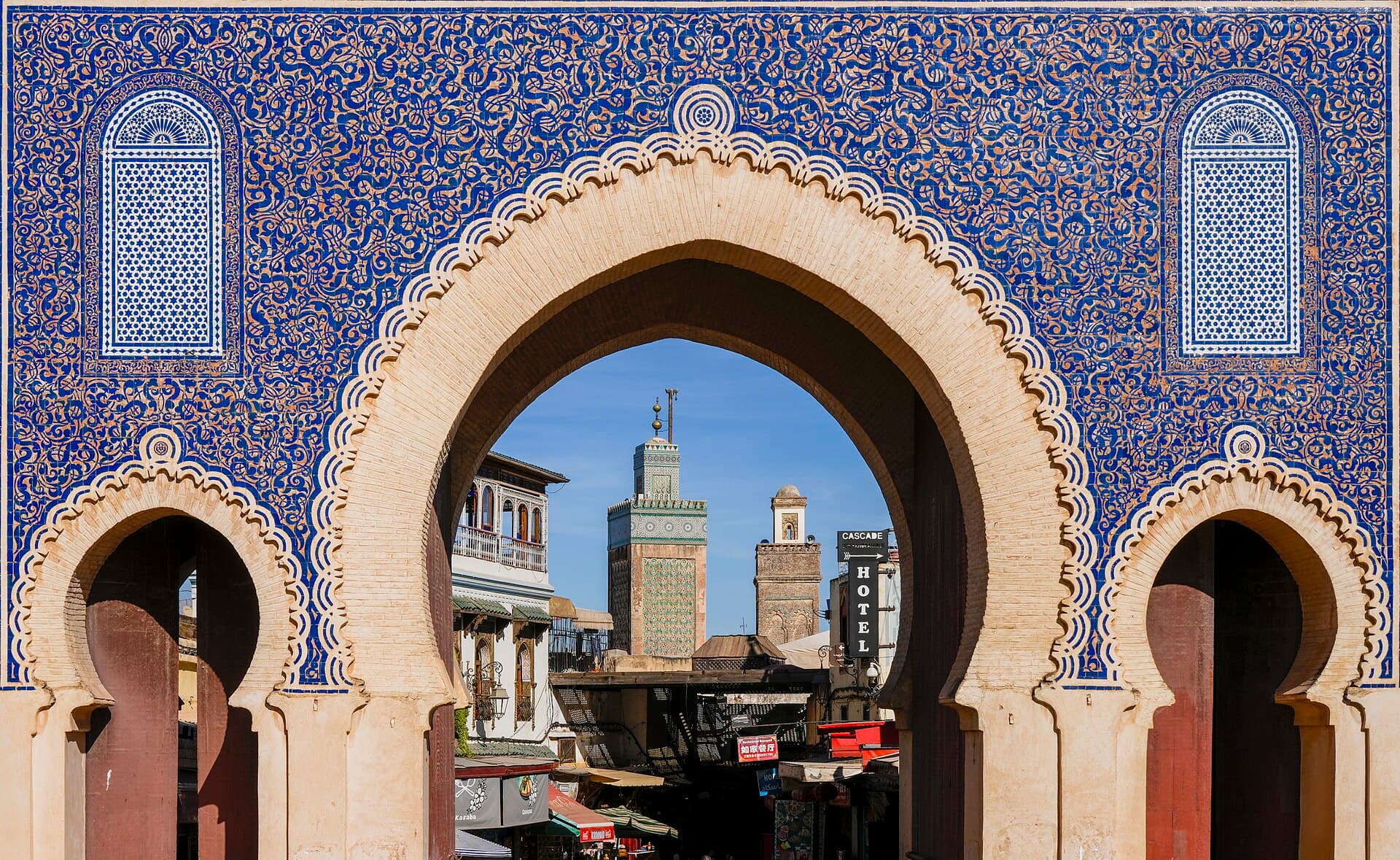
Begin your journey at Bab Bou Jeloud, also known as the Blue Gate, a beautifully tiled entrance to the medina. The outer façade is blue, the color of Fez, while the inner side is green, symbolizing Islam. From here, wander into Fes el-Bali, the largest car-free urban area in the world.
Visit the Chouara Tannery, one of the city's most recognizable and oldest industrial sites, operating since at least the 11th century. Observe the traditional process of leather tanning and dyeing, a captivating, though aromatic, experience.
Explore the Bou Inania Madrasa, a 14th-century Islamic school celebrated for its intricate tilework, stucco, and cedar wood carvings. It is one of the few religious Islamic sites in Fez accessible to non-Muslim visitors. Another architectural marvel is the Al-Attarine Madrasa, a smaller but equally impressive 14th-century school.
Discover Seffarine Square, a historic center for coppersmiths since the 12th century, where the rhythmic sound of hammering metal fills the air. Nearby, the Nejjarine Museum of Wooden Arts & Crafts, housed in a former caravanserai, displays traditional Moroccan woodworking. Do not miss the Mellah, Fez's historic Jewish Quarter, with its distinctive architecture and the restored Ibn Danan Synagogue.
The most agreeable times to visit Fez are during the spring (March to May) and autumn (September to November). During these transitional seasons, temperatures are mild and pleasant, ranging from 15°C to 25°C in spring and 12°C to 27°C in autumn. The countryside appears verdant in spring, and autumn offers comfortable days and cool nights, ideal for exploration and photography. Summers (June to August) are very hot, with daytime highs often surpassing 35°C (95°F), making extended outdoor activities uncomfortable. Winters (November to March) are milder but can be rainy.
Fez is primarily explored on foot, particularly within the medina, which is a car-free zone. Taxis can drop off and pick up at the medina's gates. While navigating the intricate passages can be challenging, even with maps, many travelers find independent exploration rewarding. However, be mindful of unofficial guides who may approach you.
Bargaining is a customary part of shopping in the souks; approach it as a friendly negotiation. Start by offering about half the asking price and be prepared to meet in the middle. Modest dress is advisable in Fez, a predominantly Muslim city, and it is a good idea for women to carry a scarf to cover their heads if visiting mosques. While generally secure, it is wise to be aware of your surroundings, especially at night in less-lit areas of the medina, and keep valuables secure.