Katzenturm (Cat's Tower)
The name of Feldkirch's imposing Katzenturm, or 'Cat's Tower,' has sparked centuries of debate.
Full story unlocks in the tour
 Norbert Kaiser / CC BY-SA 3.0 at, via Wikimedia Commons
“Where ancient stones meet Alpine majesty.”
Not the postcards. The stories even locals don't know — whispered in your ear, right where they happened.
The name of Feldkirch's imposing Katzenturm, or 'Cat's Tower,' has sparked centuries of debate.
A particular inn in Feldkirch once featured paintings so scandalous, the owner was forced to modify them.
Feldkirch's iconic Schattenburg Castle, now a museum and restaurant, is said to be haunted by a sorrowful ghost.
Discover every secret of Feldkirch
Every address, every reveal in full — in your ear, right where it happened.
You pick your stops. You walk. The voice reveals what the others miss.
No tours available yet. Check back soon — we're preparing them.
Feldkirch, Austria's westernmost municipality, offers a captivating blend of medieval history and grand Alpine scenery. Situated at the convergence of three valleys, it borders both Switzerland and Liechtenstein, making it an ideal base for exploring the wider region. The city is celebrated for its remarkably preserved medieval townscape, a testament to centuries of careful stewardship.
Stone-paved streets, historic buildings, and a commanding 13th-century castle create an atmosphere that feels straight out of a storybook. Beyond its architectural beauty, Feldkirch pulses with a lively cultural scene, from contemporary art spaces to engaging festivals, proving that its allure extends far beyond its ancient walls.
Feldkirch's origins trace back to a Roman settlement called Clunia, likely a weigh station on a route between Milan and Brigantium. The city as we know it began to take shape around 1200, when Count Hugo I of Montfort founded the town and initiated the construction of Schattenburg Castle. Feldkirch was first officially mentioned as a city in 1218, when Count Hugo I donated the Church of St. John and its associated monastery.
For nearly two centuries, the Counts of Montfort held sway, residing in Schattenburg Castle until 1390. The city and its surrounding county were then sold to the Habsburgs in 1375. Around 1500, Feldkirch's city wall was rebuilt, and the city's layout has remained largely unchanged since. This commitment to preservation earned the Feldkirch Municipal Ensemble a spot on the Austrian List of Cultural Heritage in 2015.
Feldkirch has witnessed significant historical events, including two clashes between French and Habsburg forces in March 1799. The city also has connections to notable literary figures. Arthur Conan Doyle, the creator of Sherlock Holmes, studied German at the Jesuit school Stella Matutina in 1875, a place that later became the Voralberg State Conservatory. James Joyce, another literary giant, found himself in Feldkirch in 1915, mistaken for a spy while fleeing World War I. He returned in 1932, staying for several weeks at the Hotel Löwen to work on Finnegans Wake. The city even played a role in modern cinema, with a car chase scene from the James Bond film Quantum of Solace filmed in Marktgasse in 2008.
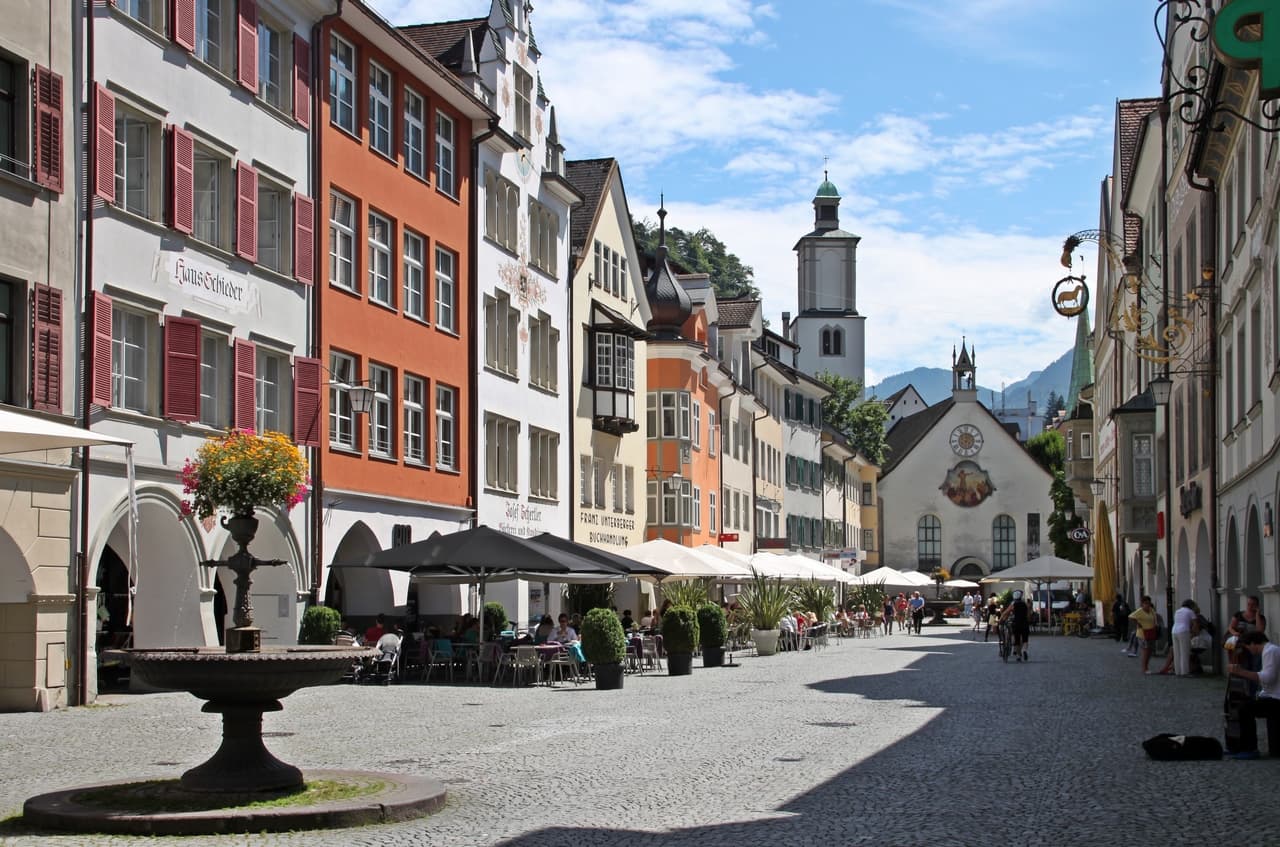
Begin your exploration in Feldkirch's well-preserved Old Town, characterized by its narrow stone-paved streets, arcades, and buildings adorned with frescoes. The Marktgasse, or Market Street, serves as the main thoroughfare, hosting twice-weekly markets where local vendors sell produce, flowers, and regional specialties.
Schattenburg Castle, a 13th-century fortress, rises above the skyline and once served as the seat of the Counts of Montfort. Today, it houses a museum with 18 rooms detailing local history and medieval life, along with a restaurant offering wide views of the city and surrounding Alps. Do not miss the castle's keep, where weapons from the Middle Ages to World War II are displayed.
Another prominent landmark is the Katzenturm, or Cat's Tower, a 40-meter-high defensive tower built in 1507 as part of the city's fortifications. It later became a bell tower and houses Vorarlberg's largest bell, weighing 8.5 tons, which rings every Friday at 3 PM. For a different architectural experience, visit the Montforthaus Feldkirch, a modern cultural and congress center with a striking curved glass and wood facade, offering a contemporary contrast to the medieval surroundings. Finally, consider a visit to Wildpark Feldkirch, a free outdoor space with hiking trails and local wildlife like deer, ibex, and wolves.
Feldkirch experiences all four seasons, and the best time to visit depends on your preferences. For warm-weather activities and festivals, late June to early September offers average daily high temperatures above 68°F (20°C), with July being the hottest month at an average high of 75°F (24°C). This is also peak season, so expect higher prices and more visitors.
If you're drawn to winter sports and festive Christmas markets, December and early January provide a snow-dusted landscape. For those seeking milder weather and fewer crowds, the shoulder seasons of spring and fall are ideal, offering pleasant temperatures and beautiful natural scenery as the forests change color.
Feldkirch is easily accessible, particularly by train, with numerous connections from major cities like Zurich, Innsbruck, and Bregenz. Driving is also an option for those on a European road trip. The city center is very pedestrian-friendly, making it easy to explore on foot. Public transportation within Feldkirch is well-covered by its city bus system, offering both daytime and nighttime routes. For a unique perspective, consider one of the themed walking tours offered by the city, led by actors portraying historical figures, some even offering schnapps or revealing "secret plans."
While English is understood in tourist-oriented areas, a few German phrases can enhance your experience. The currency used is the Euro. For accommodation, options range from budget-friendly to more luxurious hotels, many blending medieval charm with modern amenities. Remember to book train tickets in advance for the best prices and times.