Tapiola Garden City
Tapiola was conceived as a visionary experiment in urban living, a complete society in miniature.
Full story unlocks in the tour
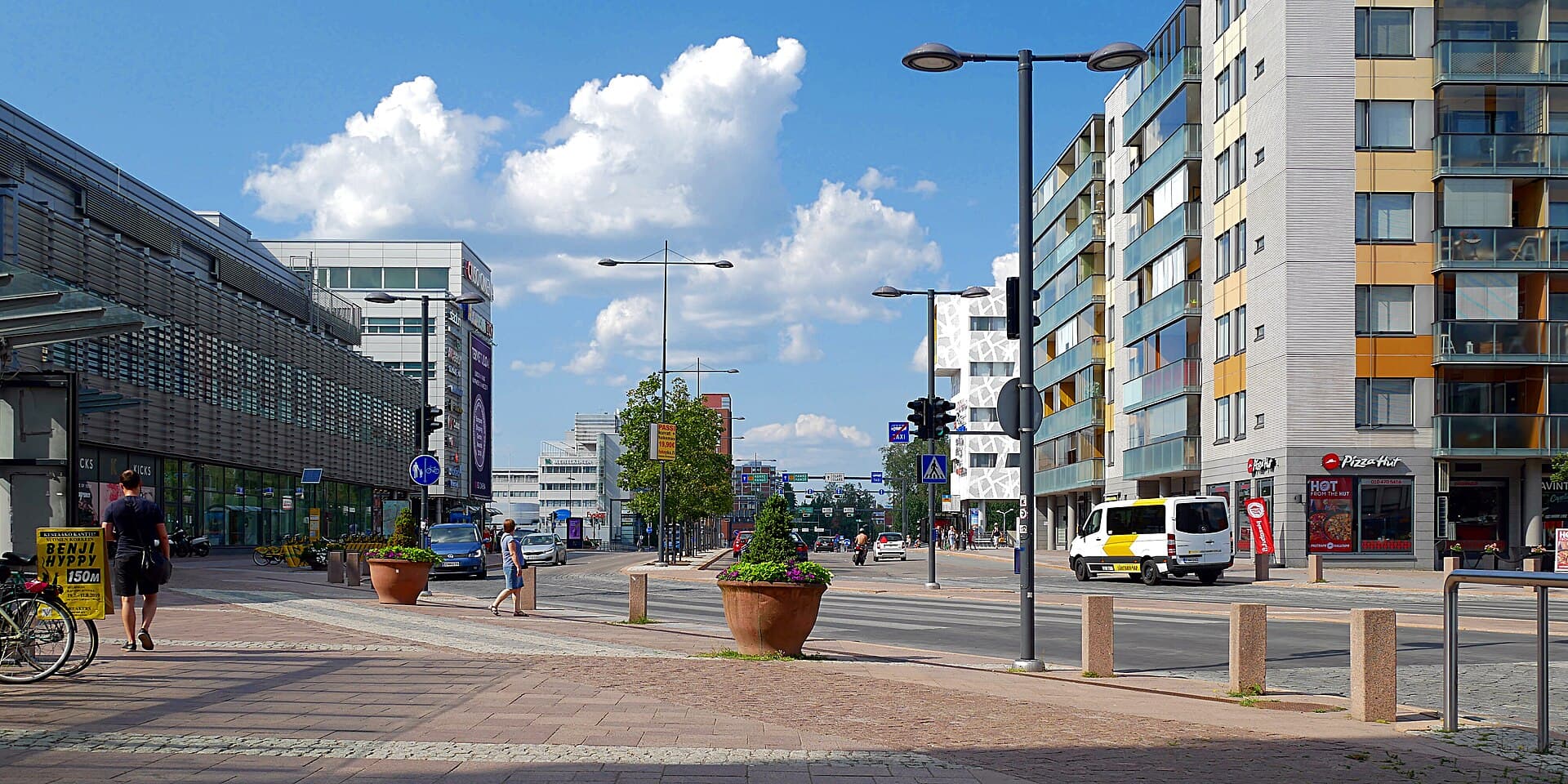 Drefer / CC BY-SA 4.0, via Wikimedia Commons
“Where urban ingenuity converges with Finland's untamed spirit.”
Not the postcards. The stories even locals don't know — whispered in your ear, right where they happened.
Tapiola was conceived as a visionary experiment in urban living, a complete society in miniature.
EMMA, Finland's largest art museum, occupies a building that once served a vastly different purpose.
Espoo possesses a remarkable number of islands, even surpassing a celebrated tropical paradise.
Discover every secret of Espoo
Every address, every reveal in full — in your ear, right where it happened.
You pick your stops. You walk. The voice reveals what the others miss.
No tours available yet. Check back soon — we're preparing them.
Espoo, Finland's second-largest city, presents a compelling fusion of cutting-edge innovation and expansive natural splendor. Positioned just west of Helsinki, it is a city that resists a single focal point, instead unfolding through five distinct urban centers, each with its own character. This decentralized structure, coupled with its dedication to sustainability, has led some to describe it as "the most American suburban city of Finland."
Beyond its contemporary exterior, Espoo serves as a gateway to the Finnish wild. Its varied terrain embraces a significant coastline along the Gulf of Finland, an archipelago of 165 islands, numerous forests, and over 100 lakes, including the expansive Lake Bodom. This singular interplay of urban existence and tranquil nature renders Espoo a captivating destination, often referred to as "Finland in miniature."
Espoo's narrative extends back to prehistoric eras, with evidence of human settlements from 8,000 years ago, though the population disappeared during the early Iron Age. During the Early Middle Ages, the area was inhabited by Tavastians and Southwestern Finns. Following the Northern Crusades, Swedish settlers began to establish permanent agricultural communities along the coastal regions of modern-day Finland.
The city's formal journey commenced in the 15th century when it became an autonomous Catholic parish, separating from Kirkkonummi in 1458. The distinguished stone Espoo Cathedral was constructed in the 1480s, becoming the spiritual core of the new parish. In 1556, King Gustav I of Sweden established a royal manor in Espoo to stabilize and develop the region, temporarily making it an administrative center.
For centuries, Espoo remained a predominantly rural, agrarian expanse, its economy centered on farming and fishing. The populace was primarily Swedish colonists, and cultural life revolved around the church and grand estates. However, the 20th century brought swift transformation. After World War II, Espoo experienced rapid urbanization and significant demographic shifts, with Finnish becoming the majority language around 1950, replacing Swedish. The municipality attained market town status in 1963 and was granted city status on January 1, 1972. This period witnessed its evolution from a rural area into a modern technological and cultural hub, particularly with the growth of neighboring Helsinki. Today, Espoo is a flourishing center for education and high-technology businesses, home to Aalto University and the headquarters of many international companies.
Espoo offers a diverse array of experiences, harmonizing its natural environment with cultural and architectural highlights. A rewarding visit is Nuuksio National Park, an expansive wilderness of ancient forests, rocky landscapes, and over 100 lakes. Here, one can traverse marked trails, gather wild berries and mushrooms, or even try snowshoeing in winter. The Finnish Nature Centre Haltia provides an immersive, eco-friendly introduction to Finnish nature, with interactive exhibitions.
For art enthusiasts, EMMA – Espoo Museum of Modern Art stands as Finland's largest art museum, situated within the architecturally significant WeeGee Exhibition Centre. EMMA displays Finnish and international contemporary art, design, and modernism, featuring permanent collections like the Saastamoinen Foundation Art Collection. The WeeGee Centre also houses other museums, including KAMU Espoo City Museum and, in summer, the distinctive Futuro House.
Explore Tapiola Garden City, an internationally recognized example of Finnish urban planning from the 1950s and 60s, celebrated for its thoughtful integration of urban living with nature. Here you will find the Espoo Cultural Centre. Those interested in history can visit the Espoo Cathedral, a medieval stone church dating back to the 1480s, the oldest preserved building in the city. Another historical treasure is the Gallen-Kallela Museum, the former residence and studio of celebrated Finnish painter Akseli Gallen-Kallela, constructed between 1911 and 1913.
Espoo presents distinct experiences throughout the year. For warm weather activities, extended daylight hours, and exploring the outdoors, the months from June to August are ideal, with average temperatures around 17.5°C in July. Spring, particularly April and May, brings sunnier, drier weather, perfect for walks and observing nature awaken. If you are drawn to snow-covered landscapes and winter sports like skiing or snowshoeing, plan your visit between December and March, when temperatures average between -3°C and 1°C in December. Autumn offers beautiful foliage, ideal for mushroom and berry gathering tours.
Espoo is readily accessible, situated just west of Helsinki. One can arrive in about 15 minutes by metro from Helsinki city center or a 30-minute drive from Helsinki Airport. Public transportation within Espoo and the wider Helsinki Metropolitan Area is efficient and convenient, utilizing an integrated HSL ticket system for metro, local trains, trams, light rail, and buses. The city is primarily in zones B and C for HSL tickets, while Helsinki city center is in zone A and Helsinki Airport in zone C.
Espoo is a bilingual municipality with Finnish and Swedish as its official languages, and English is also established as a service language. While Finnish and Swedish remain the written administrative languages, many city services are available in English. The currency used is the Euro (€). When preparing for your trip, layering is recommended due to Finland's changeable coastal climate, with a windproof and waterproof jacket and comfortable, waterproof shoes being essential year-round.