Temple of Khnum
The Esna Temple's lively ceiling was once a secret, concealed from view for centuries.
Full story unlocks in the tour
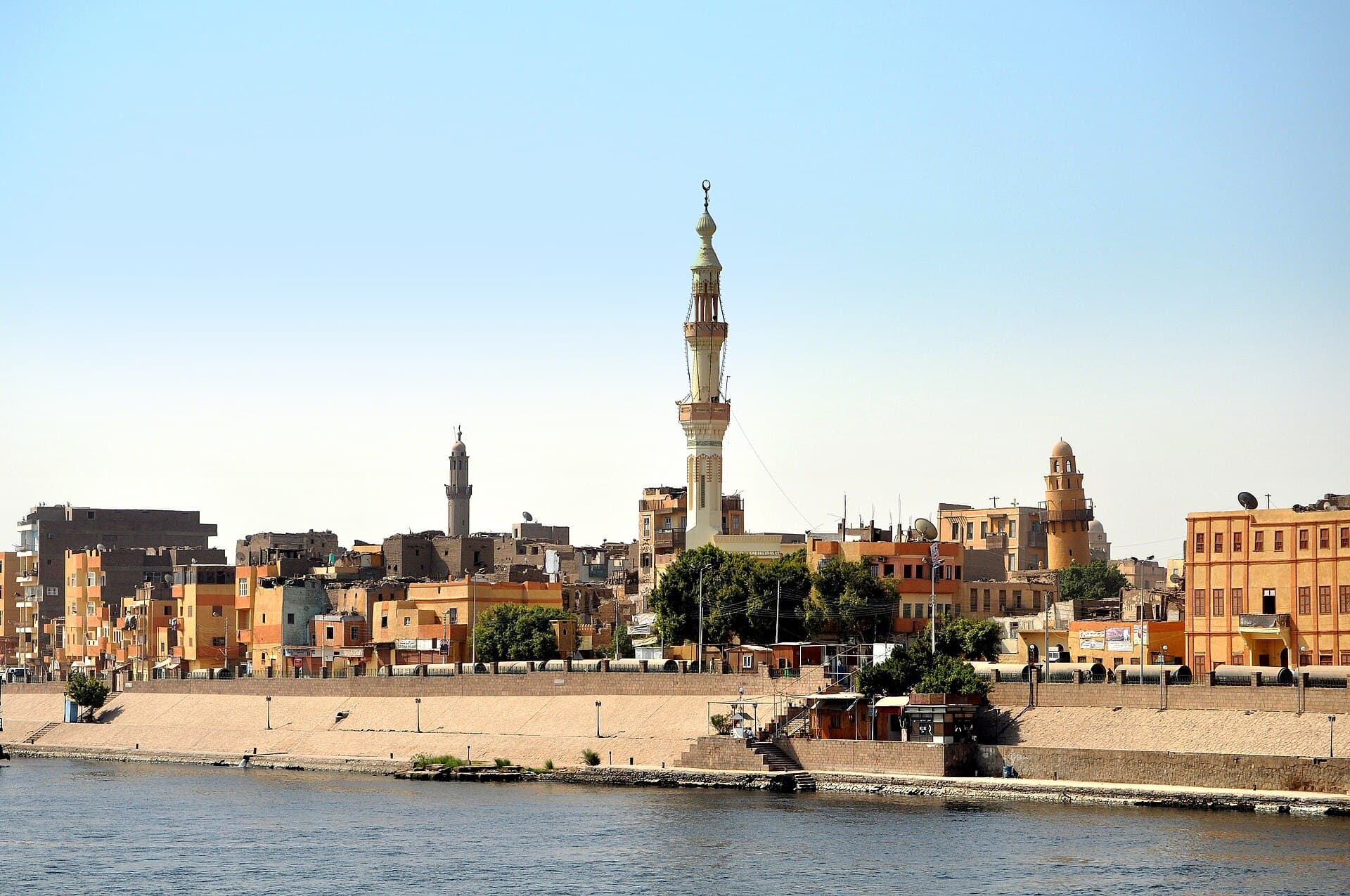 Badics / CC BY-SA 3.0, via Wikimedia Commons
“Where ancient artistry meets the rhythmic flow of the Nile.”
Not the postcards. The stories even locals don't know — whispered in your ear, right where they happened.
The Esna Temple's lively ceiling was once a secret, concealed from view for centuries.
Passing through the Esna Lock isn't just a practical necessity for Nile cruises; it's a spectacle with an unexpected past.
Beyond the main temple, Esna's bustling market holds a clue to its enduring commercial legacy.
Discover every secret of Esna
Every address, every reveal in full — in your ear, right where it happened.
You pick your stops. You walk. The voice reveals what the others miss.
No tours available yet. Check back soon — we're preparing them.
Esna, a city upon the west bank of the Nile River in Upper Egypt, offers a blend of ancient history and lively local life. Approximately 55 kilometers south of Luxor, it's a frequent stop for Nile River cruises, largely due to the Esna Lock, a modern engineering marvel regulating river traffic.
While often seen as a brief stop, Esna invites deeper exploration. The city, known as Iunyt in ancient times and Latopolis during the Greco-Roman period, has a continuous history of human settlement spanning millennia. Its allure lies in its authentic atmosphere, where traditional markets and local crafts offer a glimpse into daily Egyptian life, distinct from the more crowded tourist centers.
Esna's significance is anchored by the remarkably preserved Temple of Khnum, a testament to its past as an important religious and administrative center. Beyond the temple, the city's streets reveal layers of history, from Ottoman-era caravanserais to Coptic churches, making it a compelling destination for those seeking a more intimate encounter with Egypt's layered heritage.
Esna's history stretches back to ancient Egypt, where it was known as Iunyt (or Ta-Senet). During the Greco-Roman era, the city was renamed Latopolis, a name believed to be derived from the Nile perch (Lates niloticus), a fish abundant in the river and considered sacred in pre-Christian times. This sacred fish was closely associated with the goddess Neith, and its symbols appear in local reliefs. Esna served as the capital of the Third Nome of Upper Egypt, establishing its importance as an administrative and religious hub throughout various periods.
Construction of the Temple of Khnum, Esna's most significant monument, began during the Ptolemaic period and continued to expand under Roman emperors between 40 and 250 A.D. The temple is dedicated primarily to Khnum, the ram-headed creator god, along with other deities such as Neith and Heka. Khnum was believed to have molded humanity on his potter's wheel from the mud of the Nile, shaping their bodies and destinies. The temple's well-preserved hypostyle hall, with its 24 towering columns, showcases a unique blend of Egyptian and Roman architectural styles and inscriptions.
In the medieval period, under Arab rule, Esna became a vital stop on caravan routes connecting the Red Sea to the Western Desert oases. The bustling Al-Qīsāriyya Market, still active today, is a direct link to this commercial past. The 20th century saw the construction of the Esna Lock, which revitalized the city's importance by facilitating Nile River navigation and connecting Luxor and Aswan. Today, Esna represents a rare continuity of human settlement, with its ancient monuments, medieval heritage, and active modern life.
The primary attraction in Esna is the Temple of Khnum, a Greco-Roman masterpiece dedicated to the ram-headed creator god. Its hypostyle hall is remarkably preserved, featuring 24 columns, each approximately thirteen meters high, adorned with diverse floral capitals inspired by lotus, palm, and papyrus. The recently restored ceiling reveals lively astronomical scenes, including zodiac signs and constellations, alongside hieroglyphic accounts of temple rituals. Uniquely, the temple sits several meters below modern street level, requiring a descent into an excavated pit.
Beyond the temple, the Esna Lock is a compelling sight, particularly for those on Nile cruises. Observing vessels navigate this engineering marvel, which manages the Nile's varying water levels, offers insight into the river's vital role in modern Egypt. The Al-Qīsāriyya Market, also known as the bazaar, provides an authentic experience of local life. Visitors can stroll through numerous craft stalls and shops selling textiles, spices, and local products, experiencing a more orderly atmosphere than some other Egyptian markets. The Al Amari Mosque, though rebuilt in the 1960s, retains its Fatimid minaret, a significant architectural remnant of the city's medieval past. South of Esna, the Monastery of the Martyrs (Deir el-Shuhada) is a revered Coptic religious site dating back to the 5th and 6th centuries.
The most comfortable time to visit Esna is during the cooler months, from October to April. Temperatures during this period are generally mild and pleasant, making it ideal for exploring the temple and markets. While winter offers warm days and bright sunshine, temperatures can fluctuate significantly between day and night. Summers, from June to September, can be extremely hot, with daytime temperatures often exceeding 40°C (104°F), making outdoor activities less comfortable.
Esna is easily accessible, particularly for those on Nile River cruises, as it's a mandatory stop between Luxor and Aswan. If traveling independently, Esna is about 50-55 km south of Luxor, roughly a one-hour drive by private transfer or taxi. Luxor has an international airport, making it the closest entry point for international travelers. Trains are also an option, with Esna having its own railway station on the Nile Valley line, though it's on the east bank, requiring additional local transport to reach the main town and temple on the west bank.
When exploring Esna, light clothing and comfortable shoes are recommended, especially during warmer months. It's advisable to carry cash, as some local shops may not accept cards. Respect for religious spaces, particularly around mosques and historical areas, is important. Hiring a local guide can enhance the experience by providing deeper insights into Esna's history and culture.