The Medieval City Wall
Erlangen's medieval fortifications aren't where you'd expect them.
Full story unlocks in the tour
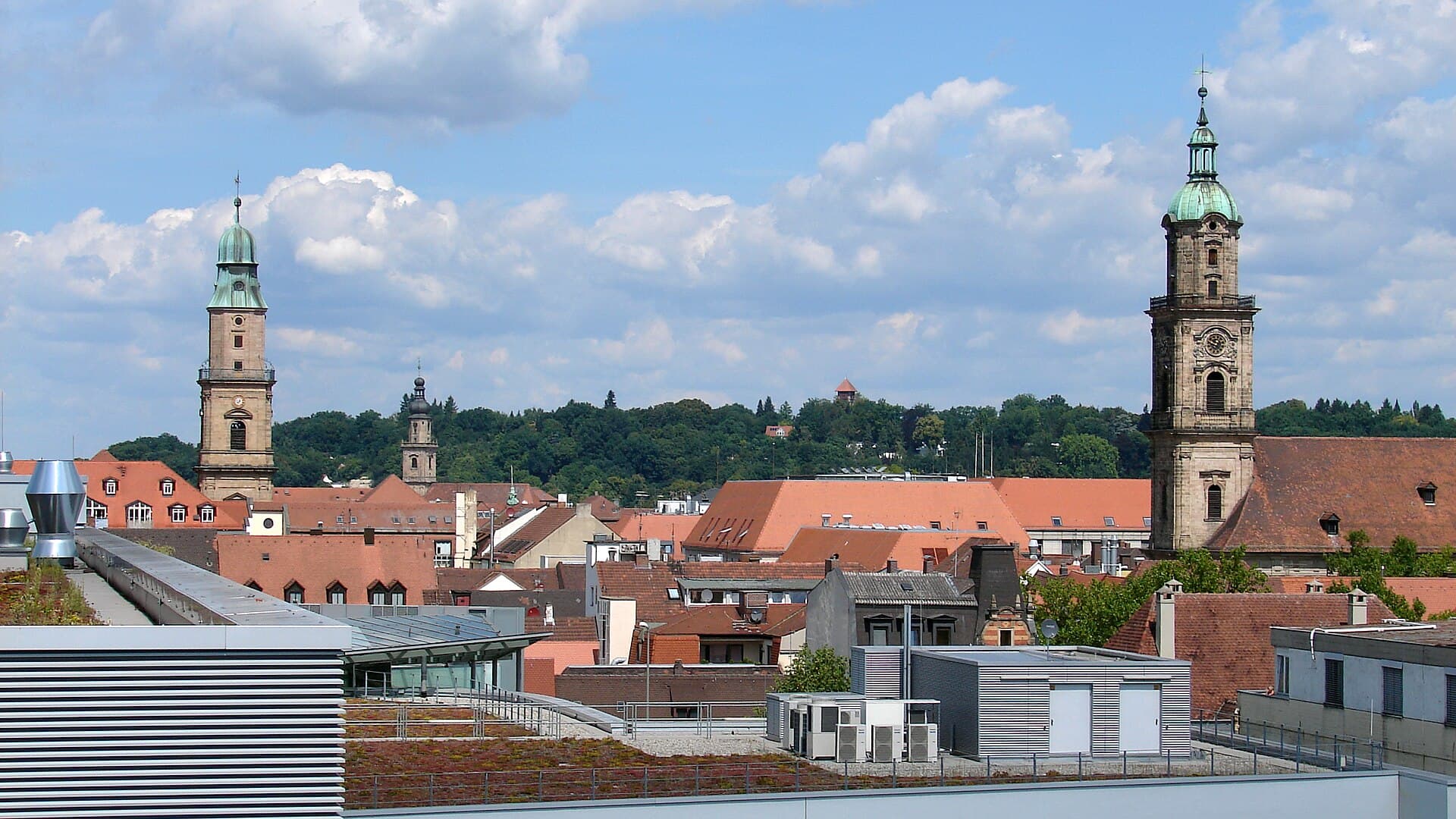 H. Helmlechner / CC BY-SA 3.0, via Wikimedia Commons
“Where Baroque precision meets Franconian spirit.”
Not the postcards. The stories even locals don't know — whispered in your ear, right where they happened.
Erlangen's medieval fortifications aren't where you'd expect them.
The first church built for Erlangen's French Protestant refugees held a unique distinction.
One of Europe's most beautiful garden parties is notoriously difficult to attend.
Discover every secret of Erlangen
Every address, every reveal in full — in your ear, right where it happened.
You pick your stops. You walk. The voice reveals what the others miss.
No tours available yet. Check back soon — we're preparing them.
Erlangen, a city in Bavaria, Germany, is a place where centuries of history intertwine with a modern, academic pulse. Located in the Middle Franconia region, north of Nuremberg, it is perhaps best known for its university, Friedrich-Alexander-University Erlangen-Nürnberg, and as a significant hub for the German conglomerate Siemens. This city of over 120,000 inhabitants is a blend of Baroque architecture and a lively, international atmosphere, shaped significantly by the arrival of French Huguenot refugees in the 17th century.
Erlangen is a city of intriguing contrasts. Its meticulously planned Baroque 'New Town' stands in architectural dialogue with remnants of its older, medieval past. Beyond its historical layers, Erlangen is recognized for its high quality of life, low crime rate, and a strong commitment to sustainability, evidenced by its extensive cycling infrastructure and green energy initiatives. Whether you are drawn to its academic vibrancy, its unique urban planning, or its welcoming atmosphere, Erlangen offers a distinctive German experience.
Erlangen's story stretches back over a millennium, with its first documented mention as "villa erlangon" in 1002. For centuries, it remained a small, relatively unimportant settlement, even receiving its city charter in 1398. However, a pivotal moment arrived in the 17th century. After being largely destroyed during the Thirty Years' War, a catastrophe that prompted its redevelopment, Erlangen was poised for a transformation.
The revocation of the Edict of Nantes in France in 1685 led to a mass exodus of Calvinist Protestants, known as Huguenots. Margrave Christian Ernst of Brandenburg-Bayreuth offered asylum to these refugees, recognizing an opportunity to revitalize his lands. This led to the ambitious creation of a new, planned city south of the existing Erlangen, initially named "Neu-Erlang" or "Christian-Erlang" after its founder. This 'New Town' was designed on Baroque principles, featuring wide, straight streets intersecting at right angles and symmetrical squares, a layout that largely survives today.
The Huguenots brought with them not only their religion but also valuable craft skills, transforming Erlangen into a center for glove-making, hat-making, and hosiery. While initially a distinct French-speaking community, German immigrants soon outnumbered them, and the French influence gradually diminished, with the last French service in the Huguenot Church held in 1822. In 1812, the 'New Town' officially merged with the older settlement.
Another significant development was the relocation of the university from Bayreuth to Erlangen in the 18th century, solidifying the city's intellectual future. The 19th century saw further infrastructural growth with the opening of the Ludwig Canal. After World War II, Erlangen's population doubled again with the arrival of the medical technology giant Siemens, further cementing its role as a center for innovation and research.
Begin your exploration at the Schlossplatz, Erlangen's central square and the heart of its Baroque layout. Flanked by elegant historic buildings, it reflects the city's origins as a planned Huguenot settlement. Adjacent to the square is the Schlossgarten, a meticulously maintained Baroque garden behind the former margravial palace, offering a tranquil retreat with symmetrical paths and fountains. The palace itself, once the summer residence of the Margrave of Brandenburg-Bayreuth, now serves as the main building for the Friedrich-Alexander University.
Discover the Huguenot Church, a significant landmark built in the late 17th century for French Protestant refugees. Its simple Baroque design speaks to the city's multicultural roots and religious tolerance. For a different perspective, climb the 117 stairs of the church tower for expansive views of the city. Delve into Erlangen's innovative spirit at the Siemens Healthineers MedMuseum, which showcases the evolution of medical technology from early X-ray machines to modern imaging devices. For a dose of nature, the Botanical Garden, maintained by the University of Erlangen-Nuremberg, features an impressive collection of plants from various global climate zones, including tropical and medicinal plant gardens.
The most pleasant time to visit Erlangen is during late spring and early autumn, specifically from May through September. During these months, temperatures are mild, typically ranging between 20°C and 25°C, making it ideal for outdoor activities and exploring the city's parks and gardens. While there is some rainfall during this period, the warmer weather and longer daylight hours, especially in July with approximately 7.8 hours of sunshine daily, enhance the experience. This season also coincides with several cultural events, including the lively Bergkirchweih festival, which usually takes place in late May or early June.
The official currency in Erlangen, and throughout Germany, is the Euro (EUR). You will find banknotes in denominations of 5, 10, 20, 50, 100, 200, and 500, along with 1 and 2 euro coins and various cent denominations. While credit and debit cards are widely accepted, it is advisable to carry some cash for smaller purchases or establishments that may be cash-only. When using ATMs or making card payments, always choose to be charged in Euros to avoid unfavorable exchange rates.
Erlangen is highly regarded for its safety, boasting a low crime rate and a visible police presence. The city is particularly bicycle-friendly, with extensive infrastructure, and many locals opt for cycling. Public transportation primarily consists of buses, with a limited S-Bahn (commuter train) service. Since January 1, 2024, all bus routes within Erlangen's city center have been free of charge, making it easy to navigate the core of the city. However, this free service is slated to be discontinued at the end of 2026. Erlangen is well-connected by train from Nuremberg, with journeys taking approximately 20 minutes.