Castello di Venere (Venus Castle)
The Norman castle on Erice's summit holds a secret much older than its medieval stones.
Full story unlocks in the tour
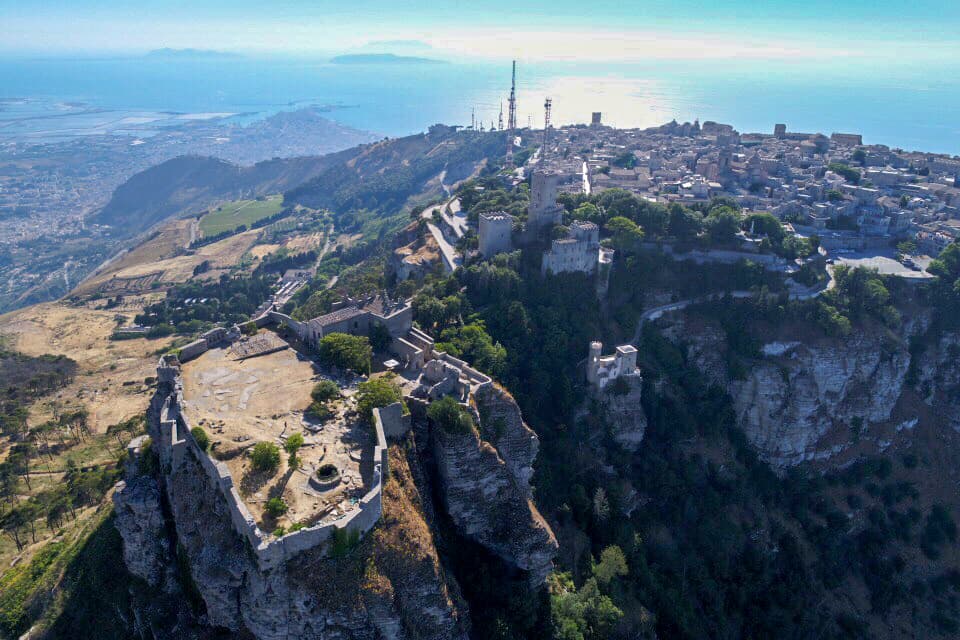 Pannucci Stefano / CC BY-SA 4.0, via Wikimedia Commons
“Where ancient myths linger in stone and mist.”
Not the postcards. The stories even locals don't know — whispered in your ear, right where they happened.
The Norman castle on Erice's summit holds a secret much older than its medieval stones.
The seemingly simple stone walls encircling Erice tell a story of layered civilizations.
The famous *genovesi ericine* pastries have a sweeter origin story than just a baker's recipe.
Discover every secret of Erice
Every address, every reveal in full — in your ear, right where it happened.
You pick your stops. You walk. The voice reveals what the others miss.
No tours available yet. Check back soon — we're preparing them.
Erice, a medieval town in western Sicily, rests atop Mount Erice at an elevation of about 750 meters above sea level. This hilltop settlement offers sweeping views that stretch across the city of Trapani, the Egadi Islands, and the vast expanse of the Mediterranean Sea, sometimes even reaching the African coast on clear days. Its historic center is a labyrinth of narrow, stone-paved streets, venerable stone buildings, and numerous churches, creating an atmosphere that often feels suspended in time.
Often enveloped in a soft, mysterious mist, Erice presents a different kind of beauty, one that feels removed from the modern world. The town's unique setting and well-preserved architecture provide a window into Sicily's multifaceted past, shaped by various civilizations over thousands of years. Erice is recognized as one of Italy's Most Beautiful Villages, a designation that underscores its historical, artistic, cultural, environmental, and traditional significance.
The history of Erice stretches back millennia, with its origins intertwined with ancient mythology. The town's ancient name was Eryx, and according to the Greek historian Thucydides, it was founded in the 8th century BC by the Elymians. The Elymians, believed to be Trojans who fled the Achaeans after the fall of Troy, settled in Sicily and, along with the Phoenicians, established cities like Eryx and Segesta. Legend attributes the town's founding to Erice, son of Aphrodite (or Venus) and Bute, who was said to have built a temple to his mother on the mountain's summit.
Due to its strategic location, Erice was a coveted stronghold and a significant religious center in the ancient Mediterranean. The sanctuary on Mount Erice was a prominent pilgrimage site, dedicated to a local form of the goddess Venus associated with love, fertility, and protection for sailors. Phoenicians worshipped Astarte here, Greeks honored Aphrodite, and Romans revered Venus Ericina, with evidence of dedications to all three divinities found at the site. The town's fortifications, known as the Cyclopean Walls, date back to 800 BC.
Erice was fought over by Carthaginians and Syracusans, and later conquered by the Romans in 244 BC during the First Punic War. Its military importance waned, and the town fell into disrepair during the Roman period. The Arabs, who gained a foothold in Sicily in the 9th century, called the mountain Gebel-Hamed. The modern settlement of Erice began to flourish under Norman rule in the 12th century, when the summit was re-fortified. The Normans constructed the Castello di Venere (Castle of Venus) on the ruins of the ancient temple, using materials from the earlier structure. During this period, the town was known as Monte San Giuliano. Over subsequent centuries, Erice experienced periods of cultural development and economic prosperity, evident in its many churches, monasteries, and private palaces. During the Fascist period, the town regained its original name, Erice.
Begin your exploration at the Castello di Venere (Venus Castle), a 12th-century Norman fortress built on the site of an ancient temple, offering expansive views of the Tyrrhenian Sea and the Egadi Islands. Adjacent to the castle are the Balio Gardens, a serene English-style garden perfect for a leisurely stroll and enjoying the vistas.
Walk through Erice's medieval streets, a maze of stone-paved lanes and ancient stone buildings that invite discovery. The Chiesa Madre (Cathedral of Erice), dedicated to the Assumption and constructed in 1314, features Gothic architecture and an impressive bell tower that can be climbed for panoramic views. Observe the historic city walls, which display layers of construction from various civilizations, including the Elymians and Romans.
For a taste of local tradition, visit Pasticceria Maria Grammatico, celebrated for its genovesi ericine—short pastries filled with warm custard cream—and other almond-based sweets. The town also has numerous artisan shops selling hand-woven carpets and ceramics.
Erice is a destination that can be enjoyed year-round, though each season offers a distinct experience. Spring and autumn provide mild weather and fewer crowds, making them ideal for exploring the town on foot. May, June, and September are particularly pleasant, with wildflowers blooming in spring and clear visibility for expansive views before the summer haze. Summer brings the clearest days for optimal views of the Egadi Islands and the Trapani salt flats, and the elevation provides some relief from coastal heat. Winter offers an atmospheric and quiet experience, with the possibility of the town being wrapped in a "sea of fog," creating a mystical ambiance. Some shops and restaurants may have reduced hours during the quieter winter months.
Erice is accessible by car, bus, or cable car from Trapani. The cable car offers a scenic 10-minute ride from Trapani to Erice, though it may close on windy days. If driving, be aware of the winding roads leading up the mountain. The historic center of Erice is best explored on foot due to its compact size and narrow, stone-paved streets. Comfortable shoes are recommended, as stone pavements can be uneven and slippery when damp. A light jacket is advisable, especially at sunset, as Erice is often cooler and windier than the coast.
For those seeking a deeper understanding of the town, consider a private guide to uncover its ancient origins, myths, and medieval architecture. While a half-day visit allows you to see the main sights, a full day or an overnight stay provides a more immersive experience, particularly after day-trippers have left and the town settles into a quiet charm.