O'Connell Street
Look down as you walk along O'Connell Street, and you might spot a relic of a muddier past.
Full story unlocks in the tour
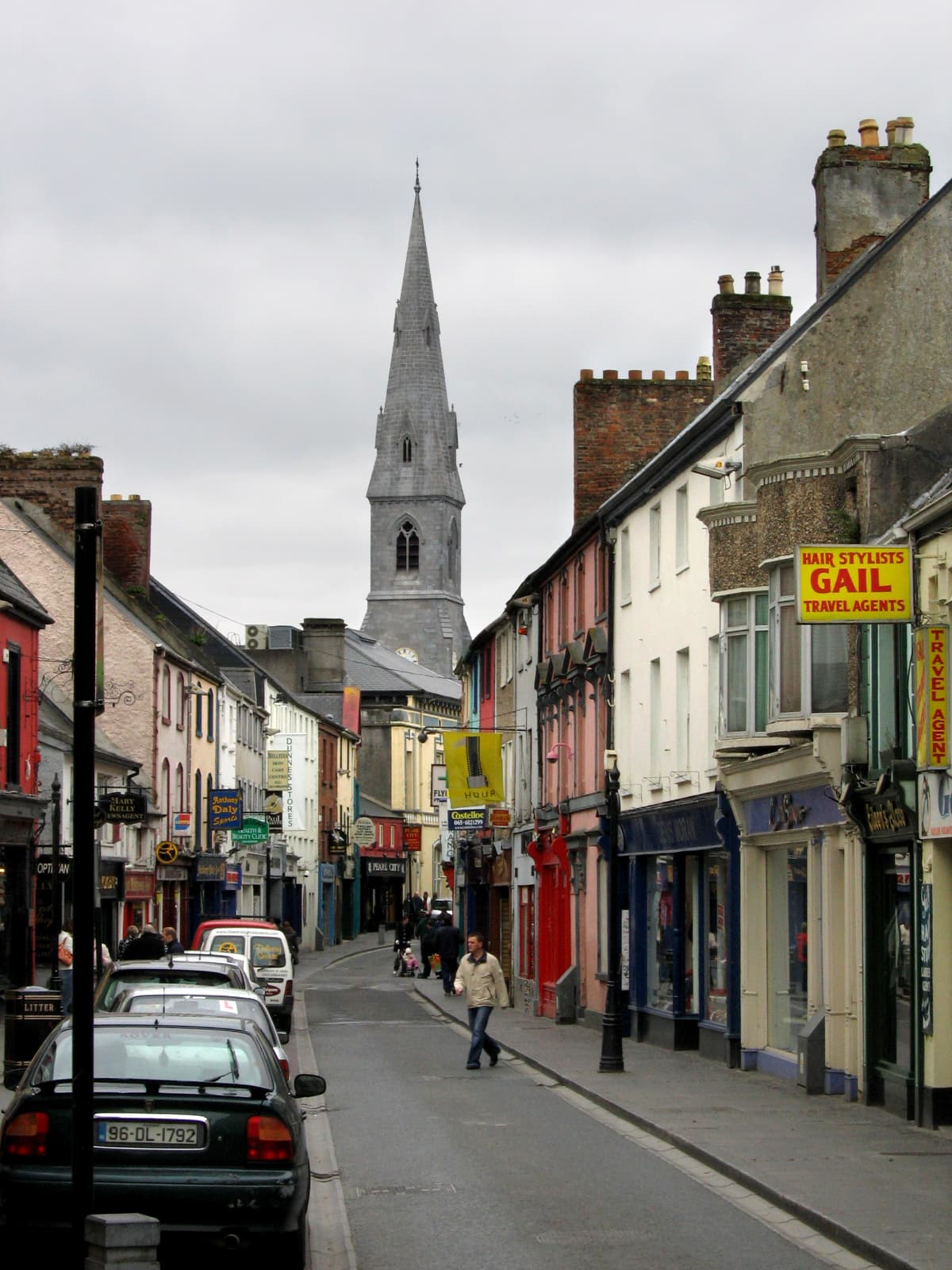 Unknown author / CC BY-SA 3.0, via Wikimedia Commons
“Where medieval lanes hum with traditional tunes and ancient stories echo through stone.”
Not the postcards. The stories even locals don't know — whispered in your ear, right where they happened.
Look down as you walk along O'Connell Street, and you might spot a relic of a muddier past.
At the entrance to the Clare Museum and Temple Gate Hotel, two stone carvings offer a surprising symbol of welcome.
While the friary is a testament to religious devotion, one of its kings may have started construction for a less pious reason.
Discover every secret of Ennis
Every address, every reveal in full — in your ear, right where it happened.
You pick your stops. You walk. The voice reveals what the others miss.
No tours available yet. Check back soon — we're preparing them.
Ennis, the county seat of Clare, is a place where history feels alive in its winding, narrow streets and laneways, locally known as 'bow-ways.' Situated on the River Fergus, the town's name, 'Inis,' means 'island,' referring to the land formed between two streams of the river where the historic Ennis Friary was established. Ennis offers a blend of medieval character and a lively contemporary atmosphere, often referred to as 'The Boutique Capital of Clare' due to its distinctive shops, cafes, and traditional pubs.
Beyond its historic core, Ennis is a center of culture, recognized for its traditional music scene, with sessions frequently filling the air in local pubs. The town's dedication to its heritage is evident in its preserved sites and ongoing cultural initiatives, including the Ennis Sculpture Trail, which adds a layer of modern art to its ancient streetscapes. Ennis also serves as an excellent base for exploring the dramatic landscapes of County Clare, including the Cliffs of Moher and the Burren, both within easy reach.
The history of Ennis is deeply intertwined with the O'Brien dynasty, descendants of the legendary Brian Boru. In the 12th century, the O'Briens, Kings of Thomond, relocated their seat of power from Limerick to Clonroad, near present-day Ennis, where they built a royal residence around 1210. The town's true foundation, however, began with the establishment of the Franciscan Friary. Between 1240 and 1249, King Donnchadh Cairbreach O'Brien invited Franciscan monks to the island formed by the River Fergus, initiating the construction of an extensive church that would become Ennis Friary.
Over the next four centuries, the Friary flourished, evolving into a significant religious center and theological college, capable of housing up to 300 friars and 600 seminarians annually. It became a burial place for the O'Briens and MacNamaras, powerful lords of the region, and was known for its impressive library and beautiful stained-glass windows. Despite King Henry VIII's 1540 Dissolution of the Monasteries, the Friary continued to operate in a reduced capacity until around 1690. In the early 17th century, the buildings were even used by the Church of Ireland as a place of worship until the late 19th century.
Ennis was designated the administrative capital of County Clare in 1586 by Queen Elizabeth I, a decision based on its central location and the influence of the Earls of Thomond. In 1610, King James I granted Ennis the right to hold fairs and markets, and a charter for a corporation followed in 1613, solidifying its role as a bustling market town. The town's lack of defensive walls proved advantageous in the 17th century, attracting Roman Catholic merchants who were prohibited from residing in walled towns like Limerick, further contributing to its prosperity.
The 19th century brought both hardship, with the Great Famine leading to population decline, and a pivotal moment in Irish history. In 1828, Daniel O'Connell, known as 'The Liberator,' achieved a monumental electoral victory in Ennis, campaigning for Catholic Emancipation. His success forced the British government to lift its ban on Catholic Members of Parliament, leading to the Catholic Emancipation Act of 1829. This event cemented Ennis's place in the narrative of Irish independence and civil rights. In more recent history, Ennis was recognized as Ireland's first 'Information Age Town' in 1997, receiving significant investment in technology and internet access for its residents.
Begin your exploration at the Ennis Friary, a 13th-century Franciscan ruin in the town center. Marvel at its Gothic tower, intricate wall carvings, and 15th and 16th-century limestone sculptures, including a notable image of St. Francis with stigmata.
Just a short stroll away, the Clare Museum, housed in a former convent, offers a deeper dive into the county's 6,000-year history with over 10,000 artifacts, interactive exhibits, and medieval armor. Do not miss the Cathedral of Saints Peter and Paul, consecrated in 1843, with its impressive spire added in 1894, and the 'Healing Hands' sculpture outside.
Take a walk to O'Connell Square to see the Daniel O'Connell Monument, a towering column dedicated to 'The Liberator' and his pivotal role in Catholic Emancipation. Wander the town's pedestrian-friendly streets and 'bow-ways,' discovering independent shops and cafes. Keep an eye out for the Ennis Sculpture Trail, which features public art along the river and in the downtown area.
For those venturing slightly further, Bunratty Castle and Folk Park, a 15th-century castle restored to its medieval splendor and a recreated 19th-century village, is a 20-minute drive away. The dramatic limestone landscapes of The Burren National Park are also just 15 minutes north, offering unique hiking trails and rare flora.
The best time to visit Ennis for pleasant weather and outdoor activities is from late June to early September. During these summer months, temperatures are comfortable, averaging between 17-19°C (63-66°F) during the day, and daylight hours are long. While rain is common year-round in Ireland, the summer typically offers more settled weather. This is also peak tourist season, so expect a lively atmosphere and traditional music sessions in the evenings. For fewer crowds and potentially lower prices, consider the shoulder seasons of April, May, September, and early October, when the weather is still pleasant and there's ample daylight for sightseeing.
Ennis is well-connected and easily accessible. Shannon Airport (SNN) is just 24 kilometers (15 miles) south, a convenient 20-minute drive away. If flying into Dublin, trains run hourly to Limerick Colbert, with connecting services to Ennis every couple of hours. The town is also located just off the M18 motorway, making it easily reachable by road from Limerick, Galway, Cork, or Dublin.
Once in Ennis, the town center is largely pedestrian-friendly, with many attractions within walking distance. Renting a car is highly recommended for exploring the wider County Clare, offering the freedom to visit sites like the Cliffs of Moher and the Burren at your own pace. Local bus services also connect Ennis to surrounding towns and attractions.
The currency used is the Euro. Power voltage is 230 V 50 Hz, using Power Sockets G. It's advisable to book accommodation and popular tours in advance, especially during peak season (June-August), as costs can be higher and availability limited.